Key Takeaways: The Vet Practice “Cheat Sheet” ( Zapier for Veterinarians )
- The 35% Admin Reduction: Clinics using AI-integrated Zapier workflows for documentation and reminders report a 35% reduction in “after-hours” charting in 2026.
- Inventory Leakage Prevention: Automated triggers between your PIMS and suppliers (like Vetsource) can reduce “missed charges” on medications by up to 12%.
- HIPAA vs. Vet Privacy: While HIPAA applies to humans, vets must follow state-specific Veterinary-Client-Patient Relationship (VCPR) privacy laws. Zapier is safe for most vet data, but sensitive client financial data should still use a “Secure Bridge.”
- The “Pet Parent” App Trend: 2026 clients expect WhatsApp/SMS-style updates. Zaps that bridge your clinical software with mobile messaging are the #1 driver of client loyalty.
- Topical Moat: Automation in 2026 isn’t just “reminders”—it’s AI-driven triage and smart inventory replenishment.
The “Compassion Fatigue” Bottleneck in 2026
In 2026, veterinary medicine is facing a “Documentation Crisis.” Between escalating “pet parent” expectations and chronic staffing shortages, the average DVM now spends 40% of their day on a computer rather than in the exam room.
The weight of this administrative burden is a primary driver of compassion fatigue. Doctors aren’t burning out from treating animals; they are burning out from:
- The “Re-typing” Loop: Manually transferring vaccine history from a PDF into the PIMS (Practice Information Management System).
- The Lab Chase: Checking three different portals for bloodwork results and manually notifying the client.
- Discharge Delays: Spending 15 minutes per patient typing out home-care instructions that are 80% identical every time.
The Zapier Solution: Zapier acts as your “Virtual Technician.” It creates a “silent layer” of automation that moves data between your booking tool, your medical records, and your client’s phone. By automating the repetitive “data shoveling,” your clinical team can finally get back to the patients.
Privacy, Security, and VCPR Compliance
One of the most common myths in 2026 is that veterinary clinics don’t need to worry about data privacy because “dogs don’t have HIPAA rights.”
While it is true that HIPAA does not apply to animal records, state-level Consumer Privacy Acts (like those in California, Indiana, and Kentucky) and VCPR regulations have tightened significantly. In 2026, protecting your client’s data (billing, address, and digital communications) is a legal mandate.
1. The Strategy: Security Without the HIPAA Overhead
Even without a federal BAA requirement, a 2026 “Practical” clinic should use high-security gateways.
- The Workflow: Use JotForm Enterprise or Airtable for digital intake. These platforms provide the encryption needed to satisfy state privacy laws and protect sensitive client financial profiles.
- The VCPR Lock: Use Zapier to ensure that any “Virtual Triage” or “Telehealth” interaction is automatically timestamped and logged. This is critical in states like California and Arizona, where 2026 laws have specific requirements for establishing and maintaining a VCPR via electronic means.
2. Audit-Proofing for Pet Insurance Success
In 2026, pet insurance has reached a 25% adoption rate among US dog owners. Insurance providers (like Trupanion or Lemonade) have become much stricter with claim documentation.
- The Problem: Claims are often denied because a “clinical note” doesn’t match an “SMS conversation” had with the owner.
- The Automation: Use Zapier to automatically archive every SMS, WhatsApp, and email thread into the patient’s permanent file in your PIMS (e.g., ezyVet or Digitail).
- The ROI: This ensures a “Single Source of Truth.” When an insurance adjuster asks for the full history of a chronic condition, you can export a complete, audit-proof record in seconds, ensuring your clients get reimbursed and your bills get paid.
Blueprint #1 – Automated Intake & “Smart Triage”
In the high-pressure environment of a 2026 veterinary clinic, “Information Gathering” is often the biggest bottleneck. If your technicians are spending the first 10 minutes of every 20-minute appointment just asking “What are they eating?” and “When did the limping start?”, you are losing clinical time.
The “Smart Triage” Workflow:
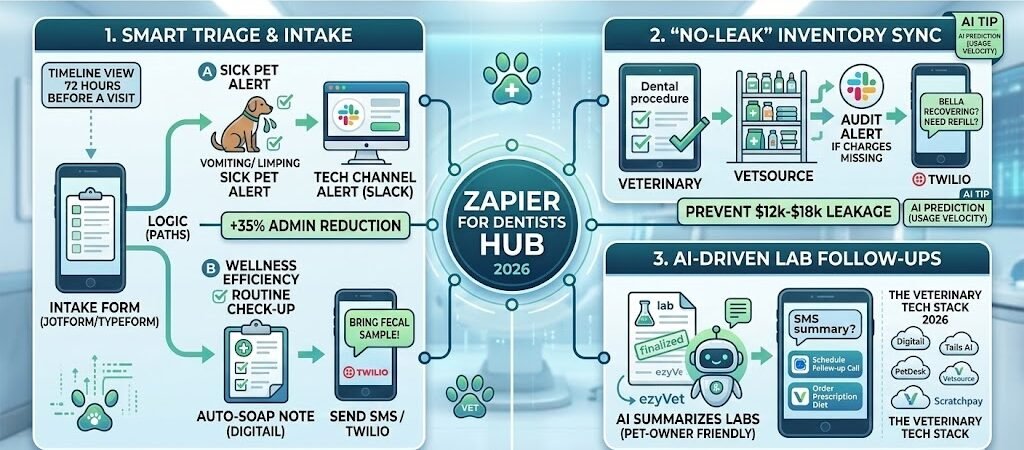
- The Trigger: 72 hours before a scheduled visit, Zapier triggers a digital intake form via JotForm or Typeformsent directly to the client’s smartphone.
- The Logic (Paths by Zapier): This is where the “Smart” part happens. Zapier analyzes the form responses:
- Path A (The “Sick Pet” Alert): If the client checks boxes for “Vomiting,” “Limping,” or “Lethargy,” Zapier bypasses the standard queue and sends an immediate high-priority alert to the Slack or Microsoft Teams“Tech Channel.” Result: Your team is prepped with the thermometer and scale before the dog even enters the lobby.
- Path B (The “Wellness” Efficiency): If it’s a routine check-up, Zapier takes the diet and flea/tick prevention info and auto-populates a SOAP note draft in your PIMS (Digitail, ezyVet, or Shepherd).
- The Action: Zapier sends a tailored “Pre-visit Prep” SMS via Twilio.
- For Wellness: “Please remember to bring a fresh fecal sample for Fido’s check-up tomorrow!”
- For Surgery: “Friendly reminder: No food after 10 PM tonight for Max’s procedure.”
Blueprint #2 – The “No-Leak” Inventory & Pharmacy Sync
Veterinary “Revenue Leakage” is a silent profit killer. In the chaos of a busy surgery day, it is incredibly easy for a technician to forget to “charge out” a surgical pack, a vial of anesthesia, or a post-op antibiotic. In 2026, the average small animal practice loses $12,000–$18,000 per year in these “forgotten” charges.
The “No-Leak” Zapier Workflow:
This Zap bridges the gap between your Clinical Records and your Pharmacy/Inventory Manager.
- The Trigger: A specific “Treatment Code” (e.g., S001 – Canine Neuter or D101 – Dental Level 2) is marked as “Completed” in your PIMS.
- The Inventory Action: Zapier pings your inventory software (e.g., Vetsource, Blue Rabbit, or Covetrus) to automatically deduct the standard “Surgical Bundle” from your stock. No manual counting required.
- The Revenue Action: Zapier cross-references the invoice. If the “Post-Op Pain Meds” code isn’t detected on the bill within 2 hours of the surgery ending, it sends an internal “Audit Alert” to the Practice Manager.
- The Client Action (Refill Logic): 7 to 10 days after the surgery, Zapier triggers an automated follow-up: “How is Bella’s recovery? We noticed your post-op medication is likely running low. Reply ‘REFILL’ to have a new supply ready for pickup.”
Summary Table: The Inventory Blueprint
| Step | System | 2026 Recommended Tool |
| Trigger | Clinical Coding | ezyVet / Digitail |
| Action 1 | Stock Deduction | Vetsource / Blue Rabbit |
| Action 2 | Internal Audit | Slack / Zapier Tables |
| Action 3 | Client Refill Reminder | Twilio / TextMagic |
Practical AI Tip: Use AI-Powered Inventory Prediction. In 2026, Zapier can monitor your “Usage Velocity” and automatically send a draft purchase order to your distributor (e.g., MWI or Patterson) before you actually run out of high-volume vaccines or heartworm preventatives.
Blueprint #3 – AI-Driven Post-Op & Lab Follow-ups
The most time-consuming part of a veterinarian’s day is “Phone Tag.” In 2026, pet owners expect instant results, but doctors are often stuck in surgery. This blueprint uses AI by Zapier to bridge that communication gap without the doctor having to type a single word.
- The Trigger: Lab results (Bloodwork, Urinalysis, or Cytology) are marked as “Received” or “Finalized” in your PIMS (e.g., ezyVet or Shepherd).
- The Action (AI by Zapier): Zapier sends the raw, technical lab data to an AI prompt. The AI is instructed to: “Summarize these results into a 3-sentence, pet-owner-friendly explanation. Highlight if values are within normal range and mention if a doctor’s call is still pending.”
- The Delivery: Zapier sends this summary via WhatsApp or SMS (using PetDesk or Twilio).
- The “Call to Action”: The message includes two interactive buttons:
- “Schedule Follow-up Call”: Links to the doctor’s Calendly for a 5-minute phone consult.
- “Order Prescription Diet”: Links directly to your online pharmacy (Vetsource) if the AI detects a need for kidney or GI support based on the labs.
The “Veterinary Tech Stack” of 2026
To build these workflows, your practice needs tools that “talk” to each other. In 2026, “Closed” systems are a liability. Here is the modern, Zapier-ready stack:
| Function | 2026 Industry Standard Tools | Zapier Integration Status | Primary Benefit |
| PIMS (Practice Mgmt) | Digitail / ezyVet / Shepherd | Native (High Perf) | Cloud-based; no local server lag. |
| AI Documentation | VetGeni / Tails AI | Native (Webhooks) | Transcribes exams into SOAP notes. |
| Client Comms | PetDesk / Birdeye | Native (Two-Way) | Automated reviews and app-based chat. |
| Online Pharmacy | Vetsource / Blue Rabbit | Native (API-Bridge) | Syncs script requests with medical records. |
| Payment/Wellness | CareCredit / Scratchpay | Native (Instant) | Auto-triggers “Apply Now” links on high quotes. |
Advanced: The ROI of Make.com for Large Vet Hospitals
While Zapier is perfect for the average 2-3 doctor clinic, Make.com is the superior choice for Multi-location ER/Specialty hospitals in 2026.
- Complex Scenario Logic: Make allows for multi-variable branching. Example: “If Species: Dog AND Weight > 50lbs, send X; If Species: Cat, send Y; If Case: Emergency, alert Specialist Z on PagerDuty.”
- Inventory Data Lifting: Make.com handles the heavy data synchronization between your PIMS and national distributors (like Covetrus) more reliably at scale, ensuring your multi-site inventory is never out of sync.
- Cost Efficiency: For hospitals running 10,000+ automation tasks a month, Make.com can reduce your software overhead by over 60% compared to Zapier’s per-task pricing.
Conclusion: Your 30-Day Vet Automation Roadmap
Don’t try to automate everything on Monday. Follow this “Slow-is-Smooth” 2026 transition plan:
- Week 1: The Admin Audit. Track your “After-Hours” work. Are you typing the same discharge instructions for every “Ear Infection”? That’s your first Zap.
- Week 2: Digital Intake. Move your intake and surgery consent forms to a digital, Zapier-ready format like JotForm.
- Week 3: The “Quick Win” Zap. Connect your forms to your PIMS to stop manual data entry.
- Week 4: The Follow-up Loop. Automate your first “Post-Visit Follow-up” sequence to check on recovering patients automatically.
By Day 30, you won’t just have a more efficient clinic; you’ll have a team that is less stressed and more focused on the animals they swore to protect.

About the Author
Aapt DubeyAapt Dubey is an automation specialist and software developer dedicated to eliminating manual workflows for small businesses. With deep, hands-on experience building complex Zapier integrations, API connections, and real-world applications, Aapt writes actionable, tested tutorials to help businesses scale efficiently.