The Tailor’s Tech Stack (Zapier for Tailors)
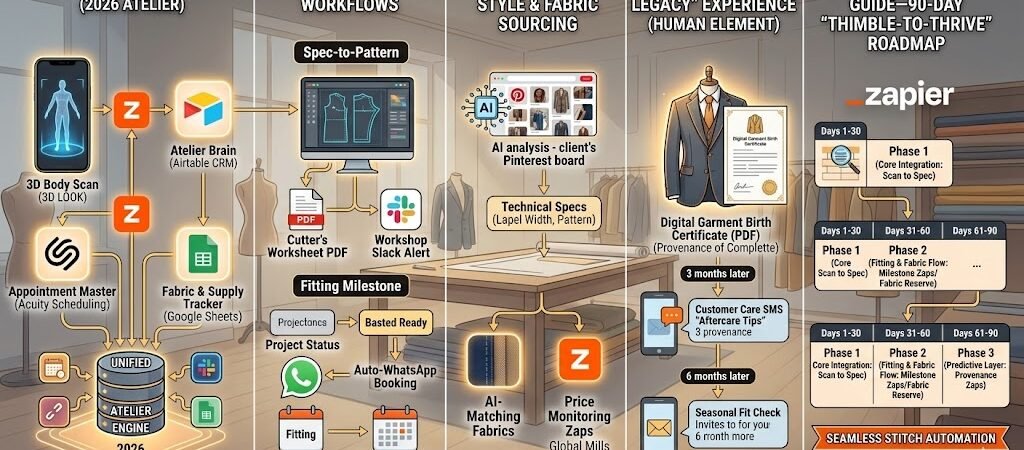
The goal of your 2026 stack is “Sartorial Accuracy.” By using Zapier to link your fitting room to your workroom, you ensure that a client’s “vitals” (measurements, posture notes, and preferences) are never lost between the tape measure and the sewing machine.
1. The Atelier Brain (CRM & Project Management)
- The Tools: Tailor-E or Airtable.
- The Value: A specialized CRM like Tailor-E tracks every garment’s lifecycle. If using Airtable, you can create a relational database that links a specific client to their unique “Block Pattern,” fabric swatches, and alteration history.
- The Zap: When a new client is added to Airtable, Zapier automatically creates a “Garment Folder” in Google Drive to house inspiration photos and technical sketches.
2. The Appointment Master (Fitting Logic)
- The Tools: Acuity Scheduling or Setmore.
- The Value: Tailoring requires multiple touchpoints (Initial consult, First fitting, Final tweak). You need a system that understands “Buffer Time” for pinning and chalking.
- The Zap: When a “Fitting” is booked in Acuity, Zapier pulls the client’s current project status from your CRM and adds it to the calendar invite so you know exactly which garment to have on the mannequin.
3. The Measurement Vault (Digital Intake)
- The Tools: 3D Look (Mobile Scanning) or Typeform.
- The Value: In 2026, many clients prefer a “Digital First” approach. 3D Look allows clients to scan themselves via smartphone, providing 80+ points of measurement with 98% accuracy.
- The Zap: Once a scan is complete, Zapier pushes the data directly into the “Measurement Table” in your Airtable, flagging any significant changes from their last fitting.
4. The Fabric & Supply Tracker
- The Tools: Stocky or Google Sheets.
- The Value: You need to track “Allocated” vs. “Available” yardage. If a client picks a rare Loro Piana wool, that yardage must be “locked” instantly.
- The Zap: When a “Fabric Selection” is confirmed in a Work Order, Zapier deducts that yardage from Stocky and, if the bolt is low, sends a Slack alert to your supplier.
The “Seamless Stitch” Stack Map
| Category | 2026 Recommended Tools | The “Zap” Value |
| Atelier CRM | Tailor-E / Airtable | Manages the “Digital Twin” of the client’s body. |
| Scheduling | Acuity / Setmore | Automates the 3-step fitting process. |
| Measurements | 3D Look / Typeform | Syncs scans to pattern-making software. |
| Inventory | Stocky / Sheets | Prevents “Out of Stock” errors for premium bolts. |
The 2026 Edge: The most successful tailors don’t spend their time at a computer; they spend it at the cutting table. The 2026 Automated Tailor uses Zapier to ensure that by the time the client walks in for a fitting, the data—and the fabric—are already waiting.
The 2026 “Pattern-Mated” Workflows
By connecting your atelier tools via Zapier, you turn your measurement tape into a data-entry tool. Here are the three core workflows for a high-precision 2026 tailoring business.
Workflow A: The “Spec-to-Pattern” Digital Intake
The Goal: From “First Measure” to “Cutting Table” with zero data entry.
- Trigger: A client completes their measurement profile via Typeform or a 3D Look scan.
- The Logic: Zapier parses the data, separating “Body Specs” (static measurements) from “Style Specs” (lapel width, button count, lining choice).
- Action: 1. Creates a “Master Pattern Record” in Airtable. 2. Generates a PDF “Cutter’s Sheet” and saves it to a Google Drive folder labeled with the Client ID. 3. Notifies the head cutter via Slack that a new project is ready for chalking.
- The Result: You eliminate the risk of misreading handwritten notes, ensuring the first cut is always the right one.
Workflow B: The “Fitting Milestone” Automation
The Goal: Keep the production line moving by automating client coordination.
- Trigger: You change a project status to “Basted Fitting Ready” in your CRM.
- The Logic: Zapier checks the client’s preferred contact method (SMS or Email).
- Action: 1. Sends an automated WhatsApp (via Twilio) with a personalized booking link. 2. When the appointment is booked, Zapier automatically updates the “Fitting Date” in your project board. 3. Triggers an internal reminder to the workshop to have the garment steamed and on the mannequin 30 minutes prior.
- The Result: You stop playing “Phone Tag” with busy clients, filling your fitting room calendar without lifting a finger.
Workflow C: The “Bolt-to-Bobbin” Supply Sync
The Goal: Never run out of the “Essentials” during a rush.
- Trigger: A specific amount of “Trimmings” (silk thread, horsehair canvas, or Bemberg lining) is logged as used in a Work Order.
- The Logic: Zapier monitors your “Consumables” list in Google Sheets.
- Action: 1. Deducts the units from your stock. 2. If stock hits a “Critical Low,” Zapier sends a purchase request to your fabric mill or supplier via Email.
- The Result: Your workshop stays stocked with the “hidden” essentials, preventing a $5,000 suit from being delayed by a missing $5 spool of thread.
Scaling with AI Style & Fabric Sourcing
Modern ateliers in 2026 use Gemini AI as a “Digital Apprentice.” By connecting your CRM to AI via Zapier, you can translate a client’s mood board into a technical build-sheet and monitor global textile markets for the best quality-to-price ratios.
1. AI-Powered “Visual Style Consultant”
Clients often bring in photos of celebrities or vintage fashion without knowing the technical details.
- The Workflow: A client uploads an inspiration photo to their Airtable profile.
- The Intelligence: Zapier sends the image to Gemini AI to extract technical details: “Peak Lapel (4-inch),” “Milanese Buttonhole,” “Double-Breasted 6-on-2,” and “Heavy-weight Flannel Texture.”
- The Action: AI suggests three matching fabric codes from your current digital swatch library.
- The Result: You move from “Guessing” to “Designing” instantly, providing a professional technical breakdown that impresses the client and guides the cutter.
2. Automated “Fabric Market” Watchdog
The price of high-end wool and silk fluctuates with global trade and material scarcity.
- The Workflow: Zapier monitors the “Stock & Price” API of major mills (e.g., Loro Piana, Vitale Barberis Canonico).
- The Logic: You set a “Buy Trigger” for specific staple fabrics (like Super 130s Navy).
- The Action: If the price drops by more than 10% or a “Last Meterage” alert is triggered for a rare bolt, Zapier sends a high-priority Slack alert: “Market Opportunity: Navy 130s Wool at $XX/meter. Order now?”
- The Result: You secure premium materials at the best margins, ensuring your “House Fabrics” remain profitable.
3. The “Pattern-to-Body” Feasibility Check
Some styles don’t suit certain body types. In 2026, AI can flag “Drape Risks” before you cut the cloth.
- The Workflow: Zapier takes the client’s 3D Scan data and the chosen Fabric Weight.
- The Intelligence: AI simulates the “Drape Factor” of that specific weight on those specific measurements.
- The Action: If the fabric is too light for the requested structured jacket, Zapier adds a “Tailor Note” to the project: “Review: Fabric weight may cause buckling on chest canvas for this posture.”
- The Result: You avoid “Unfixable” fittings, proactively suggesting better fabric choices to ensure a perfect silhouette.
The “Style & Substance” Efficiency Table
| Category | 2026 Tech Integration | The Business Value |
| Design Accuracy | Gemini AI Visual Analysis | Reduces “Style Revisions” by 30% through precise technical specs. |
| Material Margin | Sourcing APIs + Price Zaps | Increases “Fabric Profitability” by buying at market lows. |
| Fit Confidence | AI Drape Simulation | Eliminates “Unforeseen Recuts” caused by poor fabric-to-pattern matching. |
| Trend Tracking | AI Social Scraping | Keeps your “Seasonal Lookbook” updated with current global trends. |
The 2026 Edge: A great tailor knows the feel of the cloth; a successful 2026 tailor knows the data of the cloth. With AI Sourcing Zaps, you are no longer just a local craftsman; you are a global merchant with the most intelligent “Eye” in the industry.
The “Bespoke Legacy” Experience (The Human Element)
In an era of disposable “fast fashion,” the 2026 consumer is seeking Authenticity and Longevity. They aren’t just buying a suit; they are investing in an heirloom. Zapier for Tailors handles the “Status Updates” so you can focus on the “Storytelling.”
1. The “Garment Birth Certificate”: Digital Provenance
In 2026, high-end clients want to know the “who, where, and how” of their clothing.
- The Strategy: Use automation to provide a Documented Lineage for every bespoke piece.
- The Workflow: When the “Final Fitting” is marked complete in your CRM.
- The Action: Zapier pulls the fabric mill data, the tailor’s name, and the garment’s unique pattern ID into a Canva or Formstack template.
- The Connection: The client receives a beautiful “Digital Passport” for their garment, including high-res photos of the construction process and the specific sheep station the wool originated from.
- The Human Win: You transform a transaction into a “Legacy Acquisition,” significantly increasing the perceived value of your work.
2. Automated “Garment Aftercare” & Longevity
The life of a bespoke garment depends on the client’s care.
- The Opportunity: Use automation to provide Proactive Wardrobe Management.
- The Action: 3 months after delivery, Zapier triggers an automated “Care Guide” via Email.
- The Content: Personalized tips based on the fabric: “It’s been a season! Remember to brush your [Fabric Type] suit with a natural boar-hair brush and avoid dry cleaning more than once a year.”
- The Result: You position yourself as an expert advisor, ensuring the garment lasts for decades and reflecting perfectly on your craftsmanship.
3. The “Seasonal Fit” Check-In
Our bodies change, but bespoke clothing is designed to adapt.
- The Transition: Move from “One-off Sales” to Subscription-style Loyalty.
- The Action: Every 6 months, Zapier triggers a “Sartorial Health Check” via SMS.
- The Message: “Hi [Name], it’s time for your biannual fit-check. Our records show your last measurements were [Date]. Swing by for a complimentary ‘Tweak & Press’ to keep your wardrobe sharp.”
- The Result: You drive consistent foot traffic and capture “Weight Change” alterations that would otherwise result in the client letting a beautiful suit sit in the back of their closet.
Implementation Guide—The 90-Day “Thimble-to-Thrive” Roadmap
This roadmap ensures your digital infrastructure is built during the quiet “cutting hours” so it can handle the high-pressure “wedding season” rushes without a stitch out of place.
Phase 1: The “Measurement Master” Foundation (Days 1–30)
- The Goal: Eliminate manual data entry and “lost” measurement cards.
- The Tech: Connect Typeform (or 3D Look) to Airtable (Master CRM).
- The Action: Set up a Zap that triggers when a client’s measurements are submitted. It must automatically update the “Client Profile” and generate a “Cutter’s Worksheet” in Google Drive.
- The Result: You reclaim 10+ hours a month from transcribing notes and ensure that every pattern starts with 100% accurate data.
Phase 2: The “Fitting & Fabric” Flow (Days 31–60)
- The Goal: Automate client coordination and protect your premium inventory.
- The Tech: Integrate Airtable with Acuity Scheduling and Stocky (Inventory).
- The Action: 1. Set up the “Milestone Zap”: changing a project status to “First Fitting” sends an automated booking link via WhatsApp. 2. Set up the “Fabric Reserve” Zap: when a suit is commissioned, the required yardage is instantly “locked” in your inventory.
- The Result: Your fitting calendar fills itself, and you never have to tell a client their chosen cloth is out of stock mid-way through a project.
Phase 3: The “Bespoke Legacy” Layer (Days 61–90)
- The Goal: Drive recurring revenue and build high-value digital provenance.
- The Tech: Gemini AI + Formstack Documents + Email/SMS Marketing.
- The Action: 1. Implement the “Provenance Zap” that auto-generates a “Garment Birth Certificate” PDF upon final delivery. 2. Set up a “Seasonal Fit Check” Zap that invites clients back for a complimentary press and weight-check every 6 months.
- The Result: You transition from a “Service Provider” to a “Wardrobe Curator,” ensuring your atelier stays profitable year-round through consistent client re-engagement.
Conclusion: Tailoring the Future of Fashion
In 2026, the most prestigious ateliers are Data-Enhanced Craftspaces. By leveraging Zapier for Tailors, you transform your shop from a manual, high-stress environment into a high-velocity Bespoke Engine. You stop “managing the backlog” and start letting the data manage the flow.
Stop losing “Style Points” to administrative clutter. Build your first “Scan-to-Spec” Zap today.

About the Author
Aapt DubeyAapt Dubey is an automation specialist and software developer dedicated to eliminating manual workflows for small businesses. With deep, hands-on experience building complex Zapier integrations, API connections, and real-world applications, Aapt writes actionable, tested tutorials to help businesses scale efficiently.