Key Takeaways: Zapier for Podcasters
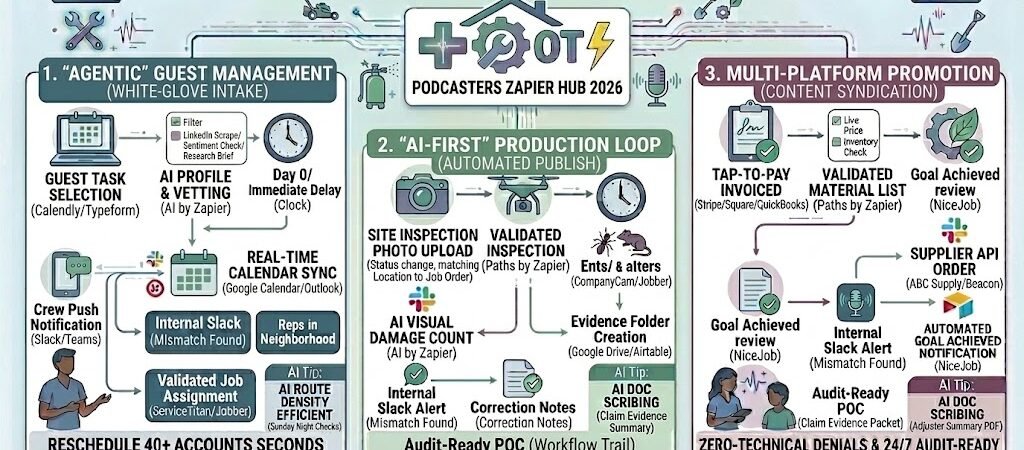
- The “Guest Concierge” Agent: Use Zapier AI Agents to handle guest vetting, scheduling, and asset collection without a human assistant.
- Production-to-Publish Loop: Automatically route raw audio through AI cleaners, transcribers, and show-note generators with a single “File Upload” trigger.
- The “Clip-to-Shorts” Pipeline: Trigger the creation of social clips and SEO-optimized blog posts the moment an episode goes live.
- Smart Distribution Sync: Real-time synchronization between your RSS host (RSS.com, Buzzsprout) and your YouTube, LinkedIn, and Newsletter channels.
The “Production Paradox” of 2026In 2026, the podcasting landscape has reached a massive scale with over 619 million global listeners, but this growth has created a brutal “Production Paradox.” While it has never been easier to record a voice, it has never been harder to stay visible. As of early 2026, statistics show that a staggering 90% of podcasts fail to make it past episode 3, and of the survivors, another 90% “podfade” before episode 20.The barrier to success isn’t the creative idea—it’s the Administrative Tax. In 2026, a successful show is no longer just an audio file; it is a multi-media ecosystem. Podcasters are now facing three primary “Growth Killers”:
The Video Mandate: In 2026, video is no longer a “plus”—it’s the primary discovery engine. YouTube is now the #1 platform for podcast discovery, with 1 in 3 listeners using it as their primary hub. If you aren’t producing high-quality video clips for Shorts, Reels, and TikTok, your show is effectively invisible to 2026 audiences.The “Solo-Creator” Burnout: The average podcaster spends 70% of their “creative” time on non-creative tasks: chasing guest bios, manually cleaning audio, and resizing social thumbnails. This “Admin Overload” is the leading cause of podfading, as creators realize they are spending 10 hours of logistics for every 1 hour of talking.The Consistency Gap: In a hyper-saturated market, an inconsistent schedule is a death sentence. Data from 2026 indicates that 80% of listeners prioritize shows that publish on a predictable rhythm. Without automation, one “busy week” in your personal life can break your momentum and cause a permanent drop in subscriber retention.
Practical AI Tip for 2026: Use AI by Zapier to “Extract the Viral Hook.” Instead of re-listening to your 60-minute episode to find a clip, have Zapier send the transcript to an AI agent that identifies the three highest-sentiment moments. It can then automatically time-stamp these for your editor (or your AI video clipper), saving you hours of “scrubbing” through waveforms.
Blueprint #1 – The Automated “Guest Concierge”
In 2026, chasing guests for headshots and bios is the fastest way to drain your creative energy. High-profile guests—the kind that grow your show—expect a frictionless, “white-glove” experience. This blueprint uses Agentic AI to act as your virtual producer, handling the vetting, asset collection, and briefing while you focus on the conversation.
1. The Trigger: The “Smart-Book” Event
- The 2026 Tech: A guest selects a recording slot via Calendly, TidyCal, or SavvyCal.
- The Integration: Zapier detects the “Invitee Created” event. In 2026, this trigger now carries deep metadata, including the guest’s LinkedIn URL and company size.
2. The Logic: Asset Collection & AI Vetting
Zapier acts as your Guest Manager, ensuring you have everything you need before the “On-Air” light turns red:
- The Auto-Intake: Zapier sends a branded Zapier Form (formerly Interfaces) to the guest. This form is AI-assisted—it can pre-fill their bio based on their LinkedIn and only asks for what’s missing (e.g., “Please upload a high-res headshot” or “What is your phonetic name pronunciation?”).
- The Research Scribe (AI by Zapier): While the guest fills out the form, Zapier sends their URL to an AI agent. The AI scans their recent posts, podcast appearances, and news mentions to create a “Guest Briefing Doc” in Google Docs.
- The Vetting Gate: If the guest hasn’t provided a headshot or bio 48 hours before the recording, Zapier sends a polite, automated nudge via SMS/Twilio: “Hi [Name]! We’re excited for Tuesday. Just a reminder to drop your headshot here so we can start on your promo graphics!”
3. The Action: The “Ready-to-Record” Sync
- The Briefing Handover: The final Briefing Doc and the guest’s assets are pushed into your Airtable “Episode Hub” and attached to the calendar event.
- The Tech-Check: Zapier creates the recording session in SquadCast or Riverside and emails the link to the guest with a “Best Practices” guide (e.g., “Use headphones,” “Find a quiet space”).
- The Result: You open your calendar 5 minutes before the interview and everything—the guest’s bio, their latest controversial tweet, and the recording link—is waiting for you in one doc.
Summary: The Guest Concierge Zap
| Step | Component | 2026 Recommended Tool |
| Trigger | Booking Confirmed | Calendly / TidyCal |
| Logic | AI Briefing Generator | AI by Zapier / ChatGPT |
| Action 1 | Asset Collection Form | Zapier Forms |
| Action 2 | Central Episode Hub | Airtable |
| Action 3 | Automated Recording Invite | SquadCast / Riverside |
Practical AI Tip for 2026: Use AI by Zapier to “Script the Intro.” Have the AI analyze the guest’s bio and your show’s tone to draft a 30-second intro script. Instead of stumbling through their accolades, you can read a polished, punchy introduction that makes both you and the guest look like pros from second one.
Blueprint #2 – The “One-Click” Production Pipeline
In 2026, “post-production” shouldn’t mean hours of staring at waveforms. The industry standard has shifted to headless production—where the creator’s job ends the moment they hit “Stop Recording.” By leveraging AI-native tools like Auphonic and AssemblyAI through Zapier, you can turn a raw multitrack recording into a polished, “ready-to-publish” show package while you sleep.
1. The Trigger: The “Watch-Folder” Drop
- The 2026 Tech: Your recording platform (Riverside, Descript, or SquadCast) automatically exports your final multitrack files to a dedicated “Raw Production” folder in Google Drive or Dropbox.
- The Action: Zapier detects the new file upload and initiates the production sequence.
2. The Logic: Intelligent Audio & Language Processing
Zapier acts as your Mastering Engineer and Head Writer, routing the audio through specialized 2026 AI nodes:
- The “Auphonic” Polish: Zapier sends the raw files to Auphonic. Using their 2026 multitrack algorithms, Auphonic automatically removes mic bleed, cuts out silent gaps and “coughs,” and normalizes the loudness to -16 LUFS (the podcast standard).
- The “AssemblyAI” Deep-Dive: The polished audio is then routed to AssemblyAI. In 2026, this isn’t just for text; it uses Universal-3 Pro models to identify different speakers with 94% accuracy, detect the “sentiment” of the conversation, and generate Auto-Chapters with precise timestamps.
- The AI Package (ChatGPT/Claude): Zapier sends the final transcript to GPT-4o or Claude 3.5. The AI generates:
- 3 Punchy Titles optimized for 2026 YouTube/Spotify search.
- The “Executive Summary” (300 words).
- 5 Social Media Hooks (timestamped for video clipping).
3. The Action: The “Airtable” Hub Delivery
- The Asset Handover: Zapier pushes the mastered audio, the SRT subtitle files, and the AI-generated show notes into a new record in your Airtable “Production Hub.”
- The Production Alert: Zapier pings your team (or just you) on Slack: “Episode #[Number] is ready for final review. Audio mastered, chapters generated, and social hooks identified.”
- The Result: Your total “hands-on” production time drops from 4 hours to 15 minutes of final quality control.
Summary: The Production Pipeline Zap
| Step | Component | 2026 Recommended Tool |
| Trigger | Raw File Upload | Google Drive / Dropbox |
| Logic 1 | AI Mastering & Leveling | Auphonic |
| Logic 2 | Transcription & Chaptering | AssemblyAI |
| Logic 3 | Show Note & Title Gen | AI by Zapier (GPT-4o) |
| Action 1 | Central Asset Hub | Airtable |
| Action 2 | Production Slack Alert | Slack |
Practical AI Tip for 2026: Use Auphonic’s 2026 “Music Cut” feature via Zapier. If your podcast uses intro/outro music, Zapier can trigger Auphonic to automatically detect the speech-to-music transitions and apply “Auto-Ducking,” ensuring your voice never gets drowned out by the beat—no manual volume keyframes required.
Blueprint #3 – The 24/7 Promotion Engine
In 2026, “publishing” an episode is only 20% of the work. With the “Video Mandate” in full effect, you need to atomize your long-form recording into a multi-channel blast. If you aren’t visible on YouTube Shorts, TikTok, and LinkedIn within 2 hours of your episode going live, you are losing the battle for attention. This blueprint automates the creation of social clips, newsletters, and SEO-rich blog posts, turning one recording into a week-long growth engine.
1. The Trigger: RSS or Hub “Go-Live”
- The 2026 Tech: Your episode status is changed to “Published” in RSS.com, Buzzsprout, or your Airtable Episode Hub.
- The Action: Zapier detects the new live URL or the status change and kicks off the multi-channel syndication.
2. The Logic: The “Content Atomizer” (AI by Zapier)
Zapier acting as your Social Media Manager, orchestrating specialized 2026 AI tools:
- The Clip Generator (quso.ai / OpusClip): Zapier sends your video link to quso.ai. The AI automatically identifies the “viral hooks,” crops them to 9:16 for TikTok/Shorts, and adds branded, high-impact captions.
- The Newsletter Draft (Substack / Mailchimp): Zapier pushes the AI-generated summary and “Key Takeaways” from Section 3 into a Substack or Kit (formerly ConvertKit) draft. It automatically inserts the “Guest Headshot” collected in Section 2.
- The SEO Blog Post (WordPress / Ghost): Zapier sends the full transcript to a WordPress draft. It uses a custom prompt to rewrite the transcript into a readable 800-word blog post with H2 headers and a “Listen Now” call-to-action.
3. The Action: The “Guest Success” Kit & Social Blast
- The Guest “Hype” Email: Zapier sends a personalized email to your guest: “We’re live! Here is your ‘Promo Kit’ with custom video clips and links to share with your audience.” (This turns your guest into your most effective salesperson).
- The Social Queue: Zapier pushes 3 unique social variants to FeedHive or Buffer. It schedules them for high-engagement slots (e.g., Post 1 at launch, Post 2 on Day 3, Post 3 on Day 6).
- The Result: You record once, and your brand stays active across 5 platforms for an entire week without you opening a single app.
Summary: The Promotion Engine Zap
| Step | Component | 2026 Recommended Tool |
| Trigger | Episode “Published” | RSS.com / Airtable |
| Logic 1 | AI Video Clipping | quso.ai / Choppity |
| Logic 2 | Newsletter Drafting | Substack / Kit |
| Action 1 | Social Media Scheduling | FeedHive / Buffer |
| Action 2 | Guest “Hype Kit” Email | Gmail / Mailchimp |
Practical AI Tip for 2026: Use AI by Zapier to “Monitor Social Sentiment.” If one of your automated clips starts getting 3x more engagement than usual on LinkedIn, have Zapier send you a Slack Alert: “Viral Alert: Clip #2 is trending! Recommend spending $20 on a ‘Boost’ or hopping into the comments to engage.” In 2026, automation starts the fire, but your human engagement fan the flames.
The 2026 Podcasting Tech Stack
In 2026, the “Golden Hour” of podcasting isn’t just about the microphone you use; it’s about the interoperability of your tools. To sustain a show that grows without causing burnout, you need a stack where audio, video, and text flow through a single automated pipeline. The 2026 industry standard favors browser-based recording and AI-first distribution hubs.
1. The 2026 Core Stack
| Function | 2026 Recommended Tool | Why It Wins in 2026 |
| Studio Hub | Riverside / SquadCast | Captures 4K local video and lossless 48kHz audio, bypassing Wi-Fi glitches. |
| AI Editor | Descript | The pioneer of “text-based editing.” If you can edit a Word doc, you can edit your podcast. |
| Audio Master | Auphonic | The “Final Polish” bot. Handles loudness normalization and noise reduction on autopilot. |
| Asset Hub | Airtable / Castmagic | Castmagic excels at instantly turning audio into show notes, titles, and social bios. |
| Syndication | RSS.com / Buzzsprout | Robust Zapier integrations that trigger your entire marketing sequence on “Publish.” |
2. The 2026 “Viral-Clip” Circuitry
In 2026, Zapier acts as your “Agency in a Box,” routing data through these three growth circuits:
- The “Shorts” Circuit: Connect Riverside to Choppity or OpusClip. As soon as the recording ends, Zapier triggers an AI scan to find the 3 most viral moments, adds branded captions, and resizes them for TikTok/Reels.
- The SEO Circuit: Link AssemblyAI to WordPress. Zapier takes your raw transcript, has an AI agent rewrite it into a long-form SEO blog post, and saves it as a draft with the podcast player embedded.
- The Guest Circuit: Connect Airtable to Gmail. Once an episode is live, Zapier pulls the custom clips and social links into a “Guest Success Kit” email, making it effortless for your guest to promote your show.
3. Hardware for the 2026 “Pro-Creator” Rig
- Hybrid XLR/USB Mics: Tools like the Shure MV7+ allow you to start simple with USB but transition to professional XLR interfaces like the RØDECaster Pro II as you scale.
- AI-Tracking Webcams: Use 4K cameras with built-in AI auto-framing. This ensures you stay centered in the “Vertical Crop” even if you lean back or move around during a passionate point.
- IoT “On-Air” Lights: Connect a smart light to your recording app via Zapier. When you hit “Record” in Riverside, the light outside your office door turns red—automatically protecting your recording from family or office interruptions.
Conclusion: Your 30-Day “Showrunner” Roadmap
- Week 1: The Intake Shield. Automate your Guest Vetting & Booking to stop the endless email back-and-forth.
- Week 2: The Production Bot. Connect your Cloud Drive to Auphonic for instant audio mastering.
- Week 3: The Clip Pipeline. Set up a “Magic Clip” trigger to start generating social shorts from every interview.
- Week 4: The 24/7 Engine. Build the “Airtable Hub” to track your growing back-catalog and automate your LinkedIn/X promotion.

About the Author
Aapt DubeyAapt Dubey is an automation specialist and software developer dedicated to eliminating manual workflows for small businesses. With deep, hands-on experience building complex Zapier integrations, API connections, and real-world applications, Aapt writes actionable, tested tutorials to help businesses scale efficiently.