Key Takeaways: Zapier for Occupational Therapists
- Real-Time Data Harvesting: Automate the collection of patient “Activities of Daily Living” (ADL) data from wearables into clinical notes.
- The “Audit-Proof” Billing Bridge: Use Zaps to ensure ICD-10 codes and functional goals match perfectly before a claim is submitted.
- Zero-Touch Patient Onboarding: Move from paper intake to “Digital First” to reduce Evaluation Latency.
- HIPAA-First AI Scribing: Leverage AI to turn 60-minute sensory or physical sessions into structured progress reports.
The “Billing Bottleneck” of 2026 OT Practices
In 2026, Occupational Therapists (OTs) are operating in a landscape defined by “Value-Based Care.” While the clinical focus remains on restoring independence, the administrative focus has shifted toward proving it with granular, objective data. This shift has created a significant “Billing Bottleneck” that threatens the profitability of independent clinics.
By 2026, the average OT loses 8+ hours per week to three specific “Operational Leaks”:
- The Functional Reporting Burden: CMS and private insurers now require “G-codes” and functional limitation reporting that is more complex than ever. OTs often spend 25% of their session time documenting minute changes in Grip Strength, Range of Motion (ROM), or ADL (Activities of Daily Living) scores just to justify a single billing unit.
- The “Evidence Gap” in Denials: In 2026, a claim is 40% more likely to be denied if the “Goal Attainment Scaling” (GAS) in the session note doesn’t perfectly match the initial Plan of Care (POC). Manual cross-referencing between these documents is the #1 source of human error.
- The Evaluation-to-Claim Latency: The time it takes for a patient to move from their initial evaluation to a processed insurance claim has stretched. In many 2026 clinics, this delay creates a cash-flow crisis, as therapists are providing care weeks before the first reimbursement check arrives.
The Zapier Solution: Zapier acts as your “Revenue Integrity Officer.” It bridges the gap between your clinical hands-on work and your back-office billing software. By connecting your EMR (Jane, TherapyNotes, or WebPT) with your billing clearinghouse, Zapier ensures that as soon as a therapist signs a note, the functional data is validated against the POC and pushed to billing—often on the same day.
Practical AI Tip for 2026: Automation isn’t just for speed; it’s for Audit Protection. Use Zapier to automatically archive a “Clinical Evidence Packet” (de-identified) for every high-value claim. If a 2026 “Recovery Audit Contractor” (RAC) requests a review, you can produce the necessary documentation in seconds, not hours.
The 2026 Secure Data & Billing Protocol
In 2026, handling Occupational Therapy (OT) data requires more than just a password. The 2026 HIPAA Security Rule Update has shifted the landscape: previously “addressable” safeguards like Multi-Factor Authentication (MFA) and end-to-end encryption are now mandatory for every clinic. When you automate progress tracking and billing, you are moving sensitive “Activities of Daily Living” (ADL) data and financial identifiers that are prime targets for cyber threats.
The 2026 golden rule for OT automation is: Zapier is your logic engine, but a “Secure Vault” is your compliance shield.
1. The “Secure Vault” Strategy
Standard Zapier accounts do not sign a Business Associate Agreement (BAA) in 2026. To remain compliant, you must use a “Secure Bridge” to de-identify PHI before it enters your automation pipeline.
- The Vault (Storage): All raw clinical data—such as specific ROM (Range of Motion) degrees or patient names—must live in a HIPAA-compliant environment like JotForm Enterprise or Airtable (Enterprise/HIPAA Tier).
- The De-identified Pipe: Your Zaps should only process Unique Record IDs or Internal Case Numbers.
- Safe Workflow: A therapist logs a “Grip Strength” improvement in a secure form. The form sends only the “Record ID: OT-992” and “Status: Goal Met” to Zapier.
- The Action: Zapier triggers a billing alert or updates a progress dashboard without ever “seeing” the patient’s name or medical history.
2. The 2026 OT Compliance Checklist
Before activating your first billing or progress Zap, verify your practice meets these updated 2026 standards:
- Universal MFA: Multi-Factor Authentication must be enabled on your EMR, your Zapier account, and any mobile devices used for in-session data entry.
- 72-Hour Restoration Rule: You must have a tested contingency plan capable of restoring all ePHI within 72 hours of a system failure or cyber incident.
- The BAA Chain: Confirm you have a signed BAA with every tool in your stack, from your EMR (Jane/WebPT) to your Secure SMS provider (Spruce Health or Twilio HIPAA).
- Network Segmentation: In 2026, clinical data must be segmented from your public office Wi-Fi to prevent lateral movement during a breach.
3. Comparison: Data De-identification in 2026
| Data Category | Secure Vault (EMR/Airtable) | Zapier Pipeline (The Pipe) |
| Patient Name / SSN | Encrypted & Stored | REDACTED (Use Record ID) |
| Clinical Diagnosis / ICD-10 | Encrypted & Stored | REDACTED (Use Category Code) |
| Total Billing Units | Visible | Visible (Operational Data) |
| Session Duration | Visible | Visible (Operational Data) |
| Goal Status (Met/Unmet) | Visible | Visible (Triggers Logic) |
Practical AI Tip for 2026: If your clinic manages more than 5 therapists, consider Keragon. It is a 2026 leader in healthcare-specific automation that signs a BAA for the entire platform. This allows you to automate OT billing and progress tracking without the manual de-identification steps required by Zapier.
Blueprint #1 – Automated Progress & Goal Tracking
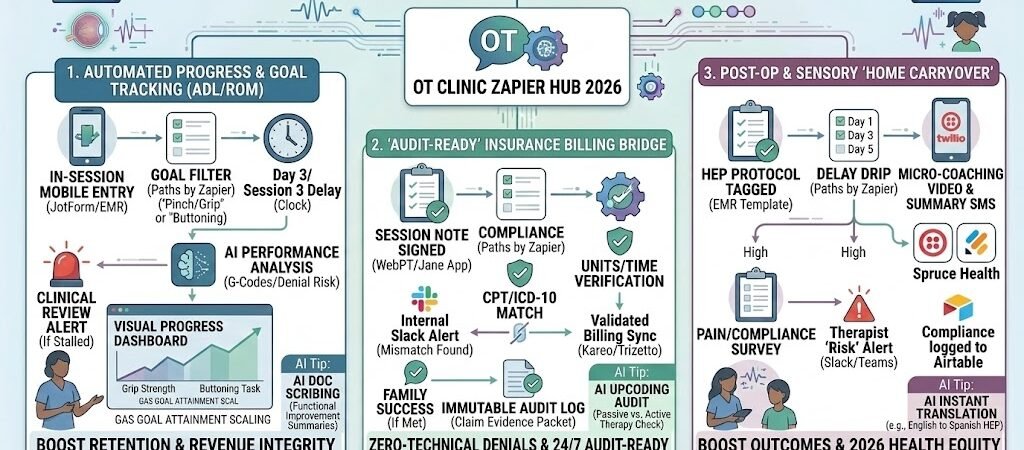
In 2026, “Goal Attainment Scaling” (GAS) is no longer a manual graphing exercise. For Occupational Therapists, demonstrating incremental progress in fine motor skills, sensory processing, or Activities of Daily Living (ADLs) is the key to maintaining authorization. This blueprint automates the data harvest, turning in-session measurements into real-time clinical dashboards.
1. The Trigger: Mobile Data Entry
- The 2026 Tool: OTs use a HIPAA-compliant mobile form like JotForm Enterprise or the native “Quick-Log” feature in their EMR (Jane or WebPT).
- The Action: During or immediately following a session, the therapist inputs specific functional metrics (e.g., “Pinch Strength: 12 lbs” or “Buttoning Task: 3/5 independent”).
- The Key: Zapier monitors this secure form for a “New Entry” trigger.
2. The Logic: Progress Filtering (Paths by Zapier)
Zapier evaluates the data against the patient’s specific Plan of Care (POC) goals:
- Path A (Goal Achievement): If the metric meets or exceeds the discharge goal, Zapier triggers a “Success Notification” to the referring physician and the family via Spruce Health.
- Path B (The 3-Session Stall): If the AI detects no improvement in a specific metric over three consecutive sessions, it creates a “Clinical Review” task in ClickUp (HIPAA Tier) to prompt a treatment pivot.
- Path C (Standard Update): For routine progress, the data is prepared for the weekly dashboard sync.
3. The Action: The Visual Progress Dashboard
- The Delivery: Zapier pushes the de-identified metrics to a HIPAA-compliant Airtable base.
- The Result: The data is automatically converted into a visual trend line. When it’s time for a 90-day Re-Evaluation, the therapist doesn’t spend an hour looking through old notes; they simply export the graph directly into the insurance report.
Summary: The Progress Tracker Zap
| Step | Component | 2026 Recommended Tool |
| Trigger | Functional Metric Entry | JotForm Enterprise / Jane App |
| Logic | Goal vs. Reality Check | Paths by Zapier |
| Action 1 | Clinical Alert (If Stalled) | ClickUp (HIPAA) / Slack |
| Action 2 | Family Success SMS | Twilio (HIPAA) / Spruce |
| Action 3 | Visual Data Sync | Airtable (HIPAA Tier) |
Practical AI Tip for 2026: Use AI by Zapier to summarize the progress. Instead of just a number, the AI can draft a sentence for the note: “Patient demonstrated a 15% increase in pinch strength since the last POC, moving from ‘Moderate Assist’ to ‘Minimal Assist’ for fine motor tasks.”
Blueprint #2 – The “Audit-Ready” Billing Pipeline
In 2026, the “Friday Afternoon Scramble”—where therapists desperately try to match their session notes to billing codes—is a major clinical risk. With Medicare and private payers using AI to flag “mismatched” claims, Occupational Therapists must ensure their documentation perfectly supports their CPT codes. This blueprint creates a real-time validation loop, ensuring that every claim is “Audit-Ready” before it ever hits the clearinghouse.
1. The Trigger: The Signed Session Note
- The 2026 Standard: The process begins the moment a therapist digitally signs a note in an EMR like Jane, WebPT, or TherapyNotes.
- The Action: Zapier monitors the “Note Signed” or “Visit Finalized” status.
2. The Logic: The “Compliance Scrub” (Paths by Zapier)
Zapier performs a three-point check to catch common 2026 billing errors:
- The Time Check: Does the duration of the session (e.g., 60 minutes) match the number of units billed (e.g., 4 units of 97530)?
- The ICD-10 Match: Does the session note contain a diagnosis code that justifies the “Medical Necessity” of the OT intervention?
- The Goal Link: Zapier checks if at least one “Functional Goal” was updated during the session.
- The Action (Internal Alert): If a mismatch is found, Zapier sends a Slack alert to the therapist: “Action Required: Session Note #OT-104 is missing an updated ADL goal. Please correct before billing submission.”
3. The Action: The Secure Billing Sync
- The Delivery: Once validated, Zapier pushes the de-identified billing data (Claim ID, Units, and CPT Codes) into your billing software or clearinghouse (Kareo or Trizetto).
- The Archive: A “Billing Snapshot” is automatically saved to a HIPAA-compliant Google Drive or Airtablefolder, creating a permanent evidence trail of what was documented at the time of the claim.
Summary: The Billing Pipeline Zap
| Step | Component | 2026 Recommended Tool |
| Trigger | Signed Session Note | Jane / WebPT / TherapyNotes |
| Logic | Time & Code Validation | Paths by Zapier |
| Action 1 | Internal Correction Alert | Slack / Microsoft Teams |
| Action 2 | Billing Software Sync | Kareo / Trizetto |
| Action 3 | Immutable Audit Log | Airtable (HIPAA Tier) |
Practical AI Tip for 2026: In 2026, “Upcoding” is a high-risk audit trigger. Use AI by Zapier to scan your notes for “Active Therapy” keywords. If the AI sees mostly “Passive Range of Motion” but the code is for “Therapeutic Activity,” it will flag the note for a supervisor review, protecting your clinic from costly clawbacks.
Blueprint #3 – Post-Surgical & Sensory Home Programs
In 2026, the success of an Occupational Therapy plan is determined by what happens between sessions. Whether a patient is recovering from a carpal tunnel release or managing a pediatric sensory processing disorder, “Home Exercise Program” (HEP) compliance is the primary driver of functional outcomes. This blueprint automates the delivery and monitoring of these programs, moving from static paper handouts to dynamic, interactive coaching.
1. The Trigger: EMR Template Selection
- The 2026 Tool: Therapists use their EMR (Jane, WebPT, or TherapyNotes) to assign a specific protocol.
- The Action: When the therapist tags a patient file with
#PostOp_Handor#Sensory_HeavyWork, Zapier triggers the corresponding educational sequence. - Pro Tip: In 2026, many OTs use JotForm Enterprise (HIPAA Tier) during the final 5 minutes of a session to “check off” the specific movements the patient mastered that day, which then dictates the automated homework.
2. The Logic: The “Micro-Coaching” Drip (Delay by Zapier)
Zapier manages the cadence of the home program to prevent “Information Overload”:
- Day 1 (Immediate Post-Session): Zapier sends a secure link via Twilio (HIPAA) containing a 15-second video of the therapist (or a library model) performing the specific exercise.
- Day 3 (The Form Check): An automated SMS asks: “On a scale of 1-5, how much discomfort did you feel during your finger glides today?”
- Day 5 (The Encouragement): A final nudge: “You’re 80% through the week! Remember, consistent sensory input helps regulate the nervous system. Keep going!”
3. The Action: The “Compliance Alert” Loop
- The Data Sync: Patient responses (pain levels, completion status) are pushed back into the Airtable (HIPAA Tier)Progress Dashboard.
- The Clinical Notification: If a patient reports a pain level of “5” or fails to open the video links for two consecutive days, Zapier sends an urgent Slack alert to the OT.
- The Result: Instead of finding out a patient hasn’t done their exercises during the next session, the therapist knows in real-time and can call to adjust the protocol, preventing 2026 “Recovery Plateaus.”
Summary: The Home Program Zap
| Step | Component | 2026 Recommended Tool |
| Trigger | HEP Protocol Tagged | Jane / WebPT / JotForm |
| Logic | Multi-Day Video Drip | Delay by Zapier |
| Action 1 | Secure Video/Text | Twilio (HIPAA) / Spruce |
| Action 2 | Pain/Compliance Survey | Twilio (HIPAA) SMS |
| Action 3 | Therapist “Risk” Alert | Slack / Microsoft Teams |
Practical AI Tip for 2026: Use AI by Zapier to translate home programs instantly. If your patient’s primary language is Spanish or Mandarin, the AI can take your English instructions and send a perfectly translated SMS, ensuring 2026 health equity standards are met in your practice.
Conclusion: Your 30-Day “Functional-First” Roadmap
Modernizing your OT clinic for 2026 is about shifting from “Admin-Heavy” to “Outcome-Focused”:
- Week 1: The Billing Audit. Identify your most common denial codes. Are they due to mismatched units or missing goals?
- Week 2: Secure the Bridge. Finalize your BAAs and move your progress tracking to a HIPAA-compliant vault.
- Week 3: Launch Blueprint #1 & #2. Automate your progress graphing and “Scrub” your billing notes before they are sent.
- Week 4: Launch Blueprint #3. Start your first automated Home Exercise Program for post-surgical or sensory patients.

About the Author
Aapt DubeyAapt Dubey is an automation specialist and software developer dedicated to eliminating manual workflows for small businesses. With deep, hands-on experience building complex Zapier integrations, API connections, and real-world applications, Aapt writes actionable, tested tutorials to help businesses scale efficiently.