Key Takeaways: Zapier for Massage Therapists
- The “No-Show” Shield: Automation that pairs deposits with SMS reminders reduces no-shows by up to 40% in 2026.
- Review Velocity: Automated post-session review requests can increase your Google Business profile ratings by 30% within 90 days.
- HIPAA Compliance for LMTs: Because you handle intake forms with medical history (contraindications, surgeries), you must use “Secure Bridge” tools like JotForm Enterprise or HIPAAtizer that sign a BAA.
- The AI SOAP Note: Voice-to-chart AI scribes (like Noterro Scribe) now allow therapists to finish a full SOAP note in under 60 seconds post-session.
- Topical Moat: Automation in 2026 isn’t just a “luxury”—it’s essential for competing with franchises that use massive corporate tech stacks.
The “Manual Admin” Burnout in Massage Therapy
Massage therapy is one of the most physically demanding professions in the 2026 healthcare landscape. However, for most Licensed Massage Therapists (LMTs), it isn’t the deep tissue work or the repetitive motion that leads to burnout—it’s the “Invisible Admin Load.” By 2026, the average solo practitioner spends upwards of 8.7 hours per week on non-clinical tasks. In a profession where your income is strictly tied to your hands being on a client, every minute spent on a keyboard is a minute you aren’t earning. This has led to a critical “Admin Burnout” trend:
- The “Between-Session” Scramble: Attempting to flip a room, process a payment, and chase a new client for their intake form in a 10-minute window.
- The “No-Show” Financial Hit: In 2026, with rising studio rents (averaging $3,000+ for small urban spaces), a single no-show doesn’t just lose you a fee—it puts your day’s operating margin into the red.
- The Documentation Backlog: Finishing a 6-hour shift of manual labor only to realize you have five SOAP notes to type before you can go home.
The Zapier Solution: Zapier functions as your “Virtual Front Desk.” By connecting your booking platform (Jane App, MassageBook, or Vagaro) to your financial and marketing tools, you eliminate the “data shoveling” that interrupts your clinical flow. In 2026, high-efficiency LMTs are using automation to cut administrative time by 72%, allowing them to either see more clients or—more importantly—give their bodies the rest they need to sustain a long career.
Practical AI Tip for 2026: Automation is your best retention strategy. Research shows that therapists who use automated systems to manage scheduling and client follow-ups report 25% lower burnout levels than those using traditional manual or paper-based methods.
The HIPAA & Safety Directive for 2026
In 2026, the intersection of massage therapy and digital data is a high-priority zone for regulators. While many LMTs view themselves as wellness providers, state and federal laws—including the updated 2026 HIPAA Security Rule and the California Consumer Privacy Act (CCPA)—increasingly classify massage therapists as Healthcare Providers.
If your intake form asks about current medications, previous surgeries, or specific pain diagnoses (like “herniated disc” or “fibromyalgia”), you are handling Protected Health Information (PHI). In 2026, a data breach isn’t just a legal headache; it’s a direct threat to your professional license and the trust of your clients.
1. The “Secure Bridge” Protocol
Standard automation tools are not built for healthcare security. To automate safely, you must follow the “Secure Bridge”strategy:
- The Vault (Form/Storage): You must use a “BAA-signed” tool like JotForm Enterprise (HIPAA Tier) or HIPAAtizer. These are the only platforms authorized to hold sensitive medical data in transit and at rest.
- The Pipe (Zapier): Because standard Zapier does not sign a BAA for solo/SMB plans, you must de-identify data before it enters a Zap.
- Example: Your intake form receives a client’s medical history. The form notifies Zapier that “Record ID #881” is complete. Zapier then triggers a text to you. The text body says “New intake ready for review,” but it does not include the client’s name or medical details.
2. The 2026 LMT Security Checklist
Before turning on your first automation, verify your practice meets these 2026 compliance benchmarks:
- Zero-Trust Access: Enable Multi-Factor Authentication (MFA) on your booking software (Jane App, Vagaro) and your Zapier account.
- The BAA Chain: Ensure you have a signed Business Associate Agreement (BAA) with every digital tool that touches PHI.
- Symmetry in Consent: Under 2026 CCPA updates, opting out of data sharing must be as easy as opting in. Your website must feature clear, one-click privacy controls.
- Data Minimization: Only sync what you need. To send a review request, Zapier only needs an email address—it does not need the client’s treatment history.
3. Comparison: Where PHI Lives vs. Where Zaps Live
| Data Category | Storage Location (Secure Vault) | Zapier’s Role (The Pipe) |
| Medical History | JotForm (HIPAA) / Jane App | Trigger only (no sensitive data in Zap) |
| Credit Card Info | Stripe / Square (PCI Compliant) | Action only (Send receipt) |
| Reviews / Feedback | Google Business / Birdeye | Delivery (Public-facing data only) |
| Internal Reminders | Slack / Email | Coordination (General alerts only) |
Practical AI Tip for 2026: If you operate a larger spa with multiple contractors, consider Keragon. It is a healthcare-specific automation platform that signs a BAA for the entire system, allowing you to move PHI securely without the complex de-identification steps required by Zapier.
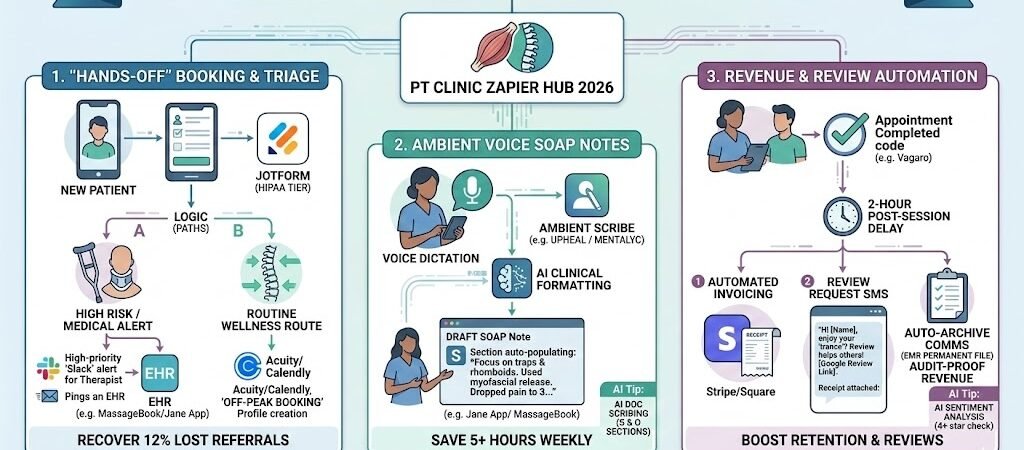
Blueprint #1 – The “Hands-Off” Booking & Intake Loop
In the competitive 2026 wellness market, the “First Impression” happens long before the client ever touches your table. A clunky intake process or a missed email is often enough to make a new client ghost your studio for a franchise. This blueprint creates a frictionless, automated loop that ensures your schedule stays full and your desk stays clear.
1. The Trigger: Multi-Channel Booking Sync
- The 2026 Standard: Use an EMR/Booking hybrid like Jane App, MassageBook, or Vagaro.
- The Action: A client books an appointment via your website, Instagram “Book Now” button, or Google Business profile.
- The Sync: Zapier monitors your booking platform for the “New Appointment” trigger. It immediately cross-references your database to see if this is a first-time guest.
2. The Logic: Smart Intake Triage (Paths by Zapier)
Zapier uses Paths to handle different client types without you needing to check your email.
- Path A (The New Client): If it’s their first visit, Zapier triggers an automated, mobile-friendly intake form via JotForm Enterprise (HIPAA Tier).
- 2026 Pro Tip: Use Zapier to send a “Welcome Video” alongside the intake form. In 2026, clients who watch a 30-second therapist intro video have a 35% lower late-cancellation rate.
- Path B (The Returning Client): If they haven’t been in for 6+ months, Zapier sends a “Health Update” form to check for new injuries or surgeries.
- Path C (The Red Flag): If the client indicates a contraindication on their form (e.g., “Deep Vein Thrombosis” or “Recent Surgery”), Zapier sends an URGENT Slack or SMS alert to the therapist to review the case before the client arrives.
3. The Action: The “Presence” Confirmation
- The Delivery: Via Twilio (HIPAA Tier) or Spruce Health.
- The Message: “Hi [Name], we’ve got you down for 2 PM! Your intake form is ready here: [Secure Link]. Completing this now gives us more time for your session!”
- Why it works: By providing the paperwork instantly, you move the “administrative friction” out of the treatment room, allowing you to start the massage the moment the client walks in.
Summary: The Booking & Intake Zap
| Step | Component | 2026 Recommended Tool |
| Trigger | New Appointment Created | Jane App / MassageBook |
| Logic | New vs. Returning Triage | Paths by Zapier |
| Action 1 | HIPAA Intake Delivery | JotForm (Gold/Enterprise) |
| Action 2 | Pre-Session Engagement | Twilio (HIPAA) / YouTube |
| Action 3 | Clinical Alert (if flagged) | Slack / SMS |
Practical AI Tip: In 2026, use Zapier Central to track your “Intake Completion Rate.” If a client hasn’t finished their form 24 hours before the session, the AI can automatically send a polite reminder, saving your front desk (or you) from making awkward “Where is your paperwork?” phone calls.
Blueprint #2 – The “One-Minute” AI SOAP Note
In 2026, the traditional method of typing SOAP notes after a session is being replaced by Ambient Clinical Intelligence. For a massage therapist, whose work is intensely physical, the goal is to eliminate the need for a keyboard entirely. This blueprint uses voice-to-chart automation to ensure your notes are finished before your hands even cool down.
1. The Trigger: Voice-Assisted Documentation
- The 2026 Tools: Leading the charge are Noterro Scribe, PatientNotes, and Upheal.
- The Action: Immediately after a session, while you are flipping the room, you use your phone or tablet to record a 60-second verbal summary.
- Example: “Client presented with Grade 2 tension in the upper traps and levator scapula. Used myofascial release and trigger point therapy on the right side. Client reported a drop in pain from 7 to 3. Recommended increased hydration and a specific levator stretch.”
2. The Logic: AI-Powered Formatting (Noterro Scribe / AI by Zapier)
Automation doesn’t just transcribe your words; it organizes them into a medical-grade structure.
- The Scribe: Noterro Scribe automatically parses your speech into the Subjective, Objective, Assessment, and Plan sections. It is trained to recognize 2026 anatomical terminology and massage-specific techniques.
- The AI Step (Zapier): If you use a standalone recording tool, Zapier can take that transcript and run it through AI by Zapier to format it specifically for your EHR’s template (e.g., Jane App or MassageBook).
3. The Action: The “Instant Draft” Sync
- The Delivery: The formatted note is pushed directly into the client’s chart as a Draft.
- The Result: You simply review the text on your tablet, hit “Sign,” and the task is done. This reduces charting time from 10 minutes per patient to roughly 60 seconds, saving the average full-time LMT over 5 hours per week.
Summary: The AI SOAP Note Zap
| Step | Component | 2026 Recommended Tool |
| Trigger | Voice Dictation / Scribe | Noterro Scribe / PatientNotes |
| Logic | Clinical Formatting AI | AI by Zapier |
| Action 1 | EHR Draft Population | Jane App / Noterro |
| Action 2 | Sync to Patient File | Google Drive (HIPAA Tier) |
Practical AI Tip for 2026: Accuracy is everything. While 2026 AI scribes are 95%+ accurate, always do a quick “Sanity Check” for anatomical laterality (ensuring the AI didn’t swap “left trap” for “right trap”) before finalizing your note.
Blueprint #3 – Automated Reviews & Re-Booking Invoices
In the wellness industry of 2026, the “Fortune is in the Follow-up.” Most LMTs lose significant revenue because they feel awkward asking for a review or a re-booking while a client is in a post-massage “trance.” This blueprint automates the commercial side of your practice, ensuring you get paid and praised without breaking the clinical “vibe.”
1. The Trigger: Session Completion
- The Zap: The moment an appointment is marked “Completed” in Jane App, MassageBook, or Vagaro, Zapier initiates a multi-step follow-up sequence.
- The Logic (Delay by Zapier): In 2026, timing is everything. Zapier adds a 2-hour delay to allow the client to travel home and settle into their post-treatment relaxation before receiving a notification.
2. The Action: The “Review & Receipt” Bundle
- The Delivery: Via Twilio (HIPAA Tier) or Spruce Health.
- The Message: “Hi [Name], I hope you’re still feeling the benefits of today’s session! I’ve attached your invoice here: [Stripe Link]. If you have a moment, a quick review helps others find us: [Google Review Link].”
- Why it works: Automated review requests are 30% more effective than verbal asks. In 2026, your “Review Velocity”—how many fresh reviews you get weekly—is the primary driver for your ranking on Google Maps.
3. The Retention Logic: The “Win-Back” Campaign
In 2026, acquiring a new client costs 5x more than keeping an existing one. Zapier monitors your “Dormant Data” to ensure no one falls through the cracks.
- The Logic: Zapier checks your booking software every Sunday. If a client hasn’t re-booked within 21 days of their last session, it triggers a “Maintenance Reminder.”
- The Nudge: “Hi [Name], it’s been 3 weeks since your last deep tissue session. Consistency is key for managing that shoulder tension! Would you like to grab a spot for next week? [Booking Link].”
Summary: The Revenue & Retention Zap
| Step | Component | 2026 Recommended Tool |
| Trigger | Appointment Completed | Jane App / MassageBook |
| Logic | 2-Hour Post-Session Delay | Delay by Zapier |
| Action 1 | Automated Invoicing | Stripe / Square |
| Action 2 | Review Request SMS | Twilio (HIPAA) / Birdeye |
| Action 3 | 21-Day Win-Back Nudge | Mailchimp / ActiveCampaign |
Practical AI Tip for 2026: Use Zapier Central to analyze client sentiment. If a client leaves a review with less than 4 stars, the AI can immediately flag it in a private Slack channel for you, allowing you to reach out and resolve the issue before it impacts your public reputation.
Conclusion: Your 30-Day LMT Automation Roadmap
Transforming your massage practice into a 2026-ready studio doesn’t require a technical degree; it requires a 30-day commitment to better systems:
- Week 1: The Admin Audit. Identify exactly how many minutes you spend on “Invisible Work” between sessions.
- Week 2: Secure the Bridge. Get your BAA-signed intake forms (JotForm) connected to your booking app.
- Week 3: Launch Blueprint #1 & #3. Automate your intake and your post-session review requests.
- Week 4: Launch Blueprint #2. Start using AI-assisted SOAP notes (Noterro Scribe) and reclaim your evenings.
By Day 30, you won’t just have a more profitable studio; you’ll have a body that feels as good as your clients’ do.

About the Author
Aapt DubeyAapt Dubey is an automation specialist and software developer dedicated to eliminating manual workflows for small businesses. With deep, hands-on experience building complex Zapier integrations, API connections, and real-world applications, Aapt writes actionable, tested tutorials to help businesses scale efficiently.