
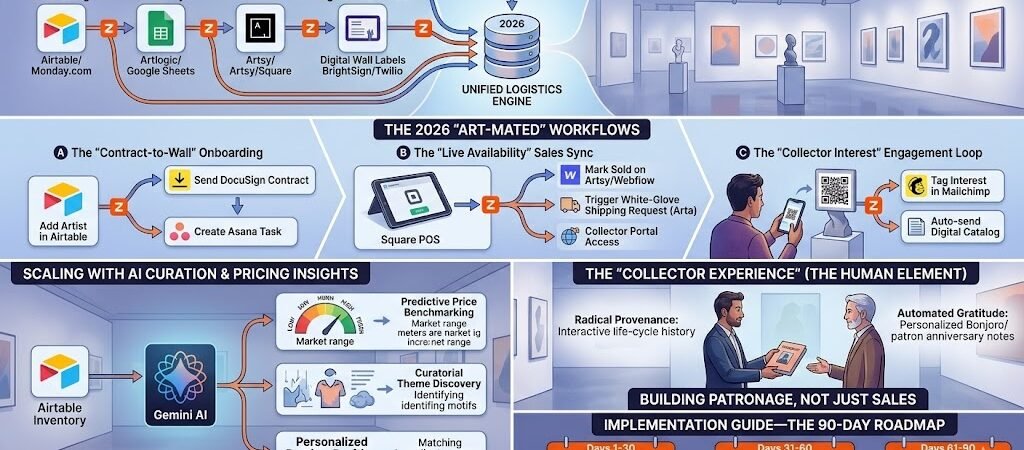
The Art Gallery Tech Stack (Zapier for Independent Art Gallery Owners)
Your 2026 tech stack is designed to provide “Curatorial Clarity.” By using Zapier to link your scheduling data with your inventory and sales platforms, you ensure that every exhibition is organized and every sale is accounted for in real-time.
1. The Exhibition & Scheduling Brain
- The Tools: Airtable or Monday.com.
- The Value: Move beyond simple calendars. Airtable, in particular, acts as a relational database, linking exhibitions to specific artists, artwork availability, and shipping logistics.
- The Zap: When an exhibition’s status is changed to “Confirmed” in Airtable, Zapier triggers a “Contract Request” via DocuSign and sets up the exhibition’s task list in Asana.
2. The Artist & Artwork Inventory
- The Tools: Artlogic or Google Sheets (as a dynamic manifest).
- The Value: The lifeblood of the gallery. Artlogic is the specialist CRM and inventory system, while dynamic Sheets can serve as a robust alternative.
- The Zap: When a new artist logs an available artwork in their Artist Portal (using an Airtable Form), Zapier creates a matching, high-resolution entry in your Artlogic inventory, ready for curation.
3. The Sales & Marketing Engine
- The Tools: Artsy, Arta (Logistics), Mailchimp, and Square/Toast.
- The Value: In 2026, sales happen everywhere—online via Artsy, and in-person via tablet-based POS systems. Artahandles fulfillment automation.
- The Zap: When a sale is confirmed on Artsy, Zapier instantly marks the item as “Sold” in your Artlogic inventory, triggers a “Logistics Pickup” in Arta, and drafts an automated “Thank You” email via Mailchimp to the collector.
4. The Physical Gallery Interface
- The Tools: BrightSign (Digital Signage) or Twilio (SMS Alerts).
- The Value: Connect the physical wall to the digital data. In 2026, dynamic digital wall labels are standard.
- The Zap: When a sale is marked in your inventory (Zap above), Zapier triggers an immediate “Availability Update” on the gallery’s digital screens, changing the label status to “Sold” in real-time.
The “Curatorial Clarity” Stack Map
| Category | 2026 Recommended Tools | The “Zap” Value |
| Scheduling | Airtable / Monday.com | Triggers artist contracts and setups the exhibition timeline. |
| Inventory | Artlogic / Google Sheets | Creates inventory entries directly from artist input forms. |
| Sales | Artsy / Square | Real-time sync of digital and physical availability. |
| Marketing | Mailchimp / HubSpot | Automated collector follow-up and segmenting by interest. |
The 2026 Edge: Independent galleries can’t afford administrative bottlenecks. The 2026 Automated Gallery Owner has a “Digital Curator.” When Zapier handles the flow of data, your gallery becomes a high-efficiency engine for artistic discovery.
The 2026 “Art-Mated” Workflows
By connecting your curatorial tools via Zapier, you ensure that the logistics of an exhibition move as fluidly as the art itself. Here are three core workflows for a high-impact 2026 gallery season.
Workflow A: The “Contract-to-Wall” Onboarding
The Goal: Automate artist logistics and legalities the moment a show is booked.
- Trigger: An exhibition status is updated to “Confirmed” in Airtable.
- The Logic: Zapier pulls the artist’s contact details and the exhibition dates.
- Action: 1. Sends a pre-filled DocuSign contract (with consignment terms) to the artist. 2. Once signed, Zapier creates a “Private Artist Folder” in Google Drive for high-res images and bios. 3. Notifies the Gallery Manager in Slack to schedule the physical installation.
- The Result: You eliminate the “chasing for signatures” phase, ensuring every artwork is legally covered before it leaves the artist’s studio.
Workflow B: The “Live Availability” Sales Sync
The Goal: Prevent the nightmare of double-selling a masterpiece.
- Trigger: A “Sold” status is marked in your Square POS or Artsy CMS.
- The Logic: Zapier identifies the unique Artwork ID across all connected platforms.
- Action: 1. Instantly updates the artwork status to “Sold” on your Gallery Website. 2. Triggers an “Availability Update” to your digital wall labels via BrightSign. 3. Sends a “Logistics Quote” request to Arta for white-glove shipping to the collector’s address.
- The Result: Your inventory is a single, live source of truth. You never have to tell a collector, “I’m sorry, that was sold five minutes ago.”
Workflow C: The “Collector Interest” Engagement Loop
The Goal: Turn a casual opening-night visitor into a long-term patron.
- Trigger: A visitor scans a QR code on a wall label and signs up for “More Info” via a Typeform.
- The Logic: Zapier parses the visitor’s interests (e.g., “Contemporary Sculpture” or “Emerging Painters”).
- Action: 1. Adds the visitor to a specific “Art Interest” segment in Mailchimp or HubSpot. 2. Sends a personalized email with a digital catalog of available works by that specific artist. 3. Schedules a “Personal Follow-up” task for the Gallery Director in Airtable 48 hours later.
- The Result: You capture high-intent leads in the moment they are most excited about the work, scaling your sales team through automation.
Scaling with AI Curation & Pricing Insights
Independent galleries in 2026 are using Predictive Art Analytics to level the playing field against global mega-galleries. By connecting your inventory to Gemini AI and art-market databases via Zapier, you can make data-backed decisions on everything from consignment rates to exhibition themes.
1. AI-Powered “Price Benchmarking”
The old way was manually searching auction records. In 2026, your inventory system cross-references global market trends in real-time.
- The Workflow: When a new artwork is added to Airtable, Zapier sends the artist’s name, medium, and dimensions to Gemini AI.
- The Intelligence: AI scrapes current market data from platforms like Artnet or Artsy to provide a “Fair Market Value” range.
- The Action: Zapier populates a “Suggested Retail Price” field in your database, flagging any works that are significantly under or over-priced compared to recent secondary market sales.
- The Result: You price with confidence, ensuring artists receive fair value and collectors feel secure in their investment.
2. Curatorial AI: The “Thematic Engine”
Planning a group show often involves days of mental fatigue trying to find common threads between diverse works.
- The Workflow: Zapier pulls the “Artist Statements” and “Visual Descriptions” for all available inventory into a central Google Doc.
- The Intelligence: AI analyzes the text for recurring motifs (e.g., “Anthropocene,” “Digital Dualism,” “Neo-Surrealism”).
- The Action: AI suggests three potential exhibition titles and drafts a 500-word curatorial essay for the press release.
- The Result: You move from concept to press-ready in minutes, allowing you to react to cultural moments while they are still relevant.
3. Predictive “Collector-to-Canvas” Matching
In 2026, you don’t send mass emails; you send “Precision Previews.”
- The Workflow: Use AI to analyze the past purchase history and “dwell time” (from your digital gallery screens) of your top collectors.
- The Zap: When a new piece arrives that matches a collector’s aesthetic profile (e.g., “Minimalist Abstract,” “Primary Palette”), Zapier triggers a personalized WhatsApp or Email preview.
- The Result: Your “Pre-Sale” rate increases because every notification a collector receives from you feels curated specifically for their collection.
The “Market & Motif” Metric Table
| Category | 2026 Tech Integration | The Business Value |
| Pricing Accuracy | Gemini AI + Market Scrapers | Reduces “Time-to-Sale” by aligning price with real-time demand. |
| Exhibition Speed | AI Content Generator | Cuts press release and catalog drafting time by 80%. |
| Client Retention | Predictive Preference Engine | Increases “Direct-to-Collector” pre-sales by 40%. |
| Trend Discovery | Sentiment Analysis + Social APIs | Identifies rising artistic movements 6 months ahead of mainstream media. |
The 2026 Edge: For an independent gallery, “Taste” is your brand, but “Data” is your fuel. With AI Curation Zaps, you aren’t replacing the human eye; you are giving it a high-definition lens to see market opportunities that were previously invisible.
The “Collector Experience” (The Human Element)
In a world saturated with digital NFTs and mass-produced prints, the 2026 collector is hungry for physical presence and provenance. They don’t just want an object; they want to be part of an artist’s journey. Zapier for Art Galleries handles the “Admin” so you can handle the “Atmosphere.”
1. Radical Provenance: The “Digital Pedigree”
“Authenticity” is no longer a paper certificate; it’s an interactive history.
- The Strategy: Use automation to provide Life-Cycle Transparency for every acquisition.
- The Workflow: When a sale is finalized, Zapier triggers a “Collector’s Portal” invite.
- The Connection: The collector receives a private link containing high-res installation shots, a video of the artist in their studio, and a time-stamped record of the work’s exhibition history.
- The Human Win: You provide an “unboxing experience” that lasts forever, increasing the perceived value of the work and the collector’s loyalty to your gallery.
2. Automated Intimacy: The “Patron Anniversary” Loop
In 2026, a sale isn’t the end of a relationship; it’s the beginning.
- The Opportunity: Use automation to scale Thoughtful Recognition.
- The Action: Use Zapier and Airtable to track the “Acquisition Anniversary.”
- The Intelligence: On the one-year anniversary of a major purchase, Zapier triggers a personalized Bonjoro video from the Gallery Director or a physical “Artist Monograph” sent via Shopify/Lulu.
- The Result: You stay “top of mind” for the collector’s next acquisition without appearing transactional.
3. Closing the “Curatorial Feedback Loop”
In 2026, your patrons are your advisory board.
- The Transition: Move from “Selling to” to “Curating with.”
- The Action: Use Zapier to trigger a “Private Viewing” invitation for top collectors 48 hours before a public opening based on their specific interest tags.
- The Result: When you tell a collector, “I thought of you specifically for this preview because of your love for neo-expressionism,” you transition from a salesperson to a trusted advisor.
Implementation Guide—The 90-Day “Canvas-to-Capital” Roadmap
The goal is to stabilize your inventory data in the first month and spend the remaining 60 days perfecting the “Collector-Matching” flow and predictive pricing systems.
Phase 1: The “Inventory Integrity” Foundation (Days 1–30)
- The Goal: Eliminate the risk of double-selling and manual data entry between artist and gallery.
- The Tech: Connect Airtable (Database) to your Website (Webflow/Squarespace) and Square/Artsy.
- The Action: Set up a Zap that triggers when a status changes to “Sold” on any platform. It must instantly update the availability on all other channels and notify the shipping coordinator.
- The Result: You reclaim 15+ hours a month from manual website updates and administrative cross-checking.
Phase 2: The “Contract & Compliance” Protocol (Days 31–60)
- The Goal: Automate the legal onboarding of artists and exhibition logistics.
- The Tech: Integrate Airtable with DocuSign, Google Drive, and Asana.
- The Action: 1. Automate the “Consignment Agreement” Zap that triggers when an artist is added to an exhibition. 2. Set up a Zap to create a standard “Exhibition Launch” project in Asana with pre-filled deadlines for PR, lighting, and catering.
- The Result: Your legal and logistical “to-do” list manages itself, ensuring you never miss a contract deadline or a press release window.
Phase 3: The “Predictive Patron” Layer (Days 61–90)
- The Goal: Use collector data to drive pre-sales and personalized advisory.
- The Tech: Mailchimp/HubSpot + Gemini AI + Typeform.
- The Action: 1. Set up the “Collector Interest” Zap that tags visitors based on QR code scans. 2. Integrate AI to scan your current inventory and auto-draft “Personalized Preview” emails for collectors whose interest tags match the new work.
- The Result: You move from “Blast Marketing” to “Personal Advisory,” significantly increasing your conversion rate for new exhibitions.
Conclusion: Curating the Future of Fine Art
In 2026, the most successful independent galleries are Data-Augmented Sanctuaries. By leveraging Zapier for Art Gallery Owners, you transform your operation from a series of exhausting logistical hurdles into a high-velocity Curatorial Engine. You stop “managing the gallery” and start letting the gallery’s data manage the growth.
Stop losing collectors to slow follow-ups. Build your first “Live Availability” Zap today.

About the Author
Aapt DubeyAapt Dubey is an automation specialist and software developer dedicated to eliminating manual workflows for small businesses. With deep, hands-on experience building complex Zapier integrations, API connections, and real-world applications, Aapt writes actionable, tested tutorials to help businesses scale efficiently.