From “Application” to “Impact Strategy”
Traditionally, grant writing was a seasonal, high-stress sprint—a frantic dash to meet a midnight deadline with a 100-page PDF. In 2026, the “Deadline Death Spiral” is a relic of the past. Modern grant writing is a year-round Mission Enginewhere automation ensures you are always “Audit-Ready.”
The “RFP Fog” Bottleneck
The biggest obstacle to securing funding isn’t a lack of mission; it’s the Administrative Friction of tracking multiple moving targets.
- The Old Way: Manually checking Grants.gov or foundation websites, downloading RFPs, and manually extracting dates into a spreadsheet. By the time the team is briefed, 20% of the submission window is gone.
- The 2026 Way: Using Zapier for Grant Writers, the search is autonomous. New opportunities that match your organization’s “Impact Profile” are pushed directly into your project management tool, with key milestones (Letter of Intent, Draft 1, Board Approval) pre-calculated and assigned.
The “Grounded AI” Gatekeepers
In 2026, funders use their own AI models to “score” applications before they reach a human reviewer. These bots check for:
- Semantic Consistency: Does the budget actually reflect the goals stated in the narrative?
- Formatting Compliance: Are font sizes, margins, and character counts strictly adhered to?
- The Automation Edge: By automating your internal “Compliance Scrub,” you ensure your proposal never gets auto-rejected by a bot. This frees you to spend your time on the Human Element—crafting the compelling stories of transformation that move the actual people on the review committee.
By shifting your focus to strategy, you stop being a “document compiler” and start being a Chief Funding Architect. You aren’t just submitting a request for money; you are presenting a data-backed roadmap for social change that is technically flawless and strategically irresistible.
The Grant Writer’s Tech Stack (The 2026 Mission Control)
The goal of your 2026 stack is “Zero-Friction Prospecting.” By using Zapier to link deep funder research directly to your drafting and compliance tools, you ensure that every hour spent writing is an hour spent on a “high-probability” win.
1. The Prospecting Hub (The Intelligence Layer)
- The Tools: Instrumentl or FundRobin.
- The Value: These platforms don’t just list grants; they analyze 990 tax forms to show a funder’s “Giving IQ”—their average gift size, geographic preference, and openness to new grantees.
- The Zap: When a “Favorite” grant is saved in Instrumentl, Zapier automatically creates a new project in Asana or Trello, pre-populating it with the funder’s specific reporting requirements and contact history.
2. The Compliance & Drafting Engine
- The Tools: Grantable or Granted AI.
- The Value: 2026 RFPs are dense. These tools use AI to “scrub” the document and extract every mandatory attachment and character limit.
- The Zap: When a new RFP PDF is uploaded to a Google Drive folder, Zapier triggers the AI to generate a “Compliance Checklist” and a “Drafting Skeleton” based on the funder’s specific evaluation rubric.
3. The Management Hub (The Submission Portal)
- The Tools: Good Grants or Submittable.
- The Value: This is where the lifecycle of the application is tracked—from “Intent to Apply” to “Final Submission.”
- The Zap: When a submission status changes to “Submitted” in Submittable, Zapier sends a confirmation message to the Board of Directors via Slack and logs the “Requested Amount” in your Salesforce/NPSP dashboard for financial forecasting.
4. The Collaboration & Storage Layer
- The Tools: Microsoft Teams, Slack, and Box/SharePoint.
- The Value: Federal grants require documents from multiple departments (Finance, HR, Program).
- The Zap: When a “Financial Audit” document is updated in Box, Zapier automatically replaces the old version in the active “Grant Attachments” folder, ensuring your team never submits an outdated budget.
The “Pipeline-to-Payout” Stack Map
| Category | 2026 Recommended Tools | The “Zap” Value |
| Prospecting | Instrumentl / FundRobin | Auto-syncs deadlines to your team calendar. |
| Drafting | Grantable / Gemini AI | Scrubs RFPs for hidden compliance requirements. |
| Tracking | Submittable / Trello | Manages multi-stage approvals and board sign-offs. |
| Compliance | Box / Google Drive | Keeps “Standard Attachments” (501c3, Audits) updated. |
The 2026 Edge: Most grant writers lose days to “document hunting.” The 2026 Automated Grant Writerhas an “Automated Vault.” When Zapier handles the document flow, your only job is to weave the narrative that connects the funder’s mission to your organization’s impact.
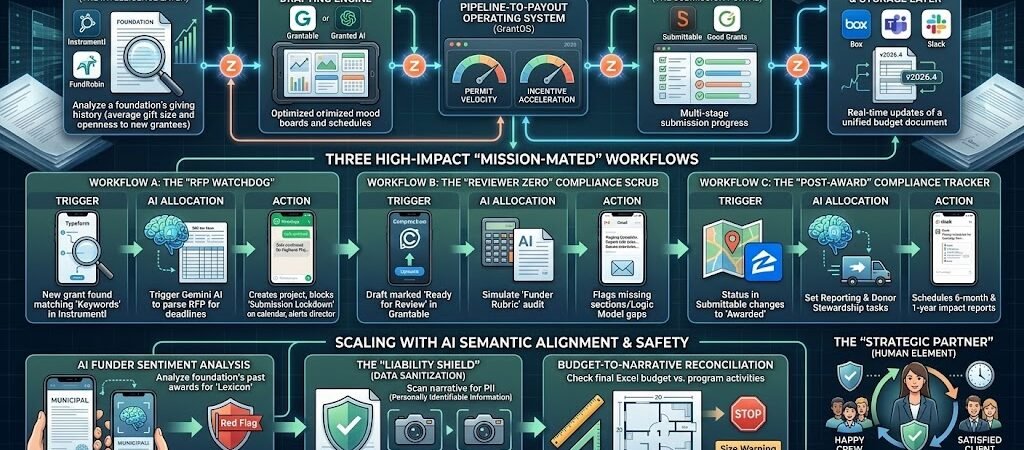
Three High-Impact “Mission-Mated” Workflows
These workflows act as a 24/7 “Chief of Staff” for your grant department, handling the complex data-syncing between funders, program directors, and financial audits.
Workflow A: The “RFP Watchdog”
The Goal: Rapid response to new opportunities.
- Trigger: A new grant matching your organization’s “Impact Keywords” is identified in Instrumentl.
- The Logic: Zapier filters the opportunity against your “Minimum Award” and “Geographic Area” requirements.
- Action: 1. Creates a project folder in Google Drive. 2. Sets up a Trello board with “Milestone Deadlines” (e.g., 7 days for LOI, 21 days for Board Review). 3. Sends a Slack notification to the Executive Director.
- The Result: You begin the “Go/No-Go” decision process within minutes of a grant being posted, not days.
Workflow B: The “Reviewer Zero” Compliance Scrub
The Goal: Beat the AI-automated rejection bots.
- Trigger: A draft is marked as “Ready for Review” in Grantable or Notion.
- The Logic: Zapier sends the draft and the funder’s RFP to Gemini AI to simulate a “Reviewer Zero” audit.
- Action: The AI flags any missing attachments (e.g., IRS Determination Letter), checks character counts, and identifies any “Logic Model” gaps.
- The Result: You catch 100% of formatting and compliance errors before the human reviewer ever sees them, maintaining your organization’s “Good Standing” status.
Workflow C: The “Post-Award” Compliance Tracker
The Goal: Secure future funding through impeccable reporting.
- Trigger: Application status changes to “Awarded” in your CRM (Salesforce or Submittable).
- The Logic: Zapier extracts the “Reporting Requirements” mentioned in the award letter.
- Action: 1. Auto-populates your Google Calendar with 6-month and 1-year impact report deadlines. 2. Sends a “Donation Thank You” task to the Board Chair. 3. Triggers an automated “Kickoff Meeting” invite to the Program Finance team.
- The Result: You eliminate the risk of “clawbacks” and ensure the funder sees you as a reliable, high-integrity partner for future cycles.
Scaling with AI Semantic Alignment & Safety
Funder priorities shift rapidly. A foundation that focused on “Access” in 2025 might pivot to “Sustainability” or “Systemic Change” in 2026. To scale, you must use Zapier and Gemini AI to perform deep-tissue analysis on funder behavior, ensuring your narrative isn’t just “good”—it’s “aligned.”
1. AI Funder Sentiment Analysis (The “Lexicon” Match)
Every foundation has a unique “vocabulary.” Some prefer data-heavy, quantitative evidence; others are moved by qualitative, community-led storytelling.
- The Workflow: When a grant is moved to the “Feasibility” stage, Zapier pulls the last three years of the foundation’s awarded grants and their latest annual report.
- The Intelligence: Gemini AI scans these documents to identify the foundation’s “lexicon.” It flags recurring themes (e.g., “Trauma-Informed,” “Scalability,” “Equity-Centered”).
- The Action: Zapier pre-fills a “Tone & Voice Guide” for the writer, suggesting specific keywords and thematic angles that have historically led to approvals.
2. The “Liability Shield” (Automated Data Sanitization)
In the 2026 regulatory environment, including Unprotected Beneficiary Data (UBD) in a public or state-facing grant is a massive liability.
- The Workflow: Before a draft is exported for submission, Zapier triggers a “PII (Personally Identifiable Information) Scrub.”
- The Detection: AI scans the narrative and attachments for names, addresses, or sensitive health data that should remain anonymous.
- The Result: It flags the section for the writer to “anonymize” or “aggregate,” protecting your organization from data breaches and compliance failures.
3. Budget-to-Narrative Reconciliation
The #1 reason for grant rejection in 2026 is a “Narrative-Budget Mismatch”—where the story promises things the spreadsheet doesn’t fund.
- The Trigger: A final Excel/Google Sheet budget is uploaded to the project folder.
- The Logic: AI compares the budget line items (e.g., “Community Outreach Coordinator”) against the “Program Activities” section of the narrative.
- The Value: If the narrative mentions a “Summer Youth Camp” but the budget shows zero spend for “Food” or “Transportation,” Zapier sends an urgent Slack alert to the team.
The “Precision & Protection” Metric Table
| Category | 2026 Tech Integration | The Business Value |
| Sentiment Analysis | Gemini AI + 990 Data | Increases “Win Rate” by aligning tone with funder history. |
| Data Privacy | NLP PII-Scrubber | Prevents legal liability and beneficiary data exposure. |
| Budget Audit | Excel + AI Reconciliation | Eliminates “Narrative Mismatch” rejections. |
| Impact Benchmarking | Zapier Tables + Historical Data | Auto-calculates “Cost Per Beneficiary” for funder ROI. |
The 2026 Edge: In the past, matching a funder’s “vibe” was an art form. In 2026, your Semantic Alignment Zap makes it a science. You aren’t just guessing what the reviewer wants to hear; you are speaking their language with mathematical accuracy.
The “Strategic Partner” (The Human Element)
The most common fear in the 2026 philanthropic sector is that AI will turn grant-seeking into a “bot-vs-bot” numbers game. In reality, Zapier for Grant Writers does the opposite: it handles the “bureaucracy of benevolence” so you can focus on the Human Nuance that no algorithm can replicate.
1. Relationship Management over Paperwork
Grant reviewers are humans looking for partners they can trust. In 2026, the most successful grant writers spend 70% of their time on external engagement and only 30% on the keyboard.
- The Strategy: While Zapier handles the “Deadline Nudges” and “Compliance Scrubs,” you use your reclaimed time to pick up the phone and speak with Program Officers.
- The Connection: You aren’t just submitting an application; you are building a multi-year partnership. Using automation to track a funder’s “Life Milestones” (e.g., a foundation’s 50th anniversary) allows you to send personalized, non-transactional notes that build social capital.
2. Ethical Storytelling and “Lived Experience”
In 2026, funders are increasingly wary of “Poverty Tourism” in grant narratives. They want stories that are authentic and community-led.
- The Opportunity: Use automation to facilitate Participatory Grantmaking.
- The Workflow: Use Zapier to send automated surveys to your program beneficiaries.
- The Human Win: You pull raw, real-time quotes and qualitative data directly into your proposals. This ensures the voice of the community—not just the voice of the writer—is at the center of the narrative.
3. The “Impact Translator”
A grant writer’s true value in 2026 is their ability to translate complex program data into a Vision of the Future.
- The Transition: Move beyond “Activities” (what we did) to “Outcomes” (how the world changed).
- The Action: Use Zapier to pull data from your program’s internal CRM and feed it into a Canva template.
- The Result: You present the funder with a “Visual Impact Dashboard” rather than just a wall of text. You show them exactly how their $100k investment moved the needle on a specific social problem.
Implementation Guide—The 90-Day “Pipeline-to-Payout” Roadmap
The goal is to eliminate “Deadline Panic” in month one, automate “Technical Accuracy” in month two, and achieve “Reporting Excellence” by day 90.
Phase 1: The “Prospecting & Pulse” Foundation (Days 1–30)
- The Goal: Centralize all opportunities and automate the “Go/No-Go” alert system.
- The Tech: Connect Instrumentl (or FundRobin) to Google Calendar and Slack.
- The Action: Set up a Zap that triggers when a grant matching your “Core Mission Keywords” is found. It must automatically block out the final 48 hours before the deadline on the team calendar as “Locked for Submission.”
- The Result: No more “surprise” RFPs discovered three days before they are due. Your team has a 30-day lead on every high-probability opportunity.
Phase 2: The “Compliance & Draft” Protocol (Days 31–60)
- The Goal: Automate the “Reviewer Zero” audit to ensure 100% technical accuracy.
- The Tech: Integrate Grantable (or Gemini AI) with Google Drive.
- The Action: Create a “Compliance Zap” that triggers when a draft reaches 80% completion. It scans the narrative against the RFP’s “Scoring Rubric” and flags any missing mandatory attachments or character count violations.
- The Result: Your “Win Rate” increases because your proposals are never disqualified for technicalities, and your writers spend 50% less time on manual formatting.
Phase 3: The “Post-Award Excellence” Loop (Days 61–90)
- The Goal: Automate stewardship and reporting to secure “Lifetime Funding.”
- The Tech: Submittable or Salesforce connected to Zapier Tables.
- The Action: 1. Set up the “Award Trigger” that automatically schedules 6-month and 12-month Impact Reports. 2. Implement the “Impact Dashboard” Zap—pulling live program data from your CRM into a pre-formatted report for the funder.
- The Result: Funders view you as their most professional and transparent partner, making “Renewals” a streamlined formality rather than a fresh battle.
Conclusion: Funding the Future with Precision
In 2026, the most successful grant writers are Mission-Driven Systems Thinkers. By leveraging Zapier for Grant Writers, you transform a high-stress administrative burden into a high-velocity Impact Engine. You stop “writing for money” and start architecting social change.
Stop fighting deadlines and start automating your funding pipeline. Build your first “RFP Watchdog” Zap today.

About the Author
Aapt DubeyAapt Dubey is an automation specialist and software developer dedicated to eliminating manual workflows for small businesses. With deep, hands-on experience building complex Zapier integrations, API connections, and real-world applications, Aapt writes actionable, tested tutorials to help businesses scale efficiently.