
Key Takeaways: Zapier for E-commerce Sellers
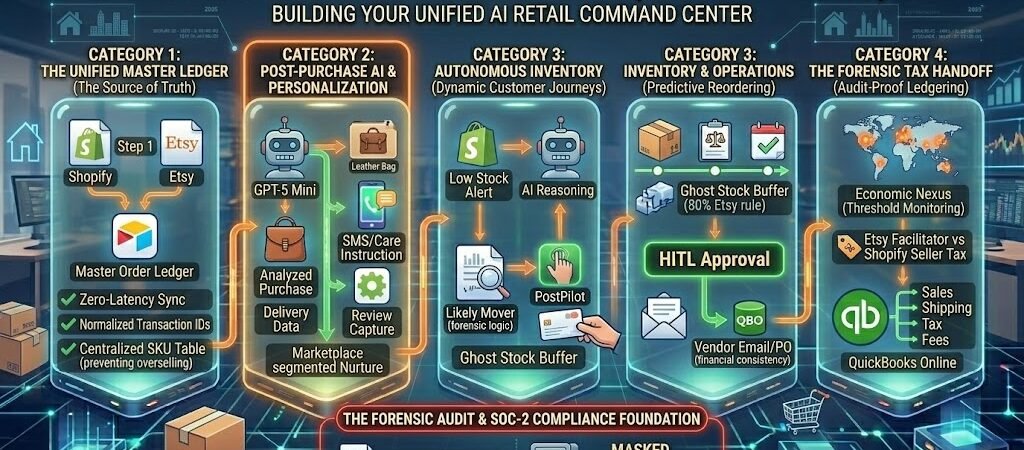
- The Multi-Channel “Source of Truth”: In 2026, trying to manage separate customer lists for Shopify and Etsy is a death sentence. Zapier must be used to sync all orders, customers, and inventory into a single “Master Ledger” (e.g., Airtable or a centralized CRM).
- Hyper-Personalized Post-Purchase AI: The 2026 standard isn’t just a “Thank You” email. Zapier uses AI (GPT-5 Mini) to analyze the specific items purchased and generates custom cross-sell recommendations or care instructions sent via SMS within 30 minutes.
- Autonomous Inventory Reordering: Don’t just get an alert when stock is low. Set up Zaps that detect a “Low Stock” threshold in Shopify and automatically draft a Purchase Order (PO) to your manufacturer or update your Etsy quantities to prevent overselling.
- The “Forensic” Tax Handoff: 2026 multi-state tax compliance is brutal. Zapier is essential for moving transaction data (line-item sales, shipping costs, and collected tax) from both Shopify and Etsy into QuickBooks Online with distinct tags, creating an audit-proof ledger for services like TaxJar.
- The “Marketplace vs. Direct” Strategy: Automated workflows reinforce the 2026 strategy: Use Etsy as a “Discovery Engine” and Shopify as your “LTV (Lifetime Value) Engine,” automatically moving Etsy buyers into your main email nurture sequence (where compliant).
Introduction: The Multi-Channel Battlefield of 2026
The e-commerce landscape in 2026 has entered a state of “Structural Reckoning.” For US small businesses, the days of succeeding on a single storefront are effectively over. High-performing sellers have pivoted to a hybrid “Shopify + Etsy” model—leveraging Etsy’s 454 million monthly visitors as a discovery engine while using Shopify as their primary high-margin “Brand Home.”
The “Data Fragmentation” Tax
As you expand across channels, you encounter the 2026 Data Fragmentation Tax. Managing Shopify and Etsy in isolation creates operational silos where inventory mismatches, conflicting customer records, and inconsistent tax reporting begin to erode your margins. In this high-velocity environment, “Data Velocity” (the speed at which information moves between your apps) has become a primary revenue lever. If your Etsy sale doesn’t update your Shopify inventory within seconds, you aren’t just disorganized—you’re at risk of overselling and marketplace penalties.
The 25-Hour “Recovery Act”
Automation is no longer an optional “upgrade”; it is the only way for a modern seller to remain competitive as Customer Acquisition Costs (CAC) continue to climb. By 2026, the shift from manual “CSV-export” workflows to Autonomous Orchestration allows the average multi-channel seller to recover 25 hours per week. This reclaimed time is being redirected into “Agentic Operations”—using AI to optimize supply chains and personalize customer journeys at a scale that was physically impossible just two years ago.
The 2026 Forensic Rule: “System of Record”
To survive a 2026 audit or a platform algorithm shift, your business must have a Single Source of Truth. You are no longer just a “Seller”; you are a Data Governor. Every order, regardless of its origin, must flow into a unified ledger that normalizes messy marketplace data into a clean, forensic-grade record.
Omnichannel Operations: Whether you sell on Shopify, Etsy, or Amazon, you can use Zapier’s e-commerce hub to centralize your order management and inventory syncing.
Category 1: The Unified “Master Ledger” (The Source of Truth)
In 2026, the most dangerous way to run an e-commerce business is to treat Shopify and Etsy as two separate islands. To scale without chaos, you must implement a Master Ledger—a centralized database (typically Airtable or a high-performance CRM) that acts as the “Command Center” for every transaction, customer, and SKU in your ecosystem.
1. The “Zero-Latency” Order Sync
In the 2026 framework, you don’t wait for a daily sync. You need “Zero-Latency” data movement to ensure your customer service and fulfillment teams are never working with stale information.
- The Multi-Channel Trigger: Zapier monitors both your Shopify “New Order” and Etsy “New Receipt” webhooks.
- The Normalization Engine (Forensic Hygiene): This is the most critical step. Etsy and Shopify provide data in different formats (e.g., Etsy uses
receipt_idwhile Shopify usesorder_number).- The Zapier Action: Using Formatter by Zapier, the Zap strips away the platform-specific formatting and populates a unified Master Ledger with a standardized “System Transaction ID.”
- The Result: One single view where a “Shopify VIP” and an “Etsy One-Timer” are treated with the same data integrity.
2. The Global Inventory Sync (The “Anti-Oversell” Shield)
Overselling is the fastest way to get your Etsy shop “de-indexed” or suspended in 2026. If you have 5 handmade items left and you sell 3 on Shopify, your Etsy shop must reflect a quantity of 2 within seconds.
- The Logic: 1. Trigger: “New Order” in Shopify. 2. Action (Find Record): Zapier searches your Master SKU Table to find the corresponding Etsy
Listing_ID. 3. Action (Math): A built-in Lead-Time Logic step calculates the remaining stock across all channels. 4. Action (Update): Zapier instantly pushes the new quantity to Etsy. - Forensic Guardrail: If inventory hits zero, Zapier sends an “Emergency Stockout” alert to Slack so you can pause ad spend on both platforms simultaneously.
3. Building the “Customer 360” Profile
The 2026 goal is to move every Etsy “borrowed” customer into your “owned” Shopify ecosystem.
- The Handoff: When an Etsy order is completed, Zapier checks if that email address already exists in your Shopify Customer List.
- The Logic Gate: * If New: Create a Shopify customer profile tagged with “Source: Etsy” and “Lead Origin: 2026-Farming.”
- If Existing: Update their Total Lifetime Value (LTV) across both platforms.
- The Benefit: You can now trigger a “Thank You” email from Shopify (where permitted by TOS/privacy settings) that recognizes their past Etsy loyalty, effectively bridging the gap between marketplace discovery and brand retention.
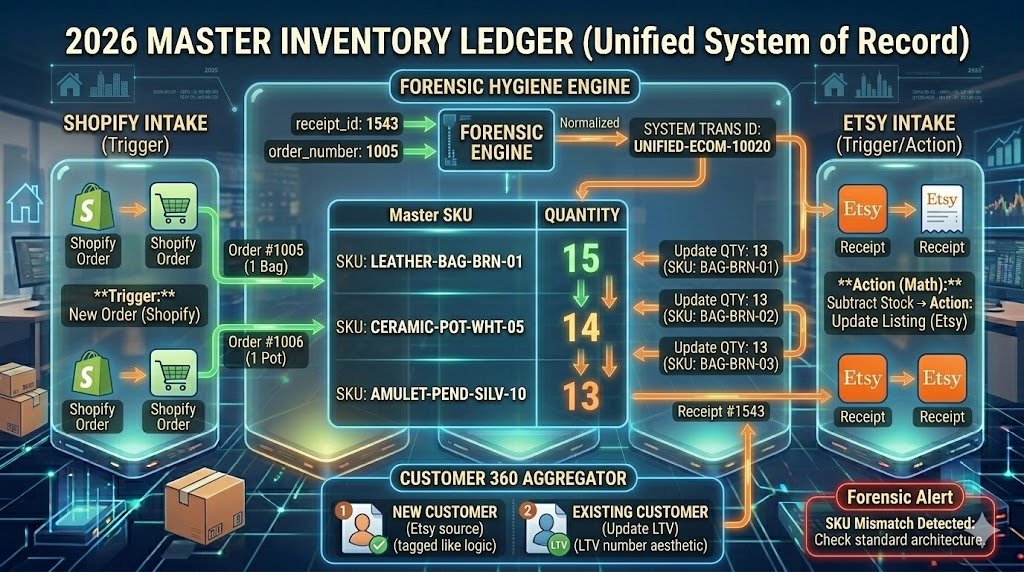
The 2026 Forensic Rule: Never use a SKU that isn’t identical across both platforms. If your Shopify SKU is BAG-BLUE-01 and your Etsy SKU is Blue_Leather_Bag, your Zaps will fail. Standardize your SKU architecture before you automate.
Category 2: Post-Purchase AI & Hyper-Personalization
In 2026, the competitive advantage in e-commerce has shifted from “the product you sell” to “the experience you orchestrate.” Basic automated emails are now filtered into “Promotions” by sophisticated AI inboxes. To stand out, US sellers are using Agentic Workflows—Zaps that use AI to reason through order data and deliver value that feels human.
1. The “AI Concierge” Review & Care Flow
The “30-Minute Standard” is the 2026 benchmark. Within half an hour of an order, your customer should receive a message that proves you know exactly what they bought and why it matters.
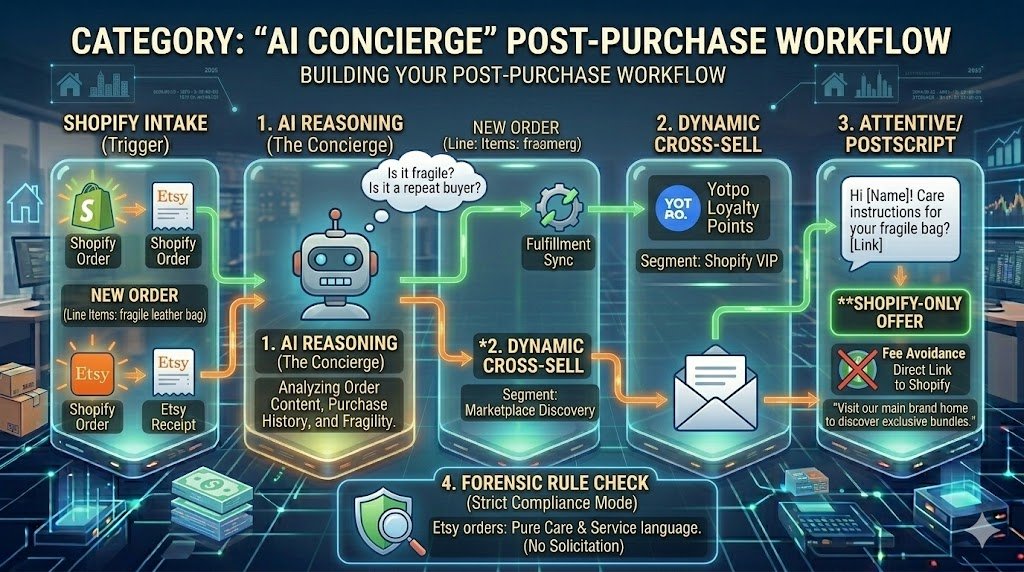
- The Workflow: 1. Trigger: New Order (Shopify or Etsy). 2. Action (AI Reasoning – GPT-5 Mini): Zapier sends the line items to AI. * The Prompt: “Analyze this order for [Product Name]. If it’s a fragile item, draft a care instruction text. If it’s a repeat purchase, draft a ‘Welcome Back’ message. Mention the specific benefit of [Product Characteristic].” 3. Action (SMS Delivery): The personalized message is sent via Attentive or Postscript.
- The Forensic Benefit: Because the AI “reads” the order, it won’t send a “First-Time Buyer” coupon to someone who has purchased from you five times. It maintains the “Single Source of Truth” integrity.
2. Autonomous “Trust Loops” (Review Capture)
Reviews are the lifeblood of Etsy search rankings and Shopify conversion rates. In 2026, we don’t just “ask” for reviews; we time them based on Actual Delivery Data.
- The “Delivery-First” Logic:
- Trigger: Shipment Status = “Delivered” in ShipStation or AfterShip.
- Delay Step: Zapier waits exactly 4 days (the “Excitement Window”).
- Action (AI Personalization): AI drafts a review request: “Hi [Name], your [Product] arrived on Tuesday. We’d love to see a photo of it in your home!”
- The Result: Higher conversion on review requests because you aren’t asking for feedback before the package has even left the warehouse.
3. Dynamic Cross-Selling (Marketplace vs. Direct)
A key 2026 strategy is using Etsy as a “Discovery Engine” and moving those buyers to Shopify for their second purchase to avoid marketplace fees.
- The Marketplace Handoff Zap:
- If Order = Etsy: Trigger a post-purchase email featuring a “Shopify-Only” exclusive bundle.
- If Order = Shopify: Trigger a “Loyalty Points” update via Yotpo or Smile.io.
- The Goal: Automatically segmenting your marketing spend based on the customer’s acquisition cost and channel preference.
The 2026 Forensic Rule: Ensure your AI prompts include “Strict Compliance Mode.” For Etsy orders, the AI must avoid any language that violates Etsy’s “Fee Avoidance” or “Solicitation” policies, focusing purely on customer service and product care to keep your shop in good standing.
Category 3: Autonomous Inventory & Operations
By 2026, the most successful US e-commerce sellers have moved beyond “Stock Alerts” and into Autonomous Procurement. In this section, we explore how Zapier acts as your Chief Operations Officer, managing the delicate balance between Shopify sales velocity and Etsy marketplace availability while ensuring your supply chain never hits a bottleneck.
1. The “Predictive Reorder” Zap (AI-Powered Procurement)
We discussed the “Task Trap,” but in supply chain, the “Stockout Trap” is far more expensive. In 2026, Zapier doesn’t just tell you that you’re low on stock; it prepares the solution.
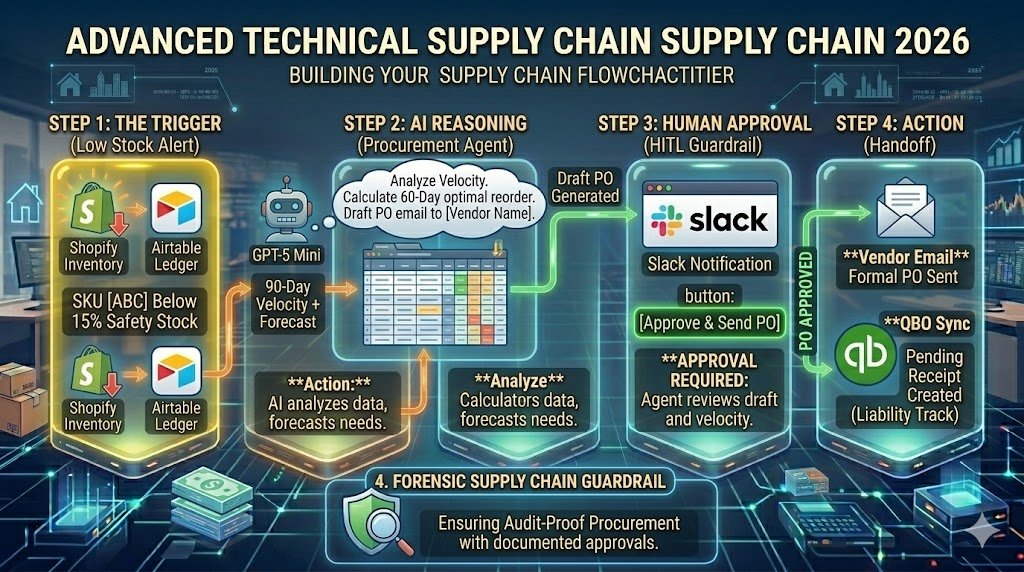
- Step 1: The Trigger (Low Stock Threshold): Shopify Flow or your Master Ledger (Airtable) detects a SKU has dropped below 15% of its safety stock.
- Step 2: The Action (AI Reasoning – GPT-5): Zapier sends the last 90 days of sales data from both Shopify and Etsy to OpenAI.
- The Prompt: “Analyze the sales velocity for SKU [ABC]. Considering a 14-day lead time from our manufacturer, calculate the optimal reorder quantity to last 60 days. Draft a formal Purchase Order email to [Vendor Name].”
- Step 3: The Approval Step (HITL): This is your safeguard. Zapier sends a Slack notification with a button:
[Approve & Send PO]. - Step 4: The Action (Email/ERP Sync): Once you click approve, Zapier emails the PO to your vendor and creates a “Pending Receipt” entry in QuickBooks Online to track the outgoing liability.
2. Autonomous Listing Distribution (The “Drafting” Engine)
Launching a product in 2026 shouldn’t require manual copy-pasting between Shopify and Etsy.
- The Workflow: Creating a “Draft Product” in Shopify triggers a Zap.
- The AI Transformation: Zapier uses AI to rewrite the description specifically for the Etsy audience (focusing on “Handmade,” “Unique,” or “Custom” keywords) and formats the technical specs to match Etsy’s attribute fields.
- The Result: You open your Etsy dashboard to find a 90% complete draft waiting for you—preserving your “Forensic” SKU consistency across platforms from Day 1.
3. “Ghost Stock” Prevention (Marketplace Buffers)
A key 2026 tactic for high-volume sellers is the “Marketplace Buffer.” You never want Etsy to show your entireinventory because a sudden Shopify “TikTok Viral” moment could wipe out your stock before Etsy can sync.
- The Buffer Logic:
- Trigger: Inventory update in Shopify.
- Action (Math): Zapier calculates
Total_Inventory * 0.8. - Action (Update): Zapier pushes only 80% of the stock to Etsy.
- The Forensic Advantage: This 20% “Ghost Stock” acts as a buffer, ensuring you always have a few units left for your high-margin Shopify customers even if Etsy sales spike unexpectedly.
The 2026 Forensic Rule: Use Zapier Tables to store your “Vendor Lead Times.” By keeping this data in a table that your Zaps can read, your AI-generated POs will always account for the most current shipping delays or manufacturer holidays, preventing “Just-in-Time” disasters.
Category 4: The “Forensic” Tax Handoff (Auditing 101)
In 2026, multi-state sales tax compliance has moved from a “yearly headache” to a “real-time liability.” With states like Illinois removing transaction thresholds in favor of pure revenue markers ($100,000) and others like California maintaining high $500,000 limits, US sellers must track their “Economic Nexus” with forensic precision. The “Forensic Handoff” ensures that your accounting isn’t just a guess—it’s an audit-proof record.
1. The QuickBooks Online “Normalizer”
The primary challenge for Shopify + Etsy sellers is data inconsistency. Etsy reports sales gross of fees, while Shopify typically reports net. If you push this raw data into QuickBooks, your “Sales” and “Marketplace Fees” will be a tangled mess, triggering red flags in a 2026 audit.
- The Forensic Zap:
- Trigger: New Order (Shopify or Etsy).
- Action (Formatter – Math): Zapier performs a “Normalization” calculation. It extracts the Gross Sale, subtracts the Shipping Revenue, isolates the Collected Sales Tax, and identifies the Marketplace Fee(using Etsy’s API for accuracy).
- Action (QuickBooks Online): Zapier creates a Sales Receipt with four distinct line items.
- The Benefit: Your profit-and-loss (P&L) statement now shows exactly how much you paid in Etsy fees versus Shopify processing, tagged by source.
2. The “Nexus Guardrail” (Threshold Monitoring)
You are only required to collect tax in states where you have Nexus. In 2026, Zapier acts as your early-warning system to prevent you from collecting tax illegally (without a permit) or failing to collect it once you hit a limit.
- The Nexus Tracker Zap:
- Trigger: New Order.
- Action (Airtable/Google Sheets): Zapier adds the order value to a “State-by-State Ledger.”
- Action (Logic Check): A Filter checks if the total for a state (e.g., Texas) is approaching the threshold (e.g., $450,000 of the $500,000 limit).
- Alert: Zapier sends a Slack alert: “CRITICAL: You are at 90% of the Texas Nexus threshold. Time to register for a permit.”
3. Marketplace Facilitator Reconciliation
Etsy collects and remits sales tax for you in most states, but you are still responsible for reporting those “Exempt” sales. Shopify, however, leaves the remittance to you.
- The “Tax Handoff” Strategy:
- Etsy Orders: Zapier tags these in QuickBooks as “Marketplace Facilitator Remitted.” This tells your accountant you don’t owe the state that money—it’s already been paid.
- Shopify Orders: Zapier tags these as “Seller-to-Remit.” This ensures the funds are set aside in your “Sales Tax Payable” account.
- The Forensic Advantage: When it’s time to file, you have a clean report showing exactly which platform took care of the tax and which one didn’t.
The 2026 Forensic Rule: Never collect sales tax in a new state without a valid permit number. Use a Zap to check your Permit Table before adding tax to a manual invoice. In 2026, “unauthorized collection” is a fast track to a state revenue department investigation.

Don’t build from scratch. You can skip the setup time for your online store by using our pre-built blueprints. We’ve compiled the ready-to-use Zapier templates specifically designed for US e-commerce sellers and small businesses.
Conclusion: The “Orchestrated” Seller of 2026
The era of the “hustling solopreneur” has reached its natural conclusion. In 2026, sheer effort is no longer a match for the sheer volume of data generated by a multi-channel business. To survive, the modern US e-commerce merchant must evolve from a manual laborer of their own brand into an Operations Orchestrator.
Being an orchestrator means you no longer spend your mornings syncing inventory or your evenings reconciling tax spreadsheets. Instead, you design systems that perform these tasks with a degree of precision and “forensic hygiene” that manual effort can never replicate. By deploying these Zapier workflows, you effectively bridge the gap between a boutique operation and a major national retailer.
Automation grants you the speed of an enterprise-level fulfillment center, the personalization of a dedicated concierge service, and the operational compliance of a corporate accounting firm. In 2026, your competitive moat is no longer just your product—it is the digital architecture that supports it. By automating the mundane, you reclaim the creative and strategic bandwidth necessary to build a brand that doesn’t just sell, but thrives in the automated age.

About the Author
Aapt DubeyAapt Dubey is an automation specialist and software developer dedicated to eliminating manual workflows for small businesses. With deep, hands-on experience building complex Zapier integrations, API connections, and real-world applications, Aapt writes actionable, tested tutorials to help businesses scale efficiently.