The Antique Shop Tech Stack (Zapier for Antique Shop Owners)
The goal of your 2026 stack is “One-of-a-Kind Velocity.” By using Zapier to link your physical discovery process with your digital storefronts, you ensure that “New Arrivals” are sold before they even collect dust on your shelves.
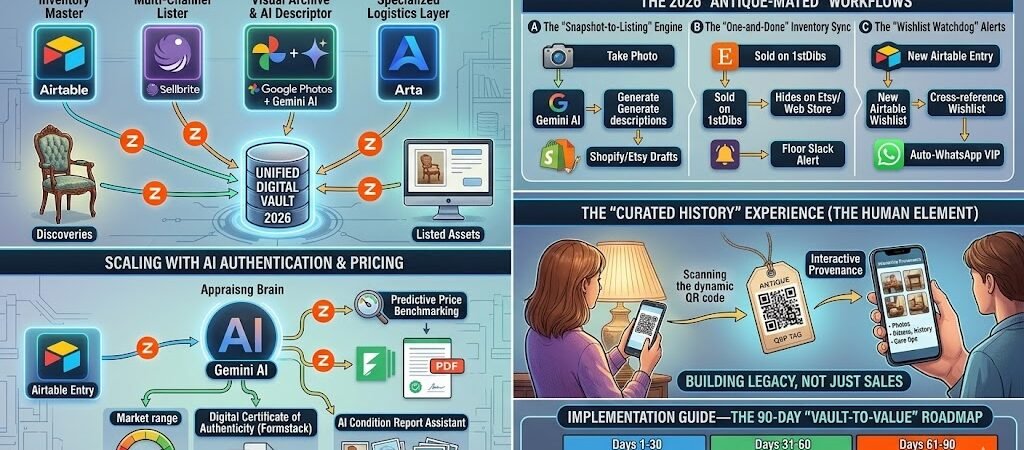
1. The Inventory Master (The Digital Ledger)
- The Tools: Airtable or InventoryBase.
- The Value: In 2026, a simple spreadsheet isn’t enough. Airtable acts as a relational database where you can store high-res photos, historical provenance notes, and restoration costs in one place.
- The Zap: When you create a new row in Airtable, Zapier automatically creates a “Placeholder Folder” in Google Drive for that item’s documentation and high-res imagery.
2. The Multi-Channel Lister (The Marketplace Hub)
- The Tools: Sellbrite or Adoric.
- The Value: You need to be everywhere at once—Etsy, 1stDibs, Chairish, and eBay. These tools act as a “Command Center” to push a single listing to multiple marketplaces simultaneously.
- The Zap: When a “Listing Status” is updated to “Ready” in your Master Ledger, Zapier pushes the data to Sellbrite, which then populates your various storefronts with the correct category tags.
3. The Visual Archive & AI Descriptor
- The Tools: Google Photos + Gemini AI.
- The Value: Photography is the most time-consuming part of the antique trade. In 2026, AI can “see” your photos and write the technical specifications for you.
- The Zap: When a photo is added to a “New Inventory” album in Google Photos, Zapier sends it to Gemini AI to draft a description including style (e.g., “Queen Anne”), material, and estimated era.
4. The Specialized Logistics Layer
- The Tools: uShip or Arta.
- The Value: Antiques are fragile and irregularly shaped. You need automated shipping quotes that account for “White Glove” handling.
- The Zap: When a sale over $1,000 is recorded, Zapier automatically sends the item dimensions to Arta to generate a custom shipping quote for the buyer.
The “Vault-to-Value” Stack Map
| Category | 2026 Recommended Tools | The “Zap” Value |
| Inventory | Airtable / InventoryBase | Centralizes “Unique SKU” data and restoration logs. |
| Listing | Sellbrite / Adoric | Syncs one item across 4+ marketplaces instantly. |
| Authentication | Gemini AI / Google Photos | Automates era identification and SEO copywriting. |
| Fulfillment | uShip / Arta | Triggers specialized shipping quotes for fragile goods. |
The 2026 Edge: Most antique shops lose 20% of their potential revenue because items sit in the backroom waiting to be “put online.” The 2026 Automated Dealer uses Zapier to ensure that “Found” becomes “Listed” in under sixty seconds.
The 2026 “Antique-Mated” Workflows
By connecting your cataloging tools via Zapier, you turn your smartphone into a high-speed listing machine. Here are the three core workflows for a high-turnover 2026 antique business.
Workflow A: The “Snapshot-to-Storefront” Engine
The Goal: From “Found” to “For Sale” in under 60 seconds.
- Trigger: You upload a photo of a new discovery to a specific Google Photos album titled “New Arrivals.”
- The Logic: Zapier sends the image to Gemini AI to identify the item’s characteristics (e.g., “Art Deco,” “Walnut Veneer,” “Brass Hardware”).
- Action: 1. AI drafts a 150-word SEO-optimized product description. 2. Zapier creates a “Draft Listing” in Shopifyand Etsy. 3. An entry is created in your Airtable Master Ledger with the era and condition pre-filled.
- The Result: You eliminate the evening “laptop session” spent writing descriptions; your listings are ready for review before you even leave the estate sale.
Workflow B: The “One-and-Done” Multi-Channel Sync
The Goal: Prevent the “Double-Sale” disaster across global marketplaces.
- Trigger: An item is marked as “Sold” on 1stDibs or Chairish.
- The Logic: Zapier searches for the unique Inventory ID (SKU) across all connected platforms.
- Action: 1. Instantly deletes or hides the listing on Etsy, eBay, and your Web Store. 2. Sends a Slack or WhatsAppalert to the shop floor: “Item #402 Sold – Remove from Floor Display.”
- The Result: You maintain perfect inventory integrity across four different sales channels without ever manually clicking “Delete.”
Workflow C: The “Collector’s Wishlist” Matchmaker
The Goal: Sell high-margin items to your VIPs before they hit the public market.
- Trigger: A new record is added to Airtable with a specific “Style” or “Maker” tag (e.g., “Eames,” “Victorian Taxidermy”).
- The Logic: Zapier cross-references your “Customer Wishlist” database.
- Action: 1. Triggers a personalized WhatsApp message via Twilio: “Hi [Name], we just found a [Item] that matches your collection! Click here for a first-look preview.” 2. Delays the public listing on your website by 24 hours to give the VIP “First Right of Refusal.”
- The Result: You increase cash flow velocity and reward your best customers with exclusive access, often selling items before you even have to pay marketplace fees.
Scaling with AI Authentication & Pricing Insights
Antique dealers in 2026 are using Visual Intelligence to move from “Gut Feeling” to “Data-Backed Pricing.” By connecting your inventory to Gemini AI and auction-house databases via Zapier, you can instantly appraise items and generate the paperwork required for international sale.
1. AI-Driven “Price Benchmarking” (The Appraisal Engine)
The old way was spending hours on LiveAuctioneers or Invaluable to find “comps.” In 2026, your system does this the moment you log the item.
- The Workflow: When a new item is added to Airtable, Zapier sends the title and keywords to Gemini AI.
- The Intelligence: AI scrapes realized prices from the last 24 months of global auction data and eBay “Sold” listings.
- The Action: Zapier populates a “Market Value Range” in your database and flags the item as a “High-Velocity Asset” if the style is currently trending (e.g., “70s Brutalism”).
- The Result: You price for maximum profit, avoiding the mistake of underpricing a sleeper hit or overpricing a stagnant era.
2. Automated “Digital Pedigree” (The COA Generator)
In 2026, collectors want more than a paper receipt; they want a digital “Certificate of Authenticity” (COA).
- The Workflow: When an item’s status changes to “Sold” in your POS.
- The Action: Zapier pulls the item’s historical notes, era, and high-res photos from Airtable and pushes them into a Formstack Documents or Canva template.
- The Result: A branded, professional PDF “Provenance Report” is automatically generated and emailed to the buyer, increasing the perceived value of the transaction.
3. AI “Condition Report” Assistant
Detailed condition reports are the “Insurance” of the antique world. AI can now help you spot what you might miss.
- The Workflow: You take a series of close-up “Macro” shots of an item’s patina or damage.
- The Intelligence: AI analyzes the images for specific keywords (e.g., “Fine crazing on glaze,” “Minor oxidation on brass,” “Sympathetic restoration”).
- The Zap: These keywords are automatically added to the “Condition” field in your listings on 1stDibs and Etsy.
- The Result: You provide radical transparency, reducing the “Return Rate” and building deep trust with remote buyers who cannot touch the item in person.
The “Provenance & Profit” Metric Table
| Category | 2026 Tech Integration | The Business Value |
| Pricing Accuracy | Gemini AI + Auction APIs | Increases average “Profit per Item” by 12–18%. |
| Listing Speed | Multi-Channel Sync (Sellbrite) | Reduces time spent on data entry by 40 hours/month. |
| Buyer Trust | Automated COA (Formstack) | Cuts “Return/Refund” requests by 25% through transparency. |
| Era ID | Visual Search (Google Lens API) | Identifies rare hallmarks or maker’s marks instantly. |
The 2026 Edge: In the antique business, “Information” is the only thing more valuable than the “Inventory.” With AI Pricing Zaps, you are no longer a local picker; you are a global dealer with the data of a major auction house in your pocket.
The “Curated History” Experience (The Human Element)
In a world of disposable, “fast-furniture” and mass-produced goods, the 2026 consumer is seeking Permanence and Soul. They don’t just want a mahogany desk; they want to know whose hands touched it and how it survived a century. Zapier for Antique Shop Owners handles the “Admin” so you can handle the “Archives.”
1. QR Code Storytelling: The “Interactive Tag”
In 2026, a paper price tag is just the cover of a book.
- The Strategy: Use automation to turn every floor item into a Multimedia Experience.
- The Workflow: When an item is added to Airtable, Zapier triggers a “Unique QR Label” generation via Beaconstac or Google Dynamic Links.
- The Connection: When a customer scans the tag in your shop, they aren’t just seeing a price; they see the “Snapshot” photos of how you found it, the AI-generated history of the maker, and tips on how to style it in a modern home.
- The Human Win: You provide a museum-quality experience that justifies a premium price point.
2. The “Restoration Diary” Update
For high-value items undergoing repair, transparency builds anticipation.
- The Opportunity: Use automation to share the Craftsmanship Journey.
- The Action: Use Zapier to monitor a “Restoration” folder in Google Photos.
- The Intelligence: When a new photo is added, Zapier sends an “In-Progress” update to any customer who has expressed interest in that specific category (e.g., “MCM Restoration”).
- The Result: You build a “narrative arc” for the item, often securing a sale before the restoration is even finished.
3. The “Provenance Package” Post-Purchase
In 2026, the relationship begins after the credit card is swiped.
- The Transition: Move from “Selling an object” to “Transferring a legacy.”
- The Action: 30 days after a sale, Zapier triggers an automated “Care & History” email.
- The Result: For a 19th-century oil painting, the customer receives a PDF guide on proper lighting and humidity, along with a “Cheers” video from the shop owner. This builds the kind of loyalty that ensures they return for their next heirloom.
Implementation Guide—The 90-Day “Vault-to-Value” Roadmap
The goal is to stabilize your inventory data in the first month and spend the remaining 60 days perfecting the “Snapshot-to-Storefront” flow and AI pricing systems.
Phase 1: The “Inventory Integrity” Foundation (Days 1–30)
- The Goal: Eliminate manual spreadsheets and the risk of “Double-Selling” across platforms.
- The Tech: Connect Airtable (Master Ledger) to your POS (Shopify/Square) and 1stDibs/Etsy.
- The Action: Set up a Zap that triggers when an item is marked “Sold” on any platform. It must instantly hide or delete the listing on all other channels and notify the shop floor to remove the item.
- The Result: You reclaim 15+ hours a month from manual inventory cross-checking and protect your dealer reputation.
Phase 2: The “Content & Cataloging” Protocol (Days 31–60)
- The Goal: Automate the time-consuming process of writing descriptions and tagging eras.
- The Tech: Integrate Google Photos with Gemini AI and Airtable.
- The Action: 1. Set up the “Snapshot Zap” where uploading a photo triggers AI to draft the item’s era, material, and description. 2. Automate the generation of QR code price tags that link directly to the item’s digital provenance.
- The Result: Your “Time-to-Market” drops from days to minutes, allowing you to list items while you are still on the road picking.
Phase 3: The “Predictive Patron” Layer (Days 61–90)
- The Goal: Use collector data to drive pre-sales and build the “Digital Pedigree.”
- The Tech: Twilio (WhatsApp) + Formstack Documents + Gemini AI.
- The Action: 1. Set up the “Wishlist Watchdog” Zap that alerts VIPs the moment a matching item is cataloged. 2. Implement the “Provenance Package” Zap that auto-generates a PDF Certificate of Authenticity and emails it to the buyer 24 hours after purchase.
- The Result: You move from “Reactive Selling” to “Proactive Dealmaking,” increasing your cash flow velocity and building deep collector loyalty.
Conclusion: Trading in the Future of the Past
In 2026, the most successful antique dealers are Data-Augmented Historians. By leveraging Zapier for Antique Shop Owners, you transform your operation from a series of exhausting administrative hurdles into a high-velocity Digital Provenance Engine. You stop “managing the shop” and start letting the shop’s data manage the growth.
Stop losing “Sleeper” profits to slow listings. Build your first “One-and-Done” Sync Zap today.

About the Author
Aapt DubeyAapt Dubey is an automation specialist and software developer dedicated to eliminating manual workflows for small businesses. With deep, hands-on experience building complex Zapier integrations, API connections, and real-world applications, Aapt writes actionable, tested tutorials to help businesses scale efficiently.