
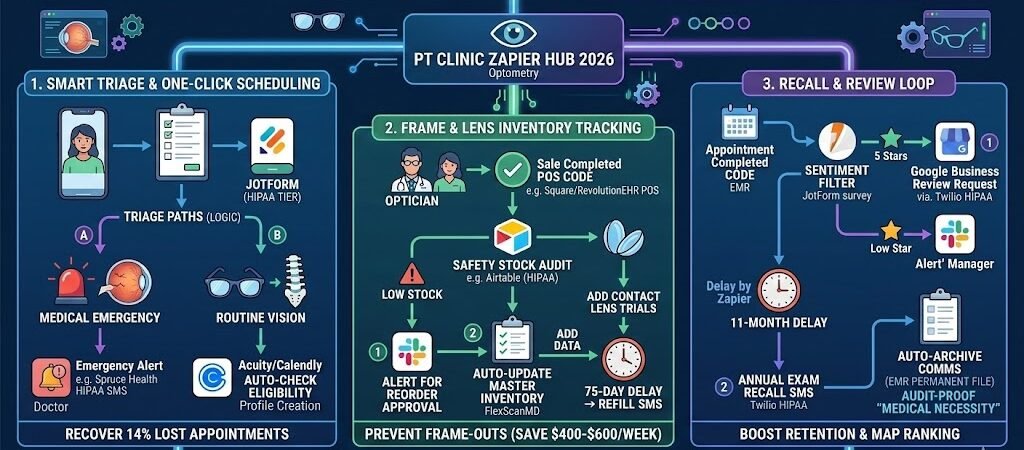
Key Takeaways: Optometrists Zapier Automation
- Triage Automation: Automated intake paths can reduce phone volume by 40% by instantly routing medical emergencies vs. routine eye exams.
- Inventory Intelligence: Real-time sync between POS and inventory management prevents “frame-outs” and reduces carrying costs of slow-moving stock by 15%.
- The 2026 HIPAA Standard: Standard Zapier is strictly for operations; clinical data requires a “Secure Bridge”(like JotForm Enterprise) with a signed BAA.
- Recall Revenue: Automated “Yearly Check-up” nudges increase annual exam retention by 22% compared to manual recall lists.
- ROI Metric: A $50/month Zapier plan can replace approximately $18,000/year in manual data entry and inventory coordination labor.
The “Dual Friction” of 2026 Optometry
By 2026, optometry practices have evolved into high-tech medical hubs, but they face a “Dual Friction” problem: balancing clinical eye care with complex retail frame operations. While diagnostic tools like AI-driven OCT imaging have accelerated exams, the administrative “tail” has grown longer.
The average 2026 practice loses 12+ hours per week to two specific “Data Monsters”:
- The Scheduling Gap: Traditional online booking often fails to distinguish between a 15-minute “Frame Adjustment” and a 60-minute “Comprehensive Medical Exam with Dilation,” leading to daily bottlenecks.
- The Inventory Leak: Manually tracking frames, contact lens trials, and medical supplies across multiple locations often results in “Out of Stock” scenarios for high-margin designer frames or expired diagnostic drops.
The Zapier Solution: Zapier functions as your “Automated Optical Tech.” It builds a bridge between your EMR (RevolutionEHR, Eye Cloud Pro, or Crystal PM) and your inventory and communication tools. In 2026, top-performing practices use these “invisible pipelines” to ensure that the moment a frame is sold or an exam is booked, the data flows exactly where it needs to go—without a human ever touching a keyboard.
The 2026 HIPAA & Optical Security Protocol
In 2026, the Office for Civil Rights (OCR) views an optometrist’s office as a “Data-Rich Environment.” Your records contain a highly sensitive mix of medical diagnoses (e.g., Glaucoma, Diabetic Retinopathy) and retail financial data. Because you are a “Covered Entity,” your automation strategy must prioritize the 2026 HIPAA Security Rule and the HITECH Act benchmarks.
The golden rule for 2026 optometry automation is simple: Standard Zapier is for operational data (staff shifts, frame counts); clinical data requires a “Secure Bridge.”
1. The “Secure Bridge” Strategy
To automate safely, you must utilize intermediaries that provide a Business Associate Agreement (BAA) to act as the vault for your sensitive data.
- The Secure Gateway: Use JotForm Enterprise or Airtable (HIPAA Tier). These platforms encrypt data at rest and in transit, providing the legal and technical shield your practice needs.
- De-identification: Zapier should only handle “Service IDs” or “Record Numbers” rather than full patient names or diagnoses.
- Safe Zap: “Form #1092 submitted” -> Trigger Slack alert for the Optical Tech.
- Unsafe Zap: “Jane Doe scheduled Glaucoma follow-up” -> Send unencrypted email.
2. The 2026 OD Security Checklist
Before connecting your first EMR-based Zap, verify your “Digital Office” meets these 2026 benchmarks:
- MFA Everywhere: Multi-Factor Authentication must be enabled on your RevolutionEHR, Zapier, and your professional email. In 2026, 85% of healthcare breaches are due to compromised passwords.
- The BAA Chain: You must have a signed BAA with every tool in your stack—from your EMR to your Form Provider and your Secure SMS tool (e.g., Twilio HIPAA tier).
- Audit-Ready Logs: Ensure all automated workflows are logged. In 2026, “I didn’t know the tool wasn’t compliant” is no longer a valid defense against federal fines.
3. Comparison: Where Optical Data Lives vs. Where Zaps Live
| Data Category | Storage Location (Vault) | Zapier’s Role (Pipe) |
| Patient Health Records | Encrypted EMR (RevolutionEHR) | Trigger Only (e.g., “Exam Complete”) |
| Financial/Insurance IDs | Stripe / EMR Billing | Action Only (e.g., “Send Invoice”) |
| Frame Inventory | Airtable (HIPAA) / POS | Sync (SKU counts and Reorders) |
| Patient Comms | Twilio (HIPAA) / Spruce | Delivery (No PHI in message body) |
Practical AI Tip for 2026: For multi-location optical groups (3+ locations), we recommend moving toward Keragon. It is a 2026 leader in healthcare-specific automation that signs a BAA for the entire platform, removing the “De-identification” hurdle required by standard Zapier workflows.
Blueprint #1 – Smart Triage & “One-Click” Exam Scheduling
In 2026, patients expect an “Uber-like” booking experience. If a patient with a sudden onset of “flashes and floaters” has to wait on hold for five minutes just to ask for an appointment, they will likely hang up and call the nearest competitor. This blueprint creates an intelligent, automated front desk that prioritizes medical urgency while streamlining routine vision checks.
1. The Trigger: The HIPAA-Gateway Intake
- The 2026 Standard: Use JotForm Enterprise (HIPAA Tier) or HIPAAtizer.
- The Action: A patient clicks “Book Exam” on your website. Instead of a static calendar, they encounter a dynamic intake form that asks about their chief complaint, current symptoms, and insurance provider.
- Pro Tip: In 2026, PlatoForms can now use AI to scan the patient’s uploaded insurance card, automatically extracting the Group and Member ID to reduce manual entry errors by 95%.
2. The Logic: Smart Triage (Paths by Zapier)
Zapier doesn’t just pass the data; it prioritizes it using Paths based on clinical severity:
- Path A (The Medical Emergency): If the patient selects symptoms like “Sudden Vision Loss,” “Eye Trauma,” or “Severe Pain,” Zapier triggers a high-priority alert via Slack or a secure Spruce Health notification to the OD: “URGENT: Potential retinal detachment/emergency patient needs immediate triage.”
- Path B (Specialty Care): If the patient expresses interest in Myopia Management or Dry Eye Therapy, Zapier automatically sends them a specialized educational PDF and a link to a longer “Consultation” time slot.
- Path C (Routine Vision): For a standard “Check-up,” Zapier auto-checks insurance eligibility and pushes the appointment into RevolutionEHR or Eye Cloud Pro.
3. The Action: The “Instant Engagement” SMS
- The Delivery: Via Twilio (HIPAA Tier) or Spruce Health.
- The Message: “Hi [Name], we’ve received your intake! Our team is verifying your benefits now. To speed up your visit, please upload a photo of your current glasses/contacts here: [Secure Link].”
- Why it works: Engaging the patient with a small task “locks them in” mentally to your practice, reducing the likelihood of them shopping around for other providers.
Summary: The Smart Triage Zap
| Step | Component | 2026 Recommended Tool |
| Trigger | Web Intake Submission | JotForm (HIPAA) / HIPAAtizer |
| Logic | Medical vs. Routine Triage | Paths by Zapier |
| Action 1 | Internal Emergency Alert | Slack / Spruce Health |
| Action 2 | Booking & Engagement SMS | Twilio (HIPAA) / Calendly |
| Action 3 | EMR Pre-Registration | RevolutionEHR / Eye Cloud Pro |
Practical AI Tip for 2026: Use Zapier Central to monitor your “Lead-to-Booking” ratio. If a patient starts the intake but doesn’t finish, the AI can detect the abandonment and send a personalized “Need help with your insurance info?” text, recovering an average of 14% of lost appointments.
Blueprint #2 – Automated Frame & Lens Inventory Tracking
In 2026, a “frame-out” (being out of stock on a trending style) is a $400–$600 lost opportunity. Most optical boutiques still rely on manual “cycle counts” or end-of-week inventory audits, which are reactive rather than proactive. This blueprint creates a real-time, “Always-On” inventory sync between your Point of Sale (POS) and your ordering manager.
1. The Trigger: Point-of-Sale (POS) Completion
- The 2026 Standard: Use an EMR-integrated POS like RevolutionEHR, Eye Cloud Pro, or a standalone retail system like Square or Stripe Terminal.
- The Action: An optician completes a sale for a pair of frames and prescription lenses. Zapier monitors the “Transaction Completed” or “New Invoice” trigger.
2. The Logic: Low-Stock Filtration (Filter by Zapier)
Zapier doesn’t just record the sale; it audits your stock levels instantly.
- The Step: Zapier checks the SKU against your master inventory database in Airtable (HIPAA Tier) or FlexScanMD.
- The Logic: If the current quantity for that specific frame brand/model (e.g., Ray-Ban 2140 Black) drops below your “Safety Stock” threshold (usually 2 units), the Zap continues.
3. The Action: The “Just-in-Time” Reorder Nudge
- Action 1 (Internal Alert): Zapier sends an automated notification to your Optician or Office Manager via Slack: “Low Stock Alert: Ray-Ban 2140. Only 1 unit remains. Click here to approve the reorder from the Luxottica portal.”
- Action 2 (Contact Lens Recall): If the sale was for a 90-day supply of contact lenses, Zapier adds a “Delay by Zapier” for 75 days.
- Action 3 (The Refill SMS): 75 days later, the patient receives a text via Twilio (HIPAA): “Hi [Name], your 3-month contact lens supply is running low. Reply ‘YES’ to reorder your [Brand] lenses and we’ll have them ready for pickup!”
Summary: The Inventory & Reorder Zap
| Step | Component | 2026 Recommended Tool |
| Trigger | Sale Completed | Square / RevolutionEHR |
| Logic | Safety Stock Audit | Filter / Airtable (HIPAA) |
| Action 1 | Internal Reorder Alert | Slack / Microsoft Teams |
| Action 2 | Smart Delay (75 Days) | Delay by Zapier |
| Action 3 | CL Refill Reminder | Twilio (HIPAA) / Spruce |
Practical AI Tip for 2026: Use Zapier Central to analyze “Turnover Velocity.” In 2026, the AI can detect if a frame brand hasn’t moved in 90 days and suggest a “Flash Sale” or a return-to-vendor (RTV) to free up capital for better-performing styles.
Blueprint #3 – The “Recall & Review” Loop
The “Annual Eye Exam” is the lifeblood of a sustainable optometry practice. However, most practices lose 20–30% of their patient base every year simply because they rely on the patient to remember their one-year mark. In 2026, manual recall lists are a relic of the past; high-growth clinics use automated loops to maintain a 90%+ retention rate and a dominant 5-star Google Maps ranking.
1. The Trigger: Appointment “Completed” Status
- The Zap: The moment an exam is marked “Completed” in your EMR (RevolutionEHR or Eye Cloud Pro), Zapier initiates two distinct, long-term automation tracks.
- Track 1 (The Review): Immediate feedback collection.
- Track 2 (The Recall): Long-term vision health maintenance.
2. The Logic: Sentiment Filtering (Filter by Zapier)
Before asking for a public review, you want to ensure the patient had a 5-star experience.
- Step 1 (The “How was your visit?” Survey): 2 hours post-exam, Zapier sends a secure link via Twilio (HIPAA)or Spruce Health.
- Step 2 (The Logic): * If 5 Stars: Zapier automatically sends a follow-up text: “We’re so glad you had a great visit! Would you mind sharing your experience on Google? [Review Link].”
- If 3 Stars or Less: Zapier stops the sequence and alerts the Office Manager in Slack: “Patient Feedback Alert: Follow-up required for [Record ID] regarding their recent exam.”
3. The Action: The “11-Month Vision Health” Recall
The most profitable Zap in your practice is the one that fills your 2027 calendar today.
- The Delay: Zapier uses “Delay by Zapier” for exactly 11 months.
- The Delivery: An SMS is sent: “Hi [Name], it’s almost been a year since your last comprehensive eye exam! Annual checks are vital for monitoring eye health. Grab your preferred time for next month here: [Booking Link].”
- The “One-Click” Booking: Because Zapier has the Record ID, the booking link can pre-fill their name and insurance info, reducing booking friction to zero.
Summary: The Recall & Review Zap
| Step | Component | 2026 Recommended Tool |
| Trigger | Appointment Completed | RevolutionEHR / Eye Cloud Pro |
| Logic 1 | 2-Hour Post-Exam Survey | JotForm (HIPAA) / Twilio |
| Logic 2 | 11-Month Smart Delay | Delay by Zapier |
| Action 1 | Automated Google Review | Google Business Profile / Birdeye |
| Action 2 | Annual Exam Recall SMS | Twilio (HIPAA) / Spruce |
| Action 3 | Internal Feedback Alert | Slack / Microsoft Teams |
Practical AI Tip for 2026: Use Zapier Central to analyze “Recall Conversion.” In 2026, the AI can identify which days of the week have the highest re-booking rates and automatically adjust the timing of your recall texts to hit patients when they are most likely to schedule.
Conclusion: Your 30-Day Optometry Automation Roadmap
Transforming your optical practice into a 2026 efficiency powerhouse requires a 30-day architectural shift:
- Week 1: The “Front Desk” Audit. Track how many hours are spent on manual scheduling and insurance verification.
- Week 2: Secure the Gateways. Set up your BAA-compliant intake (JotForm) and secure communication tools (Twilio HIPAA).
- Week 3: Launch Blueprint #1 & #2. Automate your medical triage and your frame inventory reordering.
- Week 4: Launch Blueprint #3. Implement the automated Recall & Review loop and watch your 2027 schedule fill up.
By Day 30, you won’t just have a more organized office; you’ll have a practice where the “data monster” is tamed, allowing you to focus on the clinical excellence your patients deserve.

About the Author
Aapt DubeyAapt Dubey is an automation specialist and software developer dedicated to eliminating manual workflows for small businesses. With deep, hands-on experience building complex Zapier integrations, API connections, and real-world applications, Aapt writes actionable, tested tutorials to help businesses scale efficiently.