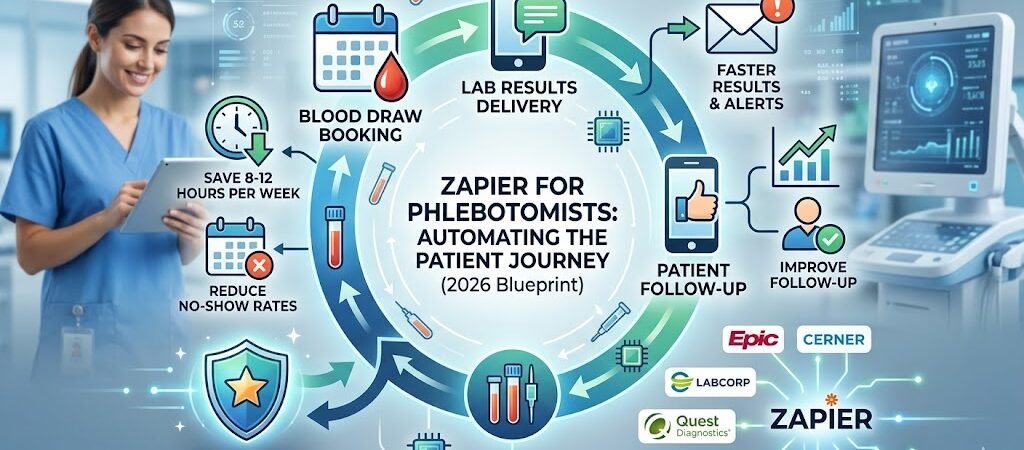
Save 8–12 hours per week, slash no-show rates, deliver lab results faster, and improve patient follow-up — all while staying fully compliant.
Zapier for Phlebotomists- Phlebotomists in 2026 are busier than ever. According to the latest ASCP and laboratory industry reports, the average phlebotomist still spends 8–12 hours per week on manual blood draw booking, chasing no-shows, entering patient data, and following up on lab results. Missed appointments, delayed result notifications, and repetitive phone calls create daily bottlenecks that increase stress and reduce the time spent actually drawing blood.
The result? Higher no-show rates, slower patient throughput, frustrated patients, and unnecessary administrative burden on an already stretched profession.
Zapier + AI Agents changes that. In this complete 2026 blueprint you’ll get exact step-by-step Zaps that automate blood draw booking, lab results delivery, and patient follow-ups for Epic, Cerner, LabCorp, Quest Diagnostics, eClinicalWorks, or any modern EHR/LIS system.
Why Phlebotomists Should Use Zapier in 2026
Here’s what most phlebotomists are still doing manually every single day in 2026:
- Booking blood draws and managing appointment slots across multiple patients and locations.
- Chasing no-shows and last-minute cancellations with individual phone calls or texts.
- Manually notifying patients when lab results are ready or require follow-up.
- Entering patient data, draw times, and collection details into multiple systems.
- Following up on abnormal results and coordinating with ordering physicians.
According to the latest ASCP and laboratory industry reports, the average phlebotomist loses 8–12 hours per week on these repetitive tasks. High no-show rates, delayed result notifications, and manual data entry continue to create daily bottlenecks that increase stress and reduce the time spent actually drawing blood.
With Zapier you can finally: (Zapier for Phlebotomists)
- Automatically book and confirm blood draw appointments.
- Send smart no-show reminders and instantly offer waitlist slots.
- Deliver lab results to patients (anonymized) with one-click follow-up options.
- Reduce no-shows by 30–40 % and cut manual follow-up calls dramatically.
- Free up 8–12 hours per week for high-value patient care.
Popular systems that connect seamlessly with Zapier include Epic, Cerner, LabCorp, Quest Diagnostics, and eClinicalWorks. You can also link Twilio or SMS by Zapier for patient notifications, Google Calendar for scheduling, and Zapier Tables for live draw tracking.
Phlebotomists who implement these automations report less daily chaos, faster patient communication, and more time focused on the patients in front of them.
How to Connect Your Lab/Phlebotomy System to Zapier (Step-by-Step)
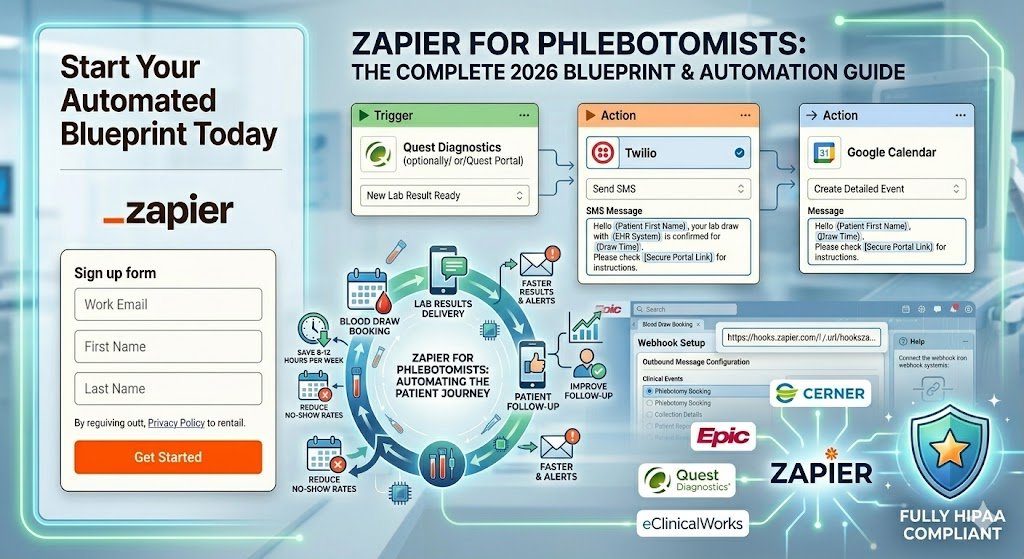
Setting up Zapier for phlebotomy workflows takes 15–30 minutes for the first Zap — no coding or IT help required.
Step 1: Create Your Zapier Account
- Go to zapier.com and sign up with your work email.
- Verify your email address.
- Start with the Professional plan ($29.99/month billed annually) — this easily covers a full day of blood draws, results, and patient notifications. The free plan is perfect for testing.
Step 2: Connect Your Lab or Phlebotomy System
Most systems used by phlebotomists (Epic, Cerner, LabCorp/Quest portals, eClinicalWorks, or mobile draw software) connect easily using one of these three methods:
- Method A – Webhooks (Recommended) In your EHR/LIS or phlebotomy scheduling software, enable webhook notifications for events like “New Blood Draw Booking”, “Sample Collected”, “Lab Result Ready”, or “Patient Follow-Up Needed”. Copy the unique Zapier webhook URL and paste it into your system.
- Method B – Email Parser (Super Easy) If you receive lab result reports or draw confirmations by email, use Zapier’s built-in Email Parser to automatically extract draw time, patient ID (anonymized), test codes, and result status.
- Method C – Google Forms / Zapier Tables Bridge Use digital blood draw request forms or daily export logs that feed directly into Zapier Tables or Google Sheets.
Pro tip: Start with Webhooks or Email Parser — they are the fastest and most reliable for blood draw booking and result notifications.
Step 3: Connect Your Supporting Apps
Once your lab system is connected, add these common tools (all have native Zapier integrations):
- Twilio or SMS by Zapier → for patient booking confirmations and follow-up reminders
- Google Calendar → for blood draw scheduling and mobile route planning
- Zapier Tables → for live draw tracking and patient follow-up dashboards
- Gmail / Outlook → for internal lab result notifications
- QuickBooks Online → for mobile draw service billing (optional)
Step 4: Set Up HIPAA-Safe Workflows (Critical in 2026)
Important: Zapier itself is not HIPAA compliant and does not sign a BAA. Safe practice: Only send non-PHI data (appointment times, anonymized draw IDs, test codes, result status). Keep all patient names, medical record numbers, and actual lab results inside your EHR/LIS system.
Total time for first Zap: 15–30 minutes. You can have your first automation (blood draw booking or patient follow-up reminder) running the same day.
8 Powerful Phlebotomist Automations You Can Build Today
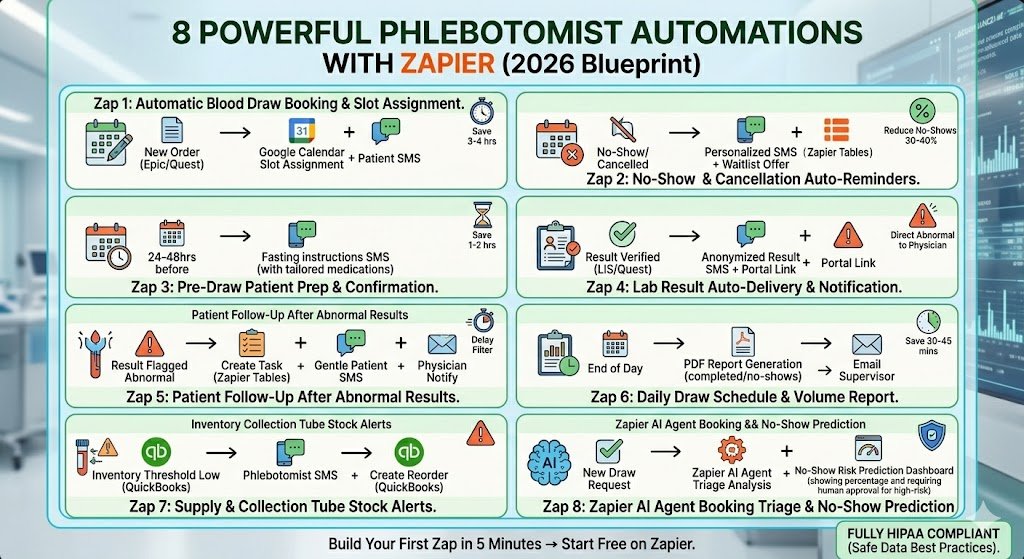
These are the exact Zaps that phlebotomists are using in 2026 to cut 8–12 hours of manual work per week. Each one includes the trigger, actions, time saved, and a practical edge case.
1. Automatic Blood Draw Booking & Slot Assignment Trigger: New blood draw order received in Epic, Cerner, LabCorp portal, or Quest outreach Action: Check availability in Google Calendar + auto-assign optimal slot + send confirmation SMS to patient Time saved: 3–4 hours per day on manual booking and phone coordination. Edge case: For stat or same-day draws, add a Filter to bypass normal queue and send immediate Slack alert to the phlebotomist. (Screenshot: New order trigger + calendar slot assignment)
2. No-Show & Cancellation Auto-Reminders Trigger: Appointment status = No-Show or Cancelled Action: Send personalized SMS reminder + automatically offer next 3 available slots from waitlist Time saved: Reduces no-show rate by 30–40 % and recovers lost draw slots daily. Edge case: Use Zapier AI to personalize the message based on patient history (e.g., “We noticed you missed your blood draw — here are 3 open slots this week”). (Screenshot: No-show trigger + waitlist rebooking flow)
3. Pre-Draw Patient Prep & Confirmation Trigger: Blood draw appointment booked (24–48 hours before) Action: Send SMS with fasting instructions, hydration reminders, and arrival time Time saved: 1–2 hours per day on patient confirmation calls. Edge case: For patients on specific medications (e.g., fasting glucose), include tailored prep instructions automatically. (Screenshot: Pre-draw reminder trigger + personalized SMS)
4. Lab Result Auto-Delivery & Notification Trigger: Lab result verified and released in LIS/EHR Action: Send anonymized result-ready notification via SMS + provide secure portal link Time saved: 2 hours per day on manual patient result calls. Edge case: For abnormal/critical results, route to a separate alert for the ordering physician instead of the patient. (Screenshot: Result verified trigger + patient notification SMS)
5. Patient Follow-Up After Abnormal Results Trigger: Lab result flagged as abnormal Action: Auto-create follow-up task in Zapier Tables + send gentle reminder SMS to patient + notify ordering physician Time saved: 1–2 hours per day on manual follow-up coordination. Edge case: Add a Filter to delay non-urgent follow-ups by 48 hours for patient convenience. (Screenshot: Abnormal result trigger + follow-up task creation)
6. Daily Draw Schedule & Volume Report Trigger: End of business day (Schedule by Zapier) Action: Pull draw data → generate PDF report of completed draws, no-shows, and volume → email to supervisor Time saved: 30–45 minutes every single day. Edge case: For mobile or home-draw services, split the report by location or technician automatically. (Screenshot: Daily schedule trigger + PDF report generation)
7. Supply & Collection Tube Stock Alerts Trigger: Collection tube or supply level drops below threshold in inventory sheet or system Action: Send SMS to phlebotomist + create reorder request in QuickBooks Time saved: Prevents mid-day supply shortages and emergency runs. Edge case: For high-cost tubes or rare collection types, route the alert only when value exceeds $200. (Screenshot: Low stock trigger + reorder action)
8. AI-Powered Booking Triage & No-Show Prediction (2026 Game-Changer) Trigger: New blood draw request or schedule change Action: Zapier AI Agent analyzes patient history and historical no-show patterns → predicts risk level → suggests optimal slot + requires human approval for high-risk bookings Time saved: 4–6 hours per week on manual triage and scheduling decisions. Edge case: AI confidence below 80 % automatically escalates the booking for phlebotomist review. (Screenshot: AI Agent triage dashboard + no-show risk prediction)
These 8 Zaps create a complete phlebotomy automation system that keeps the draw schedule full, patients informed, and results moving quickly.
HIPAA Compliance & Security Best Practices
Important 2026 note: Zapier itself is not HIPAA compliant and does not sign a Business Associate Agreement (BAA). This means you must never send Protected Health Information (PHI) — such as patient names, medical record numbers, actual lab results, or full blood draw details — through Zapier.
Safe and compliant way to use Zapier as a phlebotomist:
- Only automate non-PHI data: appointment times, anonymized draw IDs, test codes, result status (e.g., “ready” or “abnormal”), or collection tube counts.
- Keep all actual patient names, lab results, and clinical information inside your EHR/LIS system (Epic, Cerner, LabCorp/Quest portals, etc.).
- Use Zapier Tables (encrypted at rest) only for anonymized dashboards, draw schedules, or follow-up logs.
- For patient notifications and reminders, use anonymized triggers (e.g., “Draw #A-4721 is ready” instead of patient name).
Recommended security setup:
- Enable two-factor authentication on every Zapier account.
- Limit Zap access to only the phlebotomy team and authorized supervisors.
- Turn on “Require approval before turning on new Zaps” in team settings.
- For any workflow that must touch PHI, use a true HIPAA-compliant tool like Workato, Tray.io, or HIPAAtizer as a secure bridge.
By following these practices, phlebotomists can safely enjoy the time-saving power of Zapier while remaining fully compliant with HIPAA and state laboratory regulations.
Pricing & Limits for Phlebotomists
A typical phlebotomist (in-clinic or mobile) running blood draw booking, lab results, and patient follow-ups fits comfortably on Zapier’s Professional plan. Here’s the 2026 pricing breakdown:
| Plan | Monthly Cost (billed annually) | Tasks per Month | Best For Phlebotomists |
|---|---|---|---|
| Free | $0 | 100 | Testing 1–2 simple Zaps only |
| Professional | $29.99 | 750 | Most full-time phlebotomists (recommended starting plan) |
| Team | $103.50 | 2,000+ | Mobile phlebotomy services or high-volume teams |
Real-world cost example: A busy phlebotomist handling 60–120 blood draws per day (booking, reminders, result notifications, and follow-ups) typically uses 480–650 tasks per month after adding smart Filters and daily summary reports. This fits easily inside the $29.99 Professional plan.
Pro tip: You can cut task usage another 40–60 % by using Zapier AI Agents for booking triage and switching high-volume patient reminders to daily Digests instead of instant triggers.
Common Errors & Quick Fixes
Even the best phlebotomy automations can hit a snag. Here are the most common issues phlebotomists face in 2026 and exactly how to fix them fast:
1. Authentication Error with EHR/LIS Problem: Zapier suddenly shows “Authentication failed” with Epic, Cerner, LabCorp, or Quest portal. Fix: Reconnect using a fresh API key or webhook URL from your system settings (this is the #1 issue after software updates). Takes under 60 seconds.
2. Duplicate Patient Reminder Messages Problem: Patients receive the same blood draw confirmation or reminder multiple times. Fix: Add a Filter by Zapier step that checks Zapier Tables to see if a reminder was already sent for that appointment ID.
3. Booking Conflicts or Double-Booking Problem: Google Calendar shows overlapping blood draw appointments. Fix: Add a Filter or Path step to check technologist availability before creating the new booking slot.
4. Rate Limit Spikes During Peak Hours Problem: You hit your task limit during morning rush or after large lab orders. Fix: Switch high-volume patient reminders and follow-ups to daily Digests instead of instant triggers, or add a short Delay step. Most phlebotomists cut usage by 40–60 % this way.
5. AI Agent Mis-Predicting No-Shows Problem: The AI flags low-risk patients as high no-show risk or vice versa. Fix: Lower the confidence threshold to 75 % or add a mandatory human-in-the-loop approval step for any prediction the AI rates below 85 % confidence.
Conclusion & Next Steps
You no longer have to spend 8–12 hours every week manually booking blood draws, chasing no-shows, and following up on lab results.
With these 8 practical Zaps (plus the AI-powered booking triage and no-show prediction version), phlebotomists are dramatically reducing no-show rates, delivering results faster, improving patient communication, and reclaiming valuable time for actual patient care.
The best part? You can have your first automation (blood draw booking or patient follow-up reminder) running the same day you build it.
Ready to automate your phlebotomy workflow today? Build your first Zap in under 5 minutes → Start Free on Zapier
Want the complete ready-made template pack? Reply “PHLEBOTOMY TEMPLATES” in the comments or visit our homepage and I’ll send you all 8 Zaps as importable links (completely free).
Looking for a more affordable long-term solution? Many phlebotomists and mobile draw services are switching to Make.com for high-volume booking and notifications. Want the Make.com version of these blueprints? Just let me know.
Automate once. Spend more time helping patients and less time on repetitive admin tasks.

About the Author
Aapt DubeyAapt Dubey is an automation specialist and software developer dedicated to eliminating manual workflows for small businesses. With deep, hands-on experience building complex Zapier integrations, API connections, and real-world applications, Aapt writes actionable, tested tutorials to help businesses scale efficiently.