The Small Farm’s Tech Stack (Zapier for Small Farm Owners)
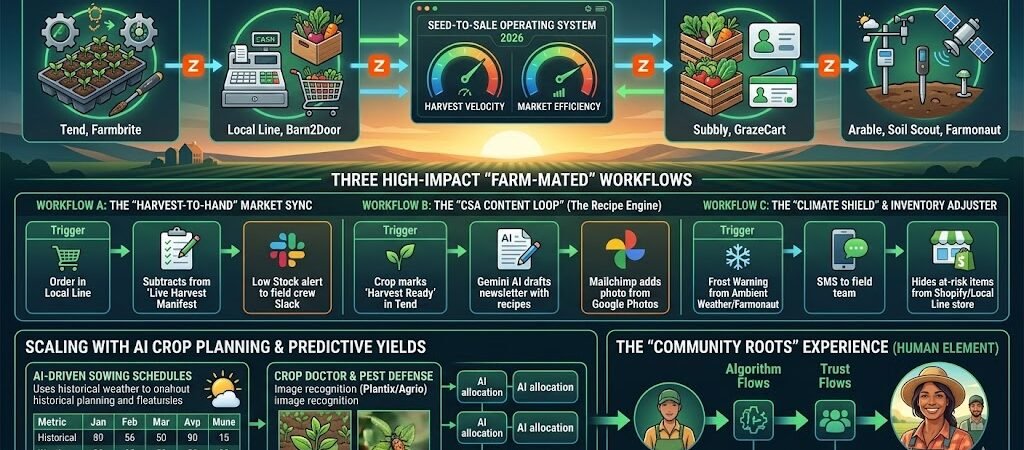
The goal of your 2026 stack is “Unified Field Logic.” By using Zapier to link your growing data with your sales platforms, you ensure that every seed planted has a pre-sold destination.
1. The Market & Online Storefront (Direct-to-Consumer)
- The Tools: Barn2Door or Local Line.
- The Value: In 2026, general e-commerce platforms like Shopify are being replaced by niche agricultural specialists. Barn2Door focuses on brand-first selling, while Local Line is the “Logistics King,” managing complex delivery routes and wholesale alongside retail.
- The Zap: When a “Market Selection” is updated in Local Line, Zapier automatically updates your Instagram Shop inventory, ensuring you never over-sell at the Saturday market.
2. The Crop & Field Manager (The Farm’s Brain)
- The Tools: Farmbrite or Tend.
- The Value: These platforms have evolved to handle high-diversity crop planning. Farmbrite is particularly strong for hybrid farms (crops + livestock), providing yield projections and integrated bookkeeping.
- The Zap: When a “Sowing Event” is logged in Tend, Zapier creates a “Projected Harvest” entry in your CSA member portal, giving subscribers a 4-week look-ahead at their boxes.
3. The CSA & Subscription Engine
- The Tools: Subbly or GrazeCart.
- The Value: In 2026, subscriptions account for up to 80% of a modern farm’s recurring revenue. Subbly offers best-in-class “Skip-a-Week” logic, while GrazeCart is designed specifically for high-volume meat and perishable fulfillment.
- The Zap: If a CSA payment fails in Subbly, Zapier instantly sends a friendly WhatsApp/SMS via Twilio, allowing the member to update their card before packing day.
4. The Environmental Monitor (The Sensor Layer)
- The Tools: Arable, Soil Scout, or Farmonaut.
- The Value: Real-time underground and satellite data now drive irrigation. Soil Scout sensors remain buried for up to 20 years, providing 24/7 moisture and temperature data without interfering with field work.
- The Zap: If the soil moisture drops below your set threshold, Zapier sends a Slack alert to the field team and logs the event in your Crop Planning sheet to adjust future yield predictions.
The “Seed-to-Sale” Stack Map
| Category | 2026 Recommended Tools | The “Zap” Value |
| Sales | Local Line / Barn2Door | Syncs online orders with physical market inventory. |
| Planning | Farmbrite / Tend | Triggers task lists in Todoist based on crop maturity. |
| Subscriptions | Subbly / GrazeCart | Automates “Box Customization” emails every Monday. |
| Monitoring | Soil Scout / Farmonaut | Alerts the farmer to frost or drought risks via SMS. |
The 2026 Edge: Most small farms lose 20% of their time to “Admin Fatigue”—reconciling paper orders and field notes. The 2026 Automated Farmer has a “Digital Ledger.” When Zapier handles the data flow, your “Seed-to-Sale” path is a straight line, not a maze.
The 2026 “Farm-Mated” Workflows
By connecting your tools via Zapier, you ensure that your admin work moves at the same speed as your biology. Here are three core workflows for a high-efficiency 2026 season.
Workflow A: The “Harvest-to-Hand” Market Sync
The Goal: Never over-sell or under-harvest for market day.
- Trigger: An order is placed in your Local Line or Barn2Door store.
- The Logic: Zapier subtracts the ordered quantity from your “Projected Harvest” manifest in Google Sheets or Farmbrite.
- Action: 1. If the stock falls below 10%, Zapier triggers a “Low Inventory” alert to the field team via Slack. 2. It automatically updates the “Availability” on your Instagram Shop and website.
- The Result: Your online inventory is always 100% accurate, eliminating the need for “out of stock” apology emails at the market pickup booth.
Workflow B: The “CSA Content Loop” (The Recipe Engine)
The Goal: Increase CSA retention by showing members how to use their box.
- Trigger: A crop status is marked as “Harvest Ready” in Tend.
- The Logic: Zapier sends the crop name (e.g., “Kohlrabi”) to Gemini AI.
- Action: 1. AI generates three quick, seasonal recipes and a “how to store” tip. 2. The content is automatically added to your Mailchimp or Flodesk “Weekly Box Preview” draft. 3. A photo of the crop from your Google Photos“Farm Life” album is attached.
- The Result: Your members receive high-value, educational content every week without you spending hours at a keyboard.
Workflow C: The “Climate Shield” & Inventory Adjuster
The Goal: Protect crops and manage customer expectations during weather events.
- Trigger: A “Frost Warning” or “Extreme Heat” alert is issued by Ambient Weather or Farmonaut.
- The Logic: Zapier identifies which fields are at risk based on your planting map.
- Action: 1. Immediate SMS alert to the field team to cover high-value crops (e.g., peppers or tomatoes). 2. If a loss is likely, Zapier automatically hides those items from your “Online Store” for the upcoming week. 3. It sends a “Weather Update” email to CSA members, building transparency and trust.
- The Result: You minimize crop loss and prevent the administrative nightmare of refunding orders for produce that was destroyed by a storm.
Scaling with AI Crop Planning & Predictive Yields
Small farms in 2026 are using Predictive Agronomy to outcompete larger operations on quality and consistency. By integrating Gemini AI and satellite-driven tools like OneSoil or Farmonaut, you can transform your field data into a proactive business strategy.
1. AI-Driven Sowing & Succession Schedules
The old way was following a static planting calendar. In 2026, your planting schedule is a “living document” that responds to real-time climate and market shifts.
- The Workflow: Use Gemini AI to analyze a decade of hyper-local weather patterns alongside current global commodity prices.
- The Action: The AI suggests “Niche Window” planting dates (e.g., “Delay sowing heirloom radishes by 4 days to hit a peak price window at local restaurants while avoiding a projected late-April frost”).
- The Result: You maximize “Profit per Bed” by ensuring your high-margin crops hit the market exactly when demand is highest and competition is lowest.
2. Predictive Yield Analysis (The “Digital Harvest”)
In 2026, you can “see” your harvest volume weeks before a single vegetable is picked.
- The Tools: Platforms like Farmonaut or CropX use multi-spectral satellite imagery and buried soil sensors to monitor “Heat Unit Accumulation” and NDVI (crop vigor) scores.
- The Zap: When the satellite detects a 5% acceleration in crop maturity due to a heatwave, Zapier automatically updates your Shopify or Local Line inventory.
- The Result: You can pre-sell 100% of your harvest with total confidence, eliminating the “Day-of-Market” waste that eats into small farm margins.
3. AI “Crop Doctor” & Pest Defense
Manual scouting is a luxury small farmers can no longer afford. In 2026, your phone is your most powerful diagnostic tool.
- The Workflow: Use apps like Plantix or Agrio to photograph any suspicious leaf spot or insect.
- The Intelligence: AI instantly identifies the pathogen and cross-references it with your farm’s history and local alerts.
- The Zap: A positive pest identification triggers a Slack alert to the field crew with the exact GPS coordinates and a recommendation for an organic, targeted treatment.
- The Result: You stop pest outbreaks in the “index plant” stage, reducing crop loss by up to 30% without the need for blanket chemical applications.
The “Precision & Prediction” Metric Table
| Category | 2026 Tech Integration | The Business Value |
| Sowing Accuracy | Gemini AI + Historical Weather | Increases “First-to-Market” advantage by 10–14 days. |
| Yield Forecasting | Satellite NDVI + Soil Sensors | Reduces post-harvest waste by up to 25%. |
| Disease Detection | Plantix / Computer Vision | Saves up to 4 days/month on manual scouting labor. |
| Input Optimization | CropX / Arable | Improves water and fertilizer efficiency by 30-80%. |
The 2026 Edge: For a small farm, a 10% increase in yield is a victory, but a 20% reduction in wasted effortis a revolution. With Predictive Yield Zaps, you are no longer reacting to the weather; you are managing your farm like a high-tech manufacturing plant where the “factory floor” just happens to be made of soil.
The “Community Roots” Experience (The Human Element)
In the age of lab-grown meat and industrial vertical farms, the 2026 consumer is hungry for unfiltered provenance. They don’t just want organic kale; they want to know the name of the farmer who grew it and the health of the soil it came from. Zapier for Small Farms handles the “Digital” so you can be the “Direct.”
1. Beyond the Box: Radical Transparency
“Transparency” is no longer a buzzword; it’s a requirement for retention.
- The Strategy: Use automation to turn every CSA box into a storytelling platform.
- The Workflow: When a specific crop is marked “Harvested” in Tend, Zapier triggers an automated “Crop Bio” to be sent to members.
- The Connection: This isn’t a marketing brochure; it’s a simple, high-resolution photo of the actual field and a 30-second “Farmer’s Note” on how the weather shaped this week’s flavor.
- The Human Win: This builds a sense of shared ownership. When a storm hits, your members don’t just see a missing item; they see a challenge their “partner” (the farmer) is facing.
2. The CSA “Skip-a-Week” Concierge
The biggest reason people cancel CSA subscriptions is “vegetable guilt”—the feeling of being overwhelmed by a box they can’t finish.
- The Opportunity: Use automation to offer radical flexibility.
- The Action: Use Zapier and Subbly to trigger a “Manage Your Box” SMS 48 hours before packing.
- The Intelligence: If a member skips, Zapier automatically reallocates that “skipped” inventory back into your Local Line store for general public sale.
- The Result: You avoid waste, the member feels zero guilt, and you maintain a 90%+ retention rate because the service fits their actual life.
3. Closing the “Feedback Soil-Loop”
In 2026, your members are your best research and development team.
- The Transition: Move from “Selling to” to “Growing with.”
- The Action: Use Zapier to trigger a one-question survey 3 days after delivery: “What was the star of your box this week?”
- The Result: When you use that data to plan next season’s crops (and tell your members: “We’re planting more of those heirloom tomatoes because you loved them”), you prove that they are an active partner in the farm’s future.
Implementation Guide—The 90-Day “Soil-to-Success” Roadmap
The goal is to stabilize your revenue stream in the first month and spend the remaining 60 days perfecting the “Field-to-Market” flow and predictive systems.
Phase 1: The “Digital Market” Foundation (Days 1–30)
- The Goal: Synchronize your online sales with your physical inventory to prevent over-selling.
- The Tech: Connect your Online Store (Local Line/Barn2Door) to your CRM (Mailchimp/HubSpot) and a master Google Sheet.
- The Action: Set up a Zap that triggers on every order. It should update your master inventory and tag the customer by their “Product Interest” (e.g., Microgreens, Heirloom Tomatoes).
- The Result: You stop losing hours every weekend manually updating spreadsheets and start building a high-value marketing list automatically.
Phase 2: The “Fulfillment & Feed” Protocol (Days 31–60)
- The Goal: Automate the “Monday Morning” admin of CSA management and member alerts.
- The Tech: Integrate Subbly/GrazeCart with Twilio and Gemini AI.
- The Action: 1. Implement the “Skip-a-Week” concierge via SMS. 2. Set up the “Recipe Engine” Zap that drafts your weekly newsletter based on what is being harvested that week.
- The Result: You eliminate “Vegetable Guilt” for your members and drastically reduce the time spent on customer support and content creation.
Phase 3: The “Predictive Field” Layer (Days 61–90)
- The Goal: Connect your environmental sensors to your planning tools for real-time agility.
- The Tech: Soil Scout/Arable + Farmbrite/Tend + Slack.
- The Action: 1. Set up the “Climate Shield” Zap that sends frost/heat alerts to the team. 2. Integrate your soil moisture data into your yield forecasting sheet to adjust “Available to Sell” quantities automatically.
- The Result: You move from reactive farming to proactive management, protecting your crops and maximizing your sell-through rate.
Conclusion: Cultivating the Future of Agriculture
In 2026, the most successful small farms are Data-Driven Ecosystems. By leveraging Zapier for Small Farm Owners, you transform your operation from a series of exhausting chores into a high-velocity Seed-to-Sale Engine. You stop “working for the farm” and start letting the farm’s data work for you.
Stop drowning in paperwork and start automating your harvest. Build your first “Market-to-Inventory” Zap today.

About the Author
Aapt DubeyAapt Dubey is an automation specialist and software developer dedicated to eliminating manual workflows for small businesses. With deep, hands-on experience building complex Zapier integrations, API connections, and real-world applications, Aapt writes actionable, tested tutorials to help businesses scale efficiently.