From “Going Twice” to “Instantly Settled”
The modern auction is a high-speed data event. In 2026, the time between the final hammer strike and the digital invoice reaching the bidder’s inbox is measured in seconds, not hours. For the auctioneer, success is no longer just about the high bid; it’s about Transaction Velocity.
The “Clerical Bottleneck”
Traditionally, the period immediately following an auction was a “black hole” of administrative labor.
- The Old Way: Manually transferring winning bidder numbers from a physical clerk sheet into an accounting system, calculating buyer’s premiums, and then emailing invoices. This delay leads to “buyer’s remorse” and logistics logjams.
- The 2026 Way: Using Zapier for Auctioneers, the “Gavel-to-Cloud” sync is instantaneous. As the clerk marks a lot as “Sold” in the bidding software, a chain of events is triggered: the buyer is invoiced, the consignor is notified, and the shipping department receives a pack-out slip.
The Rise of “Hybrid Trust”
In 2026, bidders require extreme transparency. They want to know exactly what they are bidding on and exactly what they owe, with no hidden friction.
- Real-Time Data Integrity: Automation ensures that item descriptions, condition reports, and bid increments are perfectly mirrored across your website, social media, and third-party bidding platforms.
- The Automation Edge: By automating the “Operational Spine”—registration, cataloging, and invoicing—you eliminate the human error that leads to disputed bids or incorrect billing. This frees the auctioneer to do what they do best: read the room, build excitement, and maximize the value of every lot.
By shifting your focus to High-Velocity Operations, you stop being an “event organizer” and start being a Marketplace Architect. You aren’t just selling items; you are providing a high-trust, high-speed platform where capital meets inventory with zero friction.
The Auctioneer’s Tech Stack (The 2026 Gavel Hub)
The goal of your 2026 stack is “Zero-Latency Cataloging.” By using Zapier to link your inventory management directly to your bidding platforms and payment processors, you ensure that every item is visible, bid-ready, and payable the moment it enters your facility.
1. The Bidding Engine (The “Digital Floor”)
- The Tools: Proxibid, LiveAuctioneers, or Auction-Software.
- The Value: These are the gateways for global participation. In 2026, they support low-latency video and “One-Click” bidder verification.
- The Zap: When a bidder’s registration is approved in the engine, Zapier automatically updates their “Credit Limit” in your internal records based on their past payment history.
2. The Catalog & Inventory Manager (The “Inventory Brain”)
- The Tools: Wavebid or Google Sheets (as a master manifest).
- The Value: This is where the “Hammer-to-Harvest” journey begins. It holds photos, dimensions, and consignor details.
- The Zap: When a new lot is marked “Complete” in Wavebid, Zapier triggers a “Social Push”—sending the lot photo and description to Instagram and Pinterest to begin the pre-bidding buzz.
3. The Payment & Settlement Gateway (The “Financial Spine”)
- The Tools: Stripe, Square, or QuickBooks Online.
- The Value: In 2026, manual invoicing is a liability. You need “Auto-Pay” capabilities for winning bids to ensure same-day settlement.
- The Zap: The moment the hammer falls and the lot is closed, Zapier generates a Stripe checkout link and sends it via Twilio SMS to the winning bidder.
4. The Communication & Alert Layer (The “Engager”)
- The Tools: Twilio, WhatsApp Business, or Slack.
- The Value: Auctions move too fast for email. Bidders need instant “Outbid” and “Winning” notifications on their phones.
- The Zap: When a bidder is outbid in the bidding engine, Zapier sends a WhatsApp alert with a “Re-bid” button, keeping the bidder in the action without them having to refresh a browser.
The “Hammer-to-Harvest” Stack Map
| Category | 2026 Recommended Tools | The “Zap” Value |
| Registration | Typeform / Stripe Identity | Auto-verifies bidder IDs and sets “Bidder Numbers.” |
| Inventory | Wavebid / Google Drive | Syncs high-res photos to the public catalog instantly. |
| Settlement | Stripe / QuickBooks | Generates and sends invoices the second a lot closes. |
| Logistics | ShipStation / Slack | Notifies the warehouse to “Pack & Label” once paid. |
The 2026 Edge: Most auction houses lose 24–48 hours in the “Invoicing Limbo” after an event. The 2026 Automated Auctioneer settles 90% of lots before the lights are turned off in the gallery. When Zapierhandles the paper trail, your “Cash-in-Bank” velocity doubles.
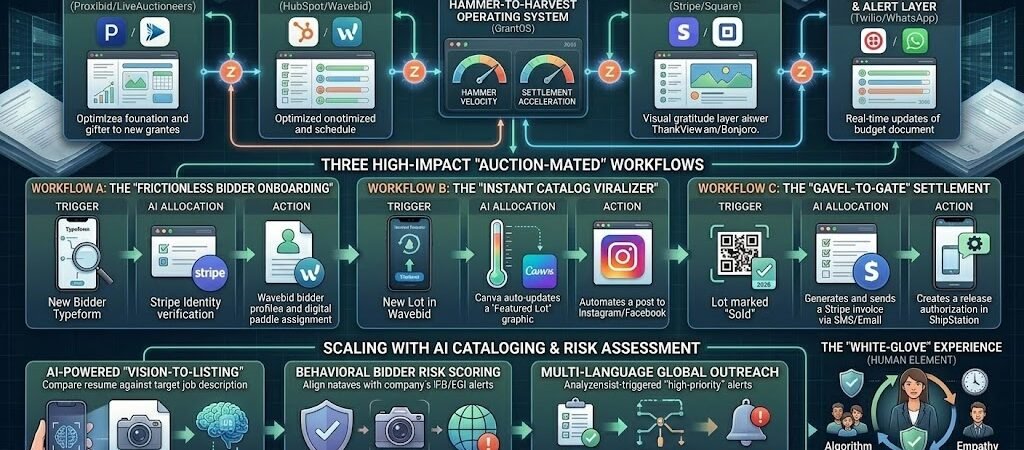
Three High-Impact “Auction-Mated” Workflows
These workflows act as your “Digital Clerk,” working in the background to sync data between the auction floor, the back office, and the bidder’s mobile device.
Workflow A: The “Frictionless Bidder Onboarding”
The Goal: Pre-verify bidders to eliminate non-payment risk.
- Trigger: A new bidder registers via your website or Typeform.
- The Logic: Zapier sends the registrant’s info to Stripe Identity for a quick ID verification and checks your “Global Blacklist” in Google Sheets.
- Action: 1. Creates a bidder profile in Wavebid. 2. Assigns a digital paddle number. 3. Sends a WhatsAppconfirmation with the “Terms of Sale” and a link to add the auction to their calendar.
- The Result: You enter auction day with a vetted, ready-to-spend audience, significantly reducing post-auction “non-payer” headaches.
Workflow B: The “Instant Catalog Viralizer”
The Goal: Build pre-auction “Watchlists” and momentum.
- Trigger: A new item is marked “Ready for Sale” in your inventory tool.
- The Logic: Zapier extracts the lot number, high-res photo, and starting bid.
- Action: 1. Triggers Canva to generate a branded “Featured Lot” graphic. 2. Posts the graphic to Instagram Storiesand Facebook Marketplace. 3. Adds the item to a “Weekly Highlights” email digest in Mailchimp.
- The Result: You generate pre-bids and “Watchlist” additions automatically as you catalog, ensuring every item has an audience before the gavel even lifts.
Workflow C: The “Gavel-to-Gate” Settlement
The Goal: Instant invoicing and logistics handoff.
- Trigger: A lot status changes to “Sold” in the bidding engine.
- The Logic: Zapier identifies the winner and calculates the final price (Hammer Price + Buyer’s Premium + Tax).
- Action: 1. Generates and sends a Stripe invoice via SMS/Email. 2. Creates a “Release Authorization” in ShipStation for the logistics team. 3. Updates the Consignor’s portal to show “Item Sold – Settlement Pending.”
- The Result: The bidder can pay on their phone before they even leave their seat, and the warehouse team is already pulling the item for pickup.
Scaling with AI Cataloging & Risk Assessment
As an auctioneer in 2026, your time is best spent sourcing high-value estates and closing deals, not typing dimensions into a spreadsheet. By leveraging Agentic Vision and Predictive Behavioral Analytics, you can process thousands of lots with the precision of a master appraiser.
1. AI-Powered “Vision-to-Listing” (The 5-Second Cataloger)
Traditionally, cataloging a single lot (photographing, identifying, measuring, and writing SEO descriptions) could take 15–20 minutes. In 2026, this is instantaneous.
- The Workflow: A cataloger takes three photos of an item (e.g., a vintage Rolex or a piece of heavy machinery) using a mobile lotting app like Webtron.
- The Intelligence: Computer Vision (YOLO26) automatically identifies the item, reads serial numbers or compliance plates, and estimates condition. Gemini AI then cross-references historical auction results to suggest an “Estimated Value” and a “Reserve Price.”
- The Action: Zapier automatically generates an 80-character, keyword-optimized title and a professional description, pushing it directly to the live catalog.
2. Behavioral Bidder Risk Scoring (The “Trust Engine”)
In the 2026 landscape of global digital bidding, “Synthetic Identities” and non-paying “snipers” are a real threat. You cannot manually vet every new registrant.
- The Workflow: When a new bidder registers, Zapier pulls their cross-platform bidding history and real-time behavioral signals (e.g., hesitation during registration or multiple accounts from one IP).
- The Intelligence: AI assigns a Risk Score. High-risk profiles are flagged for “Manual Approval,” while trusted bidders are auto-approved with higher credit limits.
- The Result: You virtually eliminate “Non-Payment Churn,” ensuring your sell-through rate remains high and your consignors stay satisfied.
3. Multi-Language Global Outreach
In 2026, your “local” auction is a global event. An art piece in Gurgaon can be sold to a collector in London or Tokyo in real-time.
- The Workflow: As soon as a lot is published, Zapier triggers a Multi-Language Translation engine.
- The Value: Your catalog is instantly available in 100+ languages, and outbid notifications are sent in the bidder’s native tongue.
- The Result: You tap into international capital without hiring a single translator, maximizing the final hammer price through global competition.
The “Precision & Protection” Metric Table
| Category | 2026 Tech Integration | The Business Value |
| Cataloging | Computer Vision + Gemini AI | Reduces lot setup time by 50%+. |
| Risk Audit | Behavioral AI Scoring | Minimizes non-payments and fraudulent “shill” bidding. |
| SEO Optimization | AI-Generated Titles | Increases organic search visibility by 30%. |
| Global Access | Auto-Translation APIs | Opens the “Digital Room” to 100+ countries. |
The 2026 Edge: In the past, cataloging was a chore. In 2026, it is your competitive engine. With Vision-Language Models, your catalog isn’t just a list of items; it’s a high-performance marketing asset that finds its own audience.
The “White-Glove” Experience (The Human Element)
In a world of digital-only “swipe-to-bid” marketplaces, the 2026 auction house wins on Authority and Advisory. Zapier for Auctioneers handles the “bureaucracy of the bid” so you can focus on the Human Trust that moves high-value assets.
1. From “Clerk” to “Concierge”
When your staff is no longer tethered to a laptop manually entering bid numbers, they are free to roam the floor and provide high-touch service.
- The Strategy: While Zapier handles the automated “Sold” notifications and invoices, your floor staff acts as Bidding Concierges.
- The Connection: They can assist “Phone Bidders” or “VIPs” in real-time, providing immediate condition-report walk-throughs via mobile video calls—a service that no bot can replicate.
- The Human Win: You aren’t just selling a lot; you are providing an “insider experience” that builds long-term loyalty with high-net-worth collectors and industrial buyers.
2. Radical Transparency in the “Chain of Custody”
In 2026, provenance is everything. Buyers want to know exactly where an item came from and that the “Condition Report” is authentic.
- The Opportunity: Use automation to facilitate Immutable Provenance.
- The Workflow: Use Zapier to sync your appraisal notes and “In-Take” photos directly into a digital “Certificate of Authenticity” for the winner.
- The Action: The winner receives a secure, digital “Vault Key” (PDF or blockchain-verified record) the moment they pay.
- The Result: You position your auction house as a high-integrity partner, reducing the risk of “Buyer’s Remorse” and disputes.
3. The “Consignor’s Peace of Mind”
The auctioneer’s other client is the Consignor. Their biggest stress is the “Settlement Gap”—the time between the sale and receiving their payout.
- The Transition: Move from “Manual Payouts” to “Transparent Settlements.”
- The Action: Use Zapier to send automated “Item Sold” updates to consignors the moment the hammer falls, including the final price and estimated payout date.
- The Result: By keeping the consignor informed automatically, you eliminate “Where is my money?” phone calls and build a reputation that secures future high-value estates.
Implementation Guide—The 90-Day “Hammer-to-Harvest” Roadmap
The goal is to solve the “Settlement Bottleneck” in the first month and spend the remaining 60 days perfecting the “Global Outreach” and “AI Cataloging” systems.
Phase 1: The “Registration & Revenue” Foundation (Days 1–30)
- The Goal: Eliminate non-paying bidders and automate the post-hammer invoice.
- The Tech: Connect Typeform (Registration) to Stripe Identity (Verification) and Wavebid (Catalog).
- The Action: Set up a Zap that triggers when a lot is marked “Sold.” It must instantly calculate the total (Hammer + Premium + Tax) and send a Stripe checkout link via SMS.
- The Result: You achieve same-day settlement for 80% of your lots, drastically reducing the “Monday Morning” clerical workload.
Phase 2: The “Velocity Cataloging” Protocol (Days 31–60)
- The Goal: Double your lot-processing speed using AI vision and automated marketing.
- The Tech: Integrate Google Lens/Gemini AI with Wavebid and Social Media (Instagram/Facebook).
- The Action: Implement the “Vision-to-Listing” Zap. When a photo is uploaded to the “New Intake” folder, AI generates the description and Zapier triggers a “Coming Soon” social media teaser.
- The Result: Your catalog is “live” and marketing itself before the physical item is even moved to the warehouse floor.
Phase 3: The “Consignor & Logistics” Loop (Days 61–90)
- The Goal: Automate “Last Mile” transparency for both buyers and sellers.
- The Tech: ShipStation + Zapier Tables + Consignor Portal.
- The Action: 1. Set up the “Paid” trigger that automatically sends a pack-out slip to the warehouse and a pickup QR code to the buyer. 2. Automate a weekly “Consignor Settlement” report that tracks item status from “Sold” to “Paid” to “Shipped.”
- The Result: You eliminate 90% of status-update phone calls, allowing your team to focus on sourcing the next big estate or collection.
Conclusion: Commanding the Room with Data
In 2026, the most successful auctioneers are Operational Architects. By leveraging Zapier for Auctioneers, you transform a high-stress event into a high-velocity Marketplace Engine. You stop “chasing payments” and start scaling authority.
Stop wrestling with bid sheets and start automating your hammer velocity. Build your first “Gavel-to-Cloud” Zap today.

About the Author
Aapt DubeyAapt Dubey is an automation specialist and software developer dedicated to eliminating manual workflows for small businesses. With deep, hands-on experience building complex Zapier integrations, API connections, and real-world applications, Aapt writes actionable, tested tutorials to help businesses scale efficiently.