From “Transactions” to “Mission Partnerships”
The “Annual Appeal” is no longer the center of the fundraising universe. In 2026, giving is decentralized, peer-to-peer, and often triggered by real-time events. If a donor supports a crisis relief fund at midnight, they shouldn’t have to wait for a Monday morning staff meeting to feel the impact of their contribution.
The “Gratitude Gap” Bottleneck
The primary reason donors “churn” (stop giving) isn’t because they lost interest in the mission; it’s because they felt like a transaction number rather than a partner.
- The Old Way: Batch-processing receipts once a week. Sending a generic “Dear Friend” letter 14 days after the gift. The emotional connection between the donor and the cause has cooled before the thank-you even arrives.
- The 2026 Way: Using Zapier for Fundraisers, the donation is the beginning of a conversation, not the end of a transaction. The moment a gift is processed, a sequence of “Micro-Touches” is triggered—from an instant impact SMS to a personalized video task for the project lead.
Unified Commerce and “Frictionless Philanthropy”
In 2026, donors give via Apple Pay, Google Pay, and even AI-powered voice assistants.
- Platform Fluidity: Whether the gift comes through a TikTok “Donate” button or a QR code at a local event, the data must flow instantly into your CRM.
- The Automation Edge: By automating the data entry and initial receipting, you ensure your records are 100% accurate without manual “copy-pasting” from various payment gateways. This allows your development team to focus on High-Value Stewardship—spending their time on the phone with major donors and “Mid-Level” supporters who are ready to increase their commitment.
By shifting your focus to partnerships, you stop being a “money collector” and start being an Impact Facilitator. You aren’t just asking for a check; you are inviting the donor into a transparent, high-speed journey where they can see their influence on the world in real-time.
The Fundraiser’s Tech Stack (The 2026 Impact Hub)
The goal of your 2026 stack is “Unified Giving.” By using Zapier to link your donation gateways directly to your engagement and reporting tools, you eliminate the “data silos” that prevent you from seeing the full picture of a donor’s journey.
1. The Donation Engine (The “Front Door”)
- The Tools: Givebutter, Donorbox, or Zeffy.
- The Value: In 2026, 0-fee platforms like Zeffy are the standard for non-profits. These tools handle everything from Venmo/Apple Pay to recurring monthly “Mission Partners.”
- The Zap: When a new donation is processed, Zapier immediately checks your CRM for an existing record. If found, it updates the “Lifetime Giving” total; if not, it creates a new “Donor Prospect” profile.
2. The CRM (The System of Record)
- The Tools: Bloomerang, Kindful, or HubSpot for Nonprofits.
- The Value: Your CRM is the “brain.” It tracks engagement scores, giving frequency, and personal milestones (like “giving anniversaries”).
- The Zap: Zapier monitors “Engagement Scores.” If a donor’s score drops (they stop opening emails), it triggers a “Re-engagement” task for a volunteer to send a handwritten-style note.
3. The Visual Gratitude Layer (The Emotional Connection)
- The Tools: ThankView or Bonjoro.
- The Value: Text emails are ignored; personal videos are watched.
- The Zap: For any gift over $100, Zapier creates a task in Bonjoro for the Program Director. The task includes the donor’s name and the specific project they funded, making the “Thank You” incredibly specific.
4. The RSVP & Event Hub (The Hybrid Experience)
- The Tools: RSVPify or RallyUp.
- The Value: Whether it’s a virtual webinar or an in-person gala, attendance data is fundraising data.
- The Zap: When a guest registers for an event in RSVPify, Zapier adds them to a specific “Event Attendee” segment in your email marketing tool (Mailchimp/Flodesk) to send the pre-event digital program.
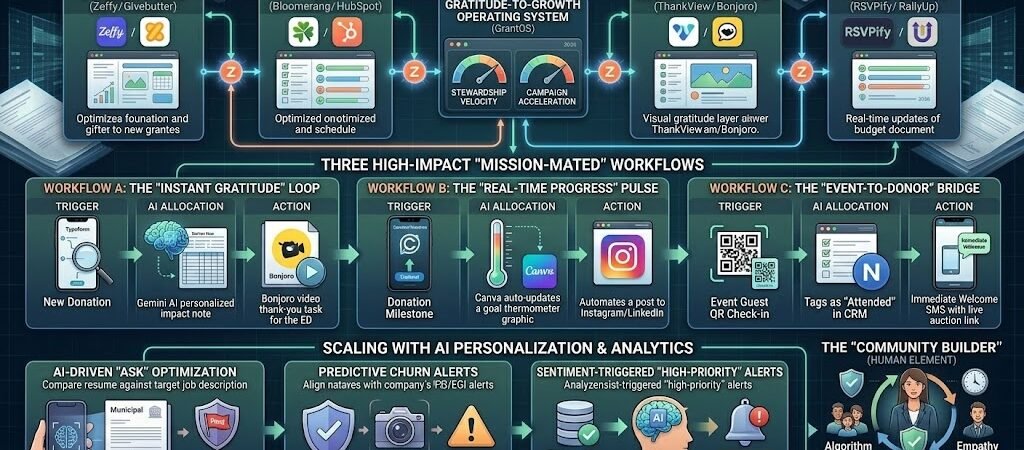
The “Gratitude-to-Growth” Stack Map
| Category | 2026 Recommended Tools | The “Zap” Value |
| Donation | Zeffy / Givebutter | Instant data sync from Apple Pay/Venmo to CRM. |
| CRM | Bloomerang / HubSpot | Automates “Donor Persona” tagging based on behavior. |
| Gratitude | Bonjoro / ThankView | Triggers personalized video tasks for major gifts. |
| Events | RSVPify / RallyUp | Real-time QR check-in triggers “Welcome” SMS. |
The 2026 Edge: Most non-profits waste weeks every year reconciling spreadsheets from different events and platforms. The 2026 Automated Fundraiser has a “Real-Time Ledger.” When Zapier handles the data flow, your “Campaign Progress” bar is always accurate to the second.
Three High-Impact “Mission-Mated” Workflows
These workflows act as a digital stewardship team, bridging the gap between a cold transaction and a warm personal connection. By automating the data flow, you ensure that every donor feels like your organization’s highest priority.
Workflow A: The “Instant Gratitude” Loop
The Goal: Eradicate the “Gratitude Gap” for new donors.
- Trigger: A new donation is processed in Givebutter or Zeffy.
- The Logic: Zapier checks if this is a first-time donor. If it is, it triggers a “High-Touch” sequence; if it’s a recurring donor, it triggers a “Loyalty” sequence.
- Action: 1. Zapier sends donor details to Gemini AI to draft a personalized “Impact Note.” 2. A task is created in Bonjoro for the Executive Director to record a 15-second “Welcome” video. 3. The donor is tagged in the CRM (Bloomerang) with the specific campaign source for future segmentation.
- The Result: The donor receives a human video and a personalized impact story before the “giving high” fades.
Workflow B: The “Real-Time Progress” Pulse
The Goal: Use momentum to drive campaign virality.
- Trigger: A specific donation milestone is reached (e.g., 25%, 50%, or 90% of goal).
- The Logic: Zapier monitors the “Total Raised” field in your campaign dashboard.
- Action: 1. Zapier triggers Canva to “Autofill Design” from a brand template, updating a “Goal Thermometer” graphic with the live amount. 2. The updated graphic is automatically posted to Instagram and LinkedIn with a caption thanking the most recent donors. 3. A “Milestone Celebration” SMS is sent to all existing campaign donors to encourage a final “push” share.
- The Result: Your donors see themselves as part of a winning, moving force, increasing the likelihood of social sharing.
Workflow C: The “Event-to-Donor” Bridge
The Goal: Transform event guests into long-term mission partners.
- Trigger: A guest checks in at your gala or webinar via RSVPify QR code.
- The Logic: Zapier identifies the guest’s “Donor Tier.”
- Action: 1. Immediate: A “Welcome” SMS is sent with a link to the digital program and the live auction. 2. Post-Event: 24 hours later, Zapier triggers a “Thank You for Attending” email that includes a link to a specific “Event-Only” recurring gift match. 3. CRM Sync: The guest’s profile is updated with “Attended [Event Name]” and any dietary/seating preferences for next year.
- The Result: You capitalize on the physical energy of the event to secure digital commitments before the guest leaves the room.
Scaling with AI Personalization & Predictive Analytics
In the 2026 philanthropic landscape, donors are “hyper-aware.” They can sense a generic mass appeal instantly. To scale without losing the human touch, fundraisers use Zapier and Gemini AI to move from “Segmented” lists to “Individualized” donor journeys.
1. AI-Driven “Ask” Optimization
In 2026, asking for the wrong amount is the fastest way to lose a donor. If a donor usually gives $100 and you ask for $10, you’ve left money on the table; if you ask for $1,000, you’ve signaled that you don’t know them.
- The Workflow: When a donor opens your campaign page, Zapier pulls their giving history from the CRM and sends it to Gemini AI.
- The Intelligence: The AI calculates the Individualized Optimal Ask based on their frequency, wealth signals, and timing (e.g., “Suggest $150 because they typically give 20% more during spring campaigns”).
- The Action: The donation form dynamically updates its suggested “buttons” to match that specific donor’s profile.
2. Predictive Churn Alerts (The “Retention Shield”)
Retaining an existing donor is 5x cheaper than acquiring a new one. In 2026, AI can predict when a donor is about to “lapse” before they even know it.
- The Workflow: Zapier monitors engagement signals—email opens, event RSVPs, and social media clicks.
- The Detection: If a “High-Value” donor hasn’t interacted with your content in 90 days, a Predictive Alert is triggered.
- The Result: Zapier creates a “Priority 1” task for a personalized “Impact Check-in” (e.g., a phone call or a 1:1 video) to re-establish the connection before the giving cycle ends.
3. Sentiment-Triggered “High-Priority” Loops
Donors often leave vital clues in the “Comments” section of a donation form or a post-event survey.
- The Trigger: A donor leaves a comment in Zeffy or Typeform.
- The Logic: AI performs Sentiment Analysis. If the comment is flagged as “Highly Emotional” (e.g., “I’m giving this in memory of my father”), Zapier escalates the notification.
- The Action: Instead of a generic auto-reply, the Executive Director receives an immediate Slack alert to send a handwritten note or a personal call, acknowledging the specific emotional weight of the gift.
The “Personalization & Prediction” Metric Table
| Category | 2026 Tech Integration | The Business Value |
| Ask Optimization | Gemini AI + CRM Data | Increases “Average Gift Size” by 15–20%. |
| Churn Prediction | Dataro / DonorSearch AI | Reduces donor lapse rates by identifying “at-risk” supporters. |
| Sentiment Audit | NLP Sentiment Analysis | Identifies “Legacy” or “Major Gift” prospects early. |
| Micro-Segmentation | Zapier + HubSpot | Sends “Animal Rescue” stories only to those who care about them. |
The 2026 Edge: In the past, fundraisers were limited by their memory. In 2026, your Predictive Analytics Zap gives you “Total Recall.” You aren’t just sending an appeal; you are meeting the donor exactly where their heart and wallet are aligned.
The “Community Builder” (The Human Element)
In the age of AI, the most valuable asset a non-profit holds is unfiltered authenticity. Donors in 2026 are weary of polished, “corporate” charity marketing. They want to see the dirt on the boots of the field staff and hear the real voices of the people their money is helping. Zapier for Fundraisers handles the “Corporate” so you can be the “Community.”
1. Micro-Touch Stewardship vs. Mass Appeals
“Stewardship” is no longer a department; it is a series of tiny, automated human moments.
- The Strategy: While Zapier handles the automated tax receipt, you use that time to send a Micro-Update.
- The Connection: Imagine a donor who gave to a “Clean Water” project receiving a text 30 days later: “The drill just arrived at the site! Here is a 5-second video of the team unloading it. You made this happen.” * The Human Win: This isn’t a “produced” video; it’s a candid cell-phone clip triggered by a field staff update. This level of transparency builds a “lifetime bond” that a glossy annual report never could.
2. Radical Transparency and “Radical Listening”
In 2026, donors want a seat at the table. They don’t just want to fund the mission; they want to influence the strategy.
- The Opportunity: Use automation to facilitate Participatory Philanthropy.
- The Workflow: Use Zapier to trigger a “Feedback Loop” after a donor reaches a certain giving milestone.
- The Action: Ask them one question: “Which part of our mission do you want to hear more about this quarter?” * The Result: You aren’t just broadcasting; you are listening. When you tailor your next update to their specific interests, you prove that they are an active partner, not a passive ATM.
3. Celebrating the “Donor Journey” Milestones
In 2026, we celebrate the relationship, not just the transaction.
- The Transition: Instead of just tracking “Total Dollars,” track “Engagement Milestones.”
- The Action: Use Zapier to trigger a celebration for a donor’s “5-Year Giving Anniversary” or their “10th Recurring Gift.”
- The Result: By acknowledging their consistency over their capacity, you validate the donor’s identity as a “supporter” of your cause. This identity-based giving is the strongest predictor of long-term retention.
Implementation Guide—The 90-Day “Gratitude-to-Growth” Roadmap
The goal is to solve the “Gratitude Gap” in the first month and spend the remaining 60 days building the predictive systems that drive long-term donor retention.
Phase 1: The “Instant Gratitude” Foundation (Days 1–30)
- The Goal: Ensure no donor waits more than 5 minutes for a receipt or 24 hours for a personal touch.
- The Tech: Connect your Donation Engine (Zeffy/Givebutter) to your CRM (Bloomerang/HubSpot) and Bonjoro.
- The Action: Set up a Zap that triggers on a new gift. It should instantly sync the donor data to the CRM and create a “Video Thank You” task for the Executive Director if the gift is above a specific threshold.
- The Result: You eliminate manual data entry errors and immediately differentiate your organization through radical responsiveness.
Phase 2: The “Campaign Momentum” Protocol (Days 31–60)
- The Goal: Use real-time data to drive social proof and campaign urgency.
- The Tech: Integrate your Donation Engine with Canva and your Social Media Hub.
- The Action: Implement the “Milestone Pulse” Zap. Every time your campaign hits a 10% progress increment, Zapier triggers Canva to generate a “Goal Update” graphic and posts it to your social channels.
- The Result: Your donors see the mission moving in real-time, creating a “winning team” effect that encourages peer-to-peer sharing.
Phase 3: The “Predictive Retention” Layer (Days 61–90)
- The Goal: Identify at-risk donors and optimize the “Ask” before the next appeal.
- The Tech: Gemini AI + Zapier Tables + Email Marketing (Mailchimp/Flodesk).
- The Action: 1. Set up a “Churn Shield” Zap that flags donors who haven’t opened an email in 90 days. 2. Use AI to analyze giving history and pre-fill “Suggested Ask” amounts for your next digital appeal.
- The Result: You stop losing donors to “the void” and start seeing higher average gift sizes driven by data-backed personalization.
Conclusion: Cultivating the Future of Philanthropy
In 2026, the most successful fundraisers are Relational Data Architects. By leveraging Zapier for Fundraisers, you transform a series of isolated donations into a high-velocity Impact Community. You stop “chasing dollars” and start nurturing movements.
Stop processing transactions and start automating your gratitude. Build your first “Instant Gratitude” Zap today.

About the Author
Aapt DubeyAapt Dubey is an automation specialist and software developer dedicated to eliminating manual workflows for small businesses. With deep, hands-on experience building complex Zapier integrations, API connections, and real-world applications, Aapt writes actionable, tested tutorials to help businesses scale efficiently.