Beyond the PDF—The Velocity of Hiring
The modern job market operates in high-frequency bursts. Job postings for top-tier roles can receive thousands of applications within hours, and the first “gatekeeper” is almost always an automated algorithm. If your client’s profile isn’t optimized and submitted within the first 24 hours, their chances of an interview drop by nearly 60%.
The “Intake Inertia” Bottleneck
The biggest friction point in the resume writing process isn’t the writing—it’s the data gathering.
- The Old Way: Sending a long Word document questionnaire and waiting days (or weeks) for the client to remember their 2018 KPIs. By the time the resume is done, the target job is filled.
- The 2026 Way: Using Zapier for Resume Writers, the intake process is an interactive, AI-assisted experience. Data is pulled from the client’s existing LinkedIn profile, cross-referenced with target job descriptions, and organized into a “Strategy Brief” automatically.
Resumes as “Searchable Assets”
In 2026, resumes must be “Algorithm-Ready.”
- Semantic Match: Recruiters now use AI to search for “skills clusters” rather than just single keywords.
- The Automation Edge: By automating the initial draft and keyword analysis, you ensure the technical foundation is perfect. This allows you to spend your time on the human narrative—the specific stories of leadership and problem-solving that an AI cannot fabricate.
By shifting your focus to velocity, you stop being a “typist” and start being a Strategic Career Agent. You aren’t just selling a document; you are selling a “Time-to-Hire” advantage that helps your clients secure roles before their competitors even finish updating their LinkedIn.
The Resume Writer’s Tech Stack (The 2026 Career Hub)
The goal of your 2026 stack is “Narrative Automation.” By using Zapier to link intake data directly to your drafting and optimization tools, you eliminate the manual “copy-paste” drudgery and spend your energy on high-level career coaching.
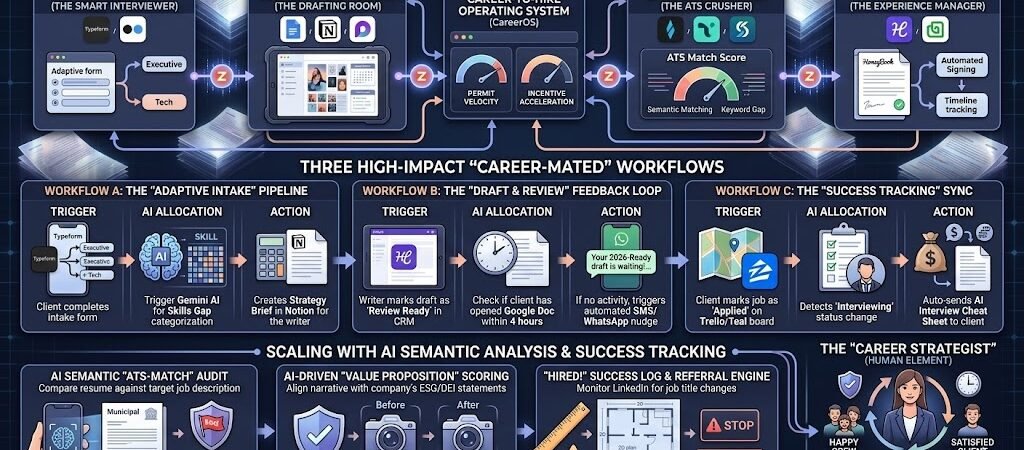
1. The Intake Hub (The Smart Interviewer)
- The Tools: Typeform or Tally.so (integrated with VideoAsk).
- The Value: Modern intake forms are “branching.” If a client selects “Executive,” the form asks about P&L responsibility; if they select “Tech,” it asks for their tech stack.
- The Zap: When a client submits their form, Zapier sends the data to Gemini AI to create a “Client Strategy Brief” in Notion, highlighting their strongest achievements and potential red flags.
2. The Collaboration Engine (The Drafting Room)
- The Tools: Google Docs, Notion, or Microsoft Loop.
- The Value: Real-time feedback is essential for high-velocity career moves.
- The Zap: When you move a client’s project to “Drafting” in your CRM (HoneyBook), Zapier creates a dedicated Google Doc from a template and invites the client with “Commenter” access.
3. The Optimization Layer (The ATS Crusher)
- The Tools: Jobscan, Teal, or Skillsyncer.
- The Value: These tools compare the resume against specific job descriptions to ensure a high “Semantic Match” score.
- The Zap: When a client uploads a target job description to their Notion dashboard, Zapier triggers an automated Teal scan and reports the “Keyword Gap” back to the writer via Slack.
4. The Client CRM (The Experience Manager)
- The Tools: HoneyBook or Bonsai.
- The Value: This handles the “business of writing”—contracts, payments, and project timelines.
- The Zap: Upon payment of the final invoice, Zapier triggers a “Success Kit” email containing the final files, a LinkedIn optimization guide, and a link to the “Job Application Tracker.”
The “Career-to-Hire” Stack Map
| Category | 2026 Recommended Tools | The “Zap” Value |
| Intake | Typeform / VideoAsk | Converts raw history into a structured Strategy Brief. |
| Drafting | Google Docs / Notion | Automates template creation and client access. |
| Optimization | Jobscan / Teal | Checks “ATS Match” against real job postings. |
| Success | HoneyBook / Zapier Tables | Tracks “Time-to-Interview” and client testimonials. |
The 2026 Edge: Most writers waste 40% of their time on formatting and “chasing info.” The 2026 Automated Writer uses Zapier to ensure the data is ready before they open the draft. You aren’t just writing; you are managing a high-speed career transition.
Three High-Impact “Career-Mated” Workflows
These workflows eliminate the “Black Hole” effect where resumes vanish into corporate databases. By automating the follow-up and the application tracking, you ensure your clients stay at the top of the pile.
Workflow A: The “Adaptive Intake” Pipeline
The Goal: From raw data to a “Strategy Brief” in minutes.
- Trigger: A client completes your 2026 AI-driven intake form (Typeform or Tally).
- The Logic: Zapier sends the raw answers to Gemini AI to categorize the client’s “Skills Gap” and identify “High-Value Achievements” based on current 2026 market trends.
- Action: Zapier creates a pre-filled Notion dashboard for the writer, including a “Target Keyword Map” for the client’s specific industry.
- The Result: You start writing with a strategic blueprint already in place, cutting your research time by 70%.
Workflow B: The “Draft & Review” Feedback Loop
The Goal: Slash the “Approval Lag” that stalls projects.
- Trigger: You move the client’s status to “Review Ready” in your CRM (HoneyBook).
- The Logic: Zapier detects the status change and checks if the client has opened the Google Doc within 4 hours.
- Action: If no activity is detected, Zapier triggers an automated WhatsApp/SMS nudge: “Your 2026-Ready draft is waiting! Check your email for the link—feedback by tomorrow keeps us on track for your Monday application deadline.”
- The Result: You maintain high project velocity and avoid the “Friday Afternoon” feedback rush.
Workflow C: The “Success Tracking” Sync
The Goal: Transform “Writing” into “Career Management.”
- Trigger: A client adds a job link to their Teal or Trello “Applied” board.
- The Logic: Zapier monitors these links. If a job is marked as “Interviewing,” it triggers a specific support sequence.
- Action: Zapier automatically sends the client an AI-generated “Interview Cheat Sheet” specifically tailored to that company’s 2026 culture and the specific keywords used in their resume.
- The Result: You aren’t just a writer; you are a partner in their hire, justifying a premium “Success-Based” fee structure.
Scaling with AI Semantic Analysis & Success Tracking
The Applicant Tracking Systems (ATS) of 2026—often called ATS 2.0—have evolved beyond simple keyword matching. They now use Semantic Matching to understand context, meaning that “keyword stuffing” can actually get a candidate flagged for “AI-generated spam.” To scale, you must use AI to audit your writing at the same level as the recruiters.
1. The “Semantic Match” Audit
Modern recruiters look for “Skills Clusters” rather than isolated terms.
- The Workflow: Once a draft is finished, Zapier sends the text and the target job description to Gemini AI for a “Contextual Audit.”
- The Intelligence: The AI doesn’t just look for “Project Management.” It checks if your bullet points demonstrate the actions associated with it—like “cross-functional leadership” or “resource allocation.”
- The Action: If the Semantic Score is below 85%, Zapier flags the specific achievement bullets that need more “Impact Evidence” (the X-Y-Z formula: Accomplished [X] as measured by [Y], by doing [Z]).
2. AI-Driven “Value Proposition” Scoring
In 2026, the old “Objective” statement is dead, replaced by the Value Proposition Summary.
- The Workflow: Zapier triggers a scan of the summary against the company’s 2026 ESG (Environmental, Social, and Governance) or DEI public statements.
- The Result: The AI suggests subtle pivots in the narrative to align the client’s values with the company culture, increasing the “Cultural Fit” score before a human even reads it.
3. The “Success Log” & Referral Engine
The most valuable data point in your business is the “Hired” notification.
- The Trigger: A client updates their LinkedIn job title (detected via periodic API checks or a client “Success Form”).
- The Logic: This triggers an automated “Celebration Sequence.”
- The Action: 1. Zapier sends a gift card and a “Congrats” message. 2. It logs the Time-to-Hire and Salary Increasein your “Results Vault.” 3. It triggers a “Referral Request” to the client’s network.
- The Result: You build an ironclad, data-backed marketing case: “Our clients get hired 40% faster with a 20% higher starting salary.”
The “Velocity & Result” Metric Table
| Category | 2026 Tech Integration | The Business Value |
| ATS Audit | Gemini AI + Teal/Jobscan | Guarantees an 85%+ “Semantic Match” score. |
| Narrative Check | NLP Sentiment Analysis | Ensures tone is “Executive-Ready” and culturally aligned. |
| Success Tracking | LinkedIn API / Success Form | Collects hard ROI data for your marketing. |
| Interview Prep | AI Mock Interviewer | Auto-generates role-specific questions for the client. |
The 2026 Edge: In the past, “optimization” was a guess. In 2026, your Semantic Audit is a mathematical certainty. You aren’t just giving them a resume; you are giving them a verified key to the interview door.
The “Career Strategist” (The Human Element)
The most common fear in 2026 is that AI will replace the resume writer entirely. In reality, Zapier for Resume Writersdoes the opposite: it removes the manual labor of keyword matching so you can focus on the intentional storytelling that triggers a human recruiter to hit “Schedule Interview.”
1. Storytelling Over Formatting
In 2026, resumes are moving toward a “Fixer” Narrative. Companies are looking for leaders who can stabilize organizations through disruption.
- The Strategy: While Zapier handles the ATS formatting, you use your reclaimed time to interview the client and extract the “Messy Middle”—the challenges they overcame that an AI-generated bullet point could never capture.
- The Connection: You aren’t just listing duties; you are defining their Personal Brand. In an automated world, “Saying what only you can say” is the ultimate competitive advantage.
2. Confidence as a Service
The job search in 2026 can be isolating, with candidates often ghosted by automated systems.
- The Opportunity: Use automation to provide “Candidate Nurturing.”
- The Zap: Send automated but personalized “Monday Motivation” emails or “Interview Day Tips” based on the client’s current status in their Trello board.
- The Result: You become a high-value coach who manages the client’s morale, not just their paper.
3. The “Intentionally Memorable” Personal Brand
Recruiters in 2026 evaluate candidates’ digital footprints before the CV is even opened.
- The Transition: Move beyond the PDF and help clients curate their “Digital Memo.”
- The Action: Use Zapier to send automated reminders for LinkedIn engagement or to help them “audit” their online presence.
- The Human Win: When you help a client move from “Visible” to “Memorable,” you justify premium pricing that AI builders can’t touch.
Implementation Guide—The 90-Day “Career-to-Hire” Roadmap
The goal is to solve the “Intake Inertia” first, then automate the optimization and success tracking that proves your ROI to high-paying executive clients.
Phase 1: The “Smart Intake” Foundation (Days 1–30)
- The Goal: Eliminate the “back-and-forth” data gathering lag.
- The Tech: Connect Typeform (or Tally) to Gemini AI and Notion.
- The Action: Set up a Zap that parses intake answers to generate a “Strategic Narrative Brief.” This should identify the client’s top three “Value Propositions” before you even have the first consultation.
- The Result: You walk into every client call with a strategy already mapped out, significantly increasing your professional authority.
Phase 2: The “Review Velocity” Protocol (Days 31–60)
- The Goal: Speed up draft approvals and reduce project turnaround time.
- The Tech: Integrate Google Docs with WhatsApp Business or Twilio.
- The Action: Implement the “Automated Nudge” Zap. If a client hasn’t opened their draft within 24 hours, they receive a text reminder with a link.
- The Result: Your project completion time drops by 40%, allowing you to take on more clients without increasing your hours.
Phase 3: The “Optimization & Results” Layer (Days 61–90)
- The Goal: Automate the “ATS Audit” and track client hiring outcomes.
- The Tech: Teal/Jobscan and Zapier Tables.
- The Action: 1. Create a Zap that runs an “ATS Semantic Check” every time a client adds a job link to their dashboard. 2. Set up the Success Log to monitor LinkedIn profile changes and auto-request testimonials when a client lands a role.
- The Result: You move from selling a “Resume” to selling a “Hire,” allowing you to charge “Performance” or “Success” bonuses.
Conclusion: Writing the Future of Work
In 2026, the most successful resume writers are Data-Driven Career Agents. By leveraging Zapier for Resume Writers, you transform a labor-intensive writing service into a high-speed career engine. You stop being a “document editor” and start being the High-Velocity Architect of your client’s future.
Stop chasing work history and start automating your career engine. Build your first “Adaptive Intake” Zap today.

About the Author
Aapt DubeyAapt Dubey is an automation specialist and software developer dedicated to eliminating manual workflows for small businesses. With deep, hands-on experience building complex Zapier integrations, API connections, and real-world applications, Aapt writes actionable, tested tutorials to help businesses scale efficiently.