
From “Interior Design” to “Real Estate Velocity”
Traditionally, home staging was viewed as a luxury boutique service—a final “polish” before an open house. In 2026, staging is a critical link in the high-speed sales supply chain. If a house isn’t staged, photographed, and listed within 72 hours of the deep clean, the listing loses its “Fresh” algorithmic boost on major platforms.
The “Inventory Fog” Bottleneck
The biggest killer of velocity in a staging business isn’t a lack of creativity; it’s logistics.
- The Old Way: Relying on memory or messy spreadsheets to know which velvet armchair is at the “Lakeview” property and which is in the warehouse. This leads to double-booking hero pieces and frantic last-minute substitutions.
- The 2026 Way: Using Zapier for Home Stagers, your inventory is a “live” ecosystem. Every sofa, lamp, and rug is a tracked asset that moves through your pipeline with zero manual data entry.
Creating “Algorithm-Ready” Environments
In 2026, you aren’t just designing for the person walking through the front door; you are designing for the AI-powered search engines.
- Visual SEO: Listings are now indexed by the furniture “vibes” they project.
- The Automation Edge: By automating your staging reports and photo uploads, you ensure that the Realtor has the “Visual Assets” they need to list the property the moment you pull the moving truck away.
By shifting your focus to velocity, you stop being a “decorator” and start being a Strategic Marketing Partner. You aren’t just placing furniture; you are shortening the “Days on Market” (DOM) for every listing you touch, which is the only metric that truly matters to your high-end Realtor clients.
The Stager’s Tech Stack (The 2026 Digital Warehouse)
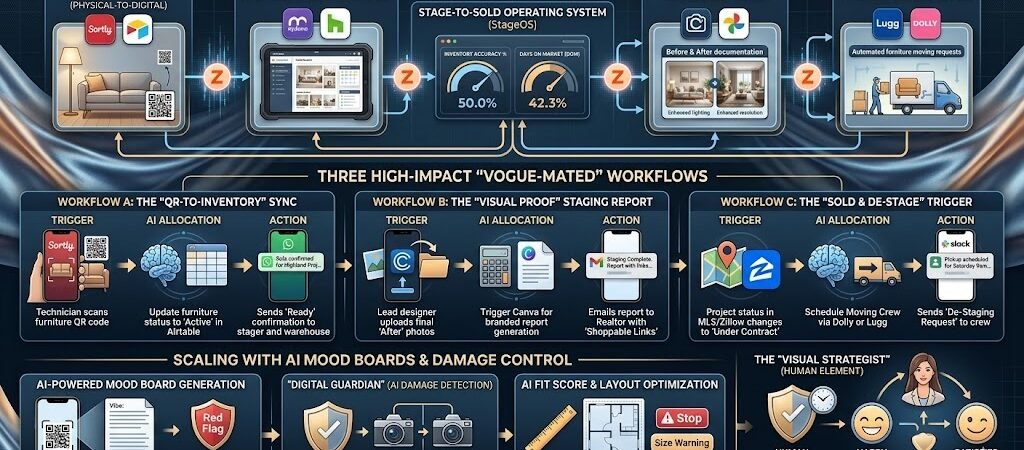
The goal of your 2026 stack is “Total Inventory Visibility.” By using Zapier to link QR-code scans directly to your project management software, you eliminate the “Inventory Fog” and ensure your team always knows exactly what’s available for the next mansion.
1. The Inventory Hub (Physical-to-Digital)
- The Tools: Sortly or Airtable (Mobile-first, QR-based tracking).
- The Value: Every item—from a $5,000 sectional to a $50 vase—has a unique digital ID.
- The Zap: When a warehouse tech scans an item’s QR code as “Out for Delivery,” Zapier automatically moves that item’s status to “Installed” in the project’s Airtable and updates its location to the property address.
2. The Creative Project Manager
- The Tools: Mydoma Next or Houzz Pro.
- The Value: This is where mood boards, floor plans, and contracts live.
- The Zap: When a “Staging Agreement” is signed in PandaDoc, Zapier creates a new project folder in Google Drive and triggers a “Selection Request” to the design team to start pulling inventory.
3. The Visual Asset Layer
- The Tools: CompanyCam or Google Photos.
- The Value: “Before & After” photos are the lifeblood of your marketing and liability protection.
- The Zap: When a stager uploads “After” photos to a property folder, Zapier triggers Cloudinary to auto-enhance the lighting (to “Listing Standard”) and saves them to a “Social Media Ready” sub-folder.
4. The Logistics & Moving Engine
- The Tools: Lugg, Dolly, or ServiceTitan (for internal fleets).
- The Value: Managing the heavy lifting requires precise timing.
- The Zap: When a project is marked “Staged” in your CRM, Zapier sends a “Job Completion” summary to the Realtor and schedules a “Quality Check” visit for the following week.
The “Stage-to-Sold” Stack Map
| Category | 2026 Recommended Tools | The “Zap” Value |
| Inventory | Sortly / Airtable | Real-time tracking via QR scans. |
| Design/PM | Mydoma Next / Houzz Pro | Syncs client contracts with design mood boards. |
| Photography | CompanyCam / Photos | Auto-organizes “Before & After” assets. |
| Logistics | Lugg / Zapier Tables | Automates de-staging requests upon home sale. |
The 2026 Edge: Most stagers lose hours looking for a specific rug or blaming movers for “missing” lamps. The 2026 Automated Stager has a digital twin of their warehouse. When Zapier handles the tracking, your “Available” list is 100% accurate, 100% of the time.
Three High-Impact “Vogue-Mated” Workflows
These workflows remove the manual friction of inventory management and reporting, allowing you to focus on the “hero” shots that sell the home.
Workflow A: The “QR-to-Inventory” Sync
The Goal: Real-time warehouse accuracy.
- Trigger: A technician scans a furniture QR code using Sortly as it’s loaded onto the truck.
- The Logic: Zapier detects the “Status Change” to “On-Site.”
- Action: Zapier updates the Airtable record for that specific property and creates a “Digital Packing List.”
- The Result: If a Realtor asks, “Do we have that blue velvet sofa available for a new listing?” you can answer with 100% certainty in seconds, not hours.
Workflow B: The “Visual Proof” Staging Report
The Goal: Instant Realtor gratification and marketing fuel.
- Trigger: The lead designer uploads the final “After” photos to a specific Google Photos or CompanyCam album.
- The Action: 1. Zapier pulls the photos into a branded Canva “Staging Completion Report.” 2. It emails the PDF to the Realtor, including a “Shoppable List” of pieces for the potential buyer to purchase.
- The Result: The Realtor has professional assets ready for the MLS before your truck has even left the neighborhood.
Workflow C: The “Sold & De-Stage” Trigger
The Goal: Automate the exit to free up inventory.
- Trigger: Project status changes to “Under Contract” (monitored via Zillow API or your CRM’s sync with the MLS).
- The Logic: Zapier calculates the closing date and sets a “Buffer” of 48 hours.
- Action: Zapier automatically sends a “De-Staging Request” to your moving crew via Slack and schedules the pickup.
- The Result: Your high-value inventory is returned to the warehouse and made available for the next project without a single “When can you pick this up?” phone call.
Scaling with AI Mood Boards & Damage Control
As you scale from staging 5 homes a month to 50, the “human eye” becomes a bottleneck. In 2026, we use Zapier and Gemini AI to bridge the gap between creative vision and logistical reality, ensuring your designs are data-driven and your assets are protected.
1. AI-Powered Mood Boards (Design at Scale)
Creating a unique mood board for every property is time-consuming.
- The Workflow: When a new project is created in Mydoma Next, Zapier sends the Realtor’s property description and “vibe” notes to Gemini AI.
- The Intelligence: The AI analyzes the listing’s target demographic (e.g., “Young Professional Couple” vs. “Growing Family”) and suggests a design style like Japandi or Sustainable Minimalism.
- The Result: Zapier cross-references this style with your Airtable inventory and auto-populates a “Suggested Furniture List” of items currently in the warehouse. Your designer spends 15 minutes refining a board instead of 4 hours building one from scratch.
2. The “Digital Guardian” (AI Damage Detection)
Furniture damage is the hidden tax of the staging industry. In 2026, “I didn’t notice that scratch” is a thing of the past.
- The Workflow: When an item is de-staged and returns to the warehouse, the crew snaps a “Return Photo.”
- The Action: Zapier sends the “Return Photo” and the “Pre-Install Photo” to a Computer Vision AI.
- The Detection: If the AI detects a new stain, tear, or scratch, it automatically:
- Triggers a “Damage Alert” to the warehouse manager.
- Creates a “Repair/Cleaning” ticket.
- Pre-fills an insurance claim form if the damage exceeds the security deposit.
3. AI Fit Score & Layout Optimization
Staging a condo vs. a coastal estate requires different spatial logic.
- The Trigger: Upload a 2D floor plan or MagicPlan 3D scan to the project folder.
- The Logic: AI analyzes the dimensions and suggests furniture layouts that maximize “Visual Flow” (essential for 2026’s VR-tours).
- The Value: It flags if a king-sized bed will make a bedroom look too small, preventing a “Move-Day Disaster” where the furniture doesn’t fit the space.
The “Scale & Shield” Metric Table
| Category | 2026 Tech Integration | The Business Value |
| Concepting | Gemini AI + Mydoma | Reduces design time by 75% using “AI Vibe Matching.” |
| Asset Safety | Vision AI + Sortly | Recovers thousands in damage fees with automated proof. |
| Space Planning | MagicPlan + Zapier | Eliminates “Doesn’t Fit” errors and costly re-deliveries. |
| Social Media | Canva AI + Photos | Auto-generates “Trend Reports” for your Instagram. |
The 2026 Edge: In the past, you needed a “Manager” to walk the warehouse and check for stains. In 2026, your Digital Guardian monitors every asset simultaneously. You aren’t just a stager; you are a High-Asset Logistics Specialist.
The “Visual Strategist” (The Human Element)
The most common fear in the 2026 market is that automation will make homes feel like “cookie-cutter” showrooms. In reality, Zapier for Home Stagers does the opposite: it removes the manual labor of tracking sofas so you can focus on the intentional design that triggers an emotional “must-buy” response.
1. Neuroaesthetics and Emotional ROI
In 2026, high-end staging has shifted toward “Modern Heritage”—a mix of vintage soul and contemporary clean lines.
- The Strategy: While Zapier handles the QR-code logistics, you use your reclaimed time to curate “Hero Pieces” that create an immediate connection.
- The Connection: Buyers aren’t just looking for a layout; they’re looking for a feeling. Using automated data to see which “vibes” (e.g., Biophilic Green vs. Warm Terracotta) are selling fastest in specific zip codes allows you to design with scientific precision.
2. The “Shoppable Home” Revenue Stream
Modern buyers often want to move into the “lifestyle” exactly as you’ve staged it.
- The Opportunity: By automating your staging reports, you can include “Shoppable Links” for the furniture used.
- The Zap: If a buyer clicks a link to purchase a staged lamp or rug, Zapier can track the affiliate commission or trigger a “Sell-from-Site” workflow, turning your inventory into a direct-sales channel.
3. Scaling the “Personal Touch”
Automation allows you to maintain a high-touch client experience without the high-stress overhead.
- The Balance: Use automated “Milestone Texts” to tell Realtors: “The ‘Desert Chic’ install is 50% complete—the natural light in the primary suite is stunning.”
- The Human Win: You stop being a “vendor” and start being a Marketing Partner. Your value is no longer in the moving; it is in the visual storytelling that shortens “Days on Market” (DOM) and maximizes sale price.
Implementation Guide—The 90-Day “Stage-to-Sold” Roadmap
The goal is to solve the inventory crisis first, then automate the communication that makes Realtors see you as an indispensable partner.
Phase 1: The “Inventory Integrity” Foundation (Days 1–30)
- The Goal: Achieve 100% warehouse visibility and eliminate double-bookings.
- The Tech: Connect Sortly (or Airtable) to Zapier Tables.
- The Action: 1. QR-code every major asset in your warehouse. 2. Set up the Zap that updates an item’s status to “Deployed” the moment it is scanned onto a truck.
- The Result: You can tell a client exactly what’s available for a Friday install in three seconds, not three hours.
Phase 2: The “Marketing Velocity” Protocol (Days 31–60)
- The Goal: Automate the delivery of staging assets to your Realtors.
- The Tech: Integrate CompanyCam (or Google Photos) with Canva and Gmail/WhatsApp.
- The Action: Create a Zap that triggers when “After” photos are uploaded. It pulls them into a branded “Staging Completion Report” and sends it to the Realtor with listing-ready descriptions.
- The Result: The Realtor has everything they need to go live on the MLS before you’ve even finished unloading the truck.
Phase 3: The “Closed-Loop” Scaling (Days 61–90)
- The Goal: Automate the de-staging process and implement AI safety.
- The Tech: Gemini AI and a sync with the MLS/Zillow API.
- The Action: 1. Set up the “MLS Trigger” that schedules a de-staging pickup the moment a house moves to “Under Contract.” 2. Implement the AI Damage Scan—comparing “In” vs. “Out” photos to flag repair needs automatically.
- The Result: Your inventory cycles faster, your damage claims are undeniable, and your design team is freed up to focus on the next luxury mansion.
Conclusion: Designing the Future of Sale
In 2026, the most successful home stagers aren’t just great decorators; they are Logistics Architects. By leveraging Zapier for Home Stagers, you transform a chaotic warehouse into a high-speed marketing engine. You stop chasing furniture and start chasing Real Estate Velocity.
Stop manual inventory checks and start automating your design pipeline. Build your first “QR-to-Project” Zap today.

About the Author
Aapt DubeyAapt Dubey is an automation specialist and software developer dedicated to eliminating manual workflows for small businesses. With deep, hands-on experience building complex Zapier integrations, API connections, and real-world applications, Aapt writes actionable, tested tutorials to help businesses scale efficiently.