
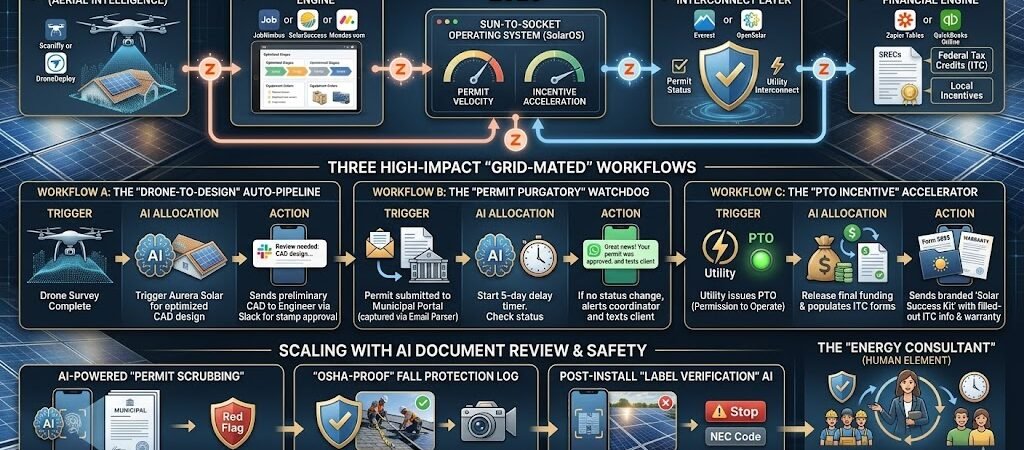
The Velocity Advantage (Winning the Race to “Live Grid”)
The solar industry in 2026 is defined by “Soft Costs.” While the price of silicon continues to drop, the cost of labor, permitting, and customer acquisition remains high. For many installers, the time between a customer signing a contract and the system actually turning on—the “Lead-to-PTO” gap—is where profits go to die.
The “Permit Purgatory” Problem
Traditionally, a solar project could sit in a municipal “black hole” for weeks. During this time:
- Cancellations Spike: The longer a client waits without an update, the more likely they are to experience “buyer’s remorse.”
- Capital is Locked: Installers often carry the cost of equipment and labor long before the final incentive check arrives.
- Route Inefficiency: You can’t schedule your crews effectively if you don’t know exactly when a permit will be released.
The 2026 Shift: High-Velocity Automation
By utilizing Zapier for Solar Installers, you turn a manual, reactive process into a proactive “Sun-to-Socket” pipeline.
- The Old Way: A project coordinator manually checks government portals and utility websites to see if a permit or interconnection has been approved.
- The 2026 Way: Automation monitors these portals for you. The moment a status changes from “Pending” to “Approved,” Zapier triggers the equipment order, notifies the crew, and sends an celebratory “Milestone Text” to the client.
In an era of high interest rates, speed is a financial product. Every day you shave off the installation timeline increases your cash flow and decreases your customer acquisition cost. Automation isn’t just about saving time; it’s about making your solar business “bankable” by proving you can move from “Contract” to “Connected” faster than anyone else in your region.
The Installer’s Tech Stack (The 2026 Energy Office)
The goal of your 2026 tech stack is “Zero-Entry Engineering.” By using Zapier to link drone data directly to design software, you eliminate the manual drafting errors that lead to permit rejections.
1. The Design & Survey Hub (Aerial Intelligence)
- The Tools: Scanifly (drone surveys) and Aurora Solar (AI design).
- The Value: Drone-based LIDAR data is now the industry standard for centimeter-accurate roof measurements.
- The Zap: When a Scanifly drone survey is marked “Complete,” Zapier automatically pushes the 3D point-cloud data into Aurora Solar to generate the preliminary shade analysis and string layout.
2. The Project Management Engine
- The Tools: JobNimbus, SolarSuccess, or Monday.com.
- The Value: Managing a “Sun-to-Socket” pipeline requires tracking hundreds of moving parts across multiple households.
- The Zap: When a contract is signed in DocuSign, Zapier creates a new project board, assigns a lead installer, and triggers the “Equipment Request” in your inventory system.
3. The Compliance & Interconnect Layer
- The Tools: OpenSolar or Everest.
- The Value: These platforms specialize in the “Soft Cost” side—utility interconnection applications and municipal permit tracking.
- The Zap: When a building permit status changes in your municipal portal (monitored via Email Parser), Zapier instantly updates the project status and notifies the client: “Great news! Your structural permit was approved. Our crew is now scheduling your install date.”
4. The Incentive & Financial Engine
- The Tools: Zapier Tables and QuickBooks Online.
- The Value: Managing Federal Tax Credits (ITC) and State RECs requires precise kWp (kilowatt-peak) data.
- The Zap: Upon the “Permission to Operate” (PTO) trigger from the utility, Zapier populates a tax-ready summary of the system costs and production specs, ready for the client’s accountant.
The “Sun-to-Socket” Stack Map
| Category | 2026 Recommended Tools | The “Zap” Value |
| Site Survey | Scanifly / DroneDeploy | Automates 3D modeling from drone footage. |
| Design | Aurora Solar / HelioScope | Generates AI-optimized shade & CAD layouts. |
| Compliance | Everest / OpenSolar | Tracks permit status & utility interconnects. |
| Financing | GoodLeap / Sunlight Fin. | Auto-triggers loan funding upon PTO. |
The 2026 Edge: Most installers lose 10 days in the “handoff” between the surveyor and the designer. The 2026 Automated Installer eliminates that gap entirely. When Zapier handles the data transfer, your engineer starts working on a “stamped” design before the drone has even landed back at the van.
Three High-Impact “Grid-Mated” Workflows
These workflows remove the administrative “dead time” between the roof work and the actual activation of the system, ensuring your cash flow remains as steady as the sun.
Workflow A: The “Drone-to-Design” Auto-Pipeline
The Goal: Eliminate the 72-hour engineering lag.
- Trigger: A field technician uploads the final 3D site scan from a drone (via Scanifly) to the cloud.
- The Logic: Zapier detects the “Survey Complete” status and instantly pulls the rooftop obstructions and shade data.
- Action: Zapier triggers Aurora Solar to generate a preliminary CAD layout and pushes it to your Structural Engineer’s Slack for a final “Stamp” approval.
- The Result: Your design phase drops from 3 days to 45 minutes.
Workflow B: The “Permit Purgatory” Watchdog
The Goal: Proactive intervention on municipal delays.
- Trigger: A building permit application is submitted (captured via Email Parser or Everest).
- The Logic: Zapier starts a “Grace Period” timer. If the status in the municipal portal hasn’t moved to “In Review” or “Approved” within 5 business days:
- Action: Zapier creates a high-priority “Phone Call” task for your coordinator and sends a branded text to the client: “We’ve noticed a slight delay at the City Office—we’re on the phone with them now to keep your project on track!”
- The Result: You stop being reactive to delays and start managing client expectations before they turn into complaints.
Workflow C: The “PTO Incentive” Accelerator
The Goal: Speed up final funding and tax credit filing.
- Trigger: The Utility company issues the “Permission to Operate” (PTO) via their portal.
- The Logic: This is the “Golden Trigger.” Zapier pulls the final system size (kWp) and equipment serial numbers.
- Action: 1. Zapier notifies the finance provider (GoodLeap/Sunlight) to release final funding. 2. It auto-generates a “Solar Success Kit” for the client, containing their filled-out Federal Tax Credit (ITC) info and warranty documents.
- The Result: You get paid faster, and your client feels supported through the most confusing part of the process.
Scaling with AI Document Review & Safety
As your installation volume doubles, the biggest bottleneck is often the “Technical Correction.” A single typo in a permit application or a missed “warning” label in a site photo can set a project back by weeks. In 2026, we use Zapier and Gemini AI to catch these errors before they leave your office.
1. AI-Powered “Permit Scrubbing”
Municipalities are notorious for sending back 20-page “Correction Notices” for a single structural minor detail.
- The Workflow: When a rejection email arrives from the city, Zapier’s Email Parser grabs the attachment and sends it to Gemini AI.
- The Intelligence: The AI is trained on your local building codes. It “scrapes” the PDF for the specific reason for rejection (e.g., “Wind load calculation for Zone B missing”).
- The Safety Net: Zapier instantly alerts the lead designer via Slack with a direct link to the correction area: “⚠️ Permit Rejected: Adjust wind load specs on Page 4 for the Highland Project.”
- The Result: You resubmit in hours, not days, maintaining your installation velocity.
2. The “OSHA-Proof” Fall Protection Log
Safety is your #1 liability on the roof. In 2026, “I thought he was clipped in” is not a legal defense.
- The Workflow: A crew lead cannot mark the “Racking” phase as complete in JobNimbus until a “Safety Scan” is uploaded.
- The Action: The lead snaps a 360° photo of the roof, showing all team members attached to their anchor points.
- The Zap: Zapier logs this photo with a GPS and time-stamp in your Compliance Vault.
- The Result: You build an ironclad audit trail that lowers your insurance premiums and protects your team.
3. Post-Install “Label Verification” AI
Interconnection is often delayed because a “Danger: High Voltage” sticker was placed two inches too low for the utility inspector.
- The Trigger: Technician uploads the “Final Commissioning” photos.
- The Logic: AI scans the photos for required NEC (National Electrical Code) labeling and placard placement.
- The Action: If a label is missing or obscured, Zapier sends a “Stop” alert to the tech’s phone: “⚠️ Interconnect Failure Risk: DC Disconnect label missing. Apply before leaving site.”
The “Velocity & Compliance” Metric Table
| Category | 2026 Tech Integration | The Business Value |
| Permit Review | Gemini AI + Everest | Reduces “Rejection Loop” time by 80%. |
| Safety Logs | 360° Photos + Zapier Tables | Proof of fall-protection for OSHA/Insurance. |
| Label Check | AI Image Recognition | Guarantees first-time Utility Interconnect approval. |
| Equipment Monitoring | Enphase/Tesla + Zapier | Auto-notifies office of production “Dead Zones.” |
The 2026 Edge: In the past, you needed a manager for every three crews to maintain quality. In 2026, your AI Oversight monitors every roof simultaneously. You aren’t just scaling; you are future-proofing your reputation.
The “Energy Consultant” (The Human Element)
The most common fear in the 2026 solar market is that automation will make the experience feel like a faceless utility transaction. In reality, Zapier for Solar Installers does the opposite: it removes the anxiety of the “Waiting Period” so you can focus on educating the client.
1. Trust Through Micro-Transparency
Solar has a notoriously long “fulfillment gap”—the weeks between the sale and the power being turned on.
- The Connection: When you use automated “Milestone Updates,” you aren’t just sending a status report; you are providing psychological relief.
- The Result: A client who receives a text saying, “Your CAD design just passed engineering review,” feels progress. This transparency eliminates “Buyer’s Remorse” and builds a level of trust that justifies premium pricing.
2. Moving Beyond the “One-Time Sale”
Modern solar is not just about panels; it’s about Grid Management (VPPs, battery storage, and EV charging).
- The Strategy: While Zapier handles the permit tracking, you use that reclaimed time to consult on the client’s energy future.
- The Upsell: Because you aren’t stuck on the phone with the utility company, you can explain how their new battery backup will protect them during the next grid event. You become a trusted advisor, not a one-time contractor.
3. The “Post-Install” Guardian
The relationship shouldn’t end when the crew leaves the roof.
- The Balance: Use automation to monitor the system’s performance via API. If production dips below 15% of the projected yield (due to dust or a faulty micro-inverter), Zapier alerts you before the client even notices their bill is higher.
- The Human Win: When you call a client to say, “We noticed a production dip and have a tech in your area to clean your panels,” you create a customer for life.
Implementation Guide—The 90-Day “Sun-to-Socket” Roadmap
The goal is to eliminate the largest “soft cost” bottlenecks—design handoffs and permit tracking—before layering on advanced AI diagnostics.
Phase 1: The “Design Velocity” Foundation (Days 1–30)
- The Goal: Eliminate the 3-day engineering lag between survey and design.
- The Tech: Connect Scanifly (or your drone app) to Aurora Solar.
- The Action: Set up the Zap that triggers the 3D model generation and shade analysis the moment the drone flight data is uploaded.
- The Result: Your sales team can present a “Final Engineering” layout to the client while the excitement of the site visit is still fresh.
Phase 2: The “Permit Purgatory” Protocol (Days 31–60)
- The Goal: Automate client updates and municipal monitoring.
- The Tech: Integrate Everest/OpenSolar with WhatsApp Business and Email Parser.
- The Action: 1. Implement the “Watchdog Zap” to monitor municipal portal status changes. 2. Automate “Milestone Texts” to clients so they are notified the second a permit is approved or a utility interconnect is requested.
- The Result: You eliminate “Where is my project?” calls and reduce client anxiety during the long fulfillment gap.
Phase 3: The “Compliance & Incentive” Layer (Days 61–90)
- The Goal: Speed up final funding and ensure 100% safety compliance.
- The Tech: Gemini AI and Zapier Tables.
- The Action:
- Set up the AI Permit Scrubber to analyze rejection notices and flag corrections instantly.
- Implement the Incentive Accelerator—automatically populating Federal Tax Credit (ITC) data once the “Permission to Operate” (PTO) is issued.
- Mandatory “Safety Scan” upload requirement for all roof-work completions.
- The Result: You get paid faster, your team stays safer, and your business becomes a “referral machine.”
Conclusion: Powering the Future
In 2026, the solar business is a race of administrative efficiency. By leveraging Zapier for Solar Installers, you transform a complex, bureaucratic nightmare into a sleek, automated energy pipeline. You stop being a “roofer with panels” and start being a High-Velocity Utility Partner.
Stop waiting for the city to call and start automating your grid connection. Build your first “Drone-to-Design” Zap today.

About the Author
Aapt DubeyAapt Dubey is an automation specialist and software developer dedicated to eliminating manual workflows for small businesses. With deep, hands-on experience building complex Zapier integrations, API connections, and real-world applications, Aapt writes actionable, tested tutorials to help businesses scale efficiently.