From Tidy Boxes to Intelligent Systems
For years, the “gold standard” of a professional organizer was the “After” photo: rows of matching bins, perfectly folded linens, and color-coded pantries. But the industry’s biggest secret was the Maintenance Gap. Without a system to manage the flow of new items coming into a home, even the most beautiful organization eventually collapses.
In 2026, “Tidy” is a temporary state; “Systemic” is a permanent solution.
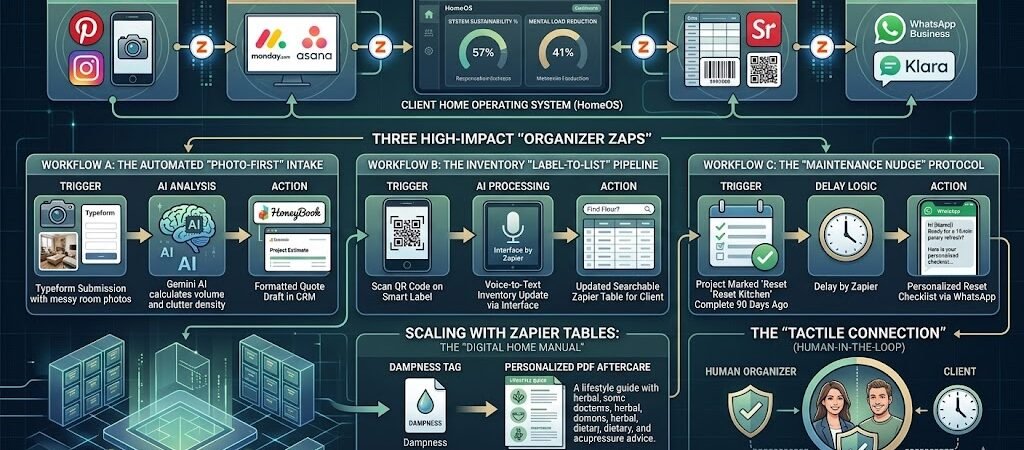
The shift toward Zapier for Professional Organizers represents the evolution of the craft. You are moving away from being a manual laborer who simply moves boxes, to becoming a Spatial Architect. This means you aren’t just clearing a shelf; you are installing a “Home Operating System” (HomeOS) that manages the life of the objects on that shelf.
The Death of the Static After-Photo
Static organization is reactive—it fixes a mess that has already happened. Automated organization is proactive.
- The Old Way: You organize a playroom in January. By April, the client calls you back because they’ve bought ten new toys, and the original bins are overflowing.
- The 2026 Way: Using Zapier, you create a “One-In, One-Out” trigger. When a client scans a new toy into their digital inventory, Zapier sends a friendly nudge: “New toy added! Which old one should we donate to keep the bin at 80% capacity?”
Why Systems Win Over Aesthetics
While the visual appeal of a project remains important for your portfolio, the systemic logic is what drives your referrals and long-term revenue. In 2026, automation acts as the “glue” that holds your physical work together. By offloading the “inventory memory” to Zapier, you solve the primary psychological hurdle of organizing: Decision Fatigue.
When you automate the intake of new items, the tracking of warranties, and the schedule of seasonal refreshes, you aren’t just selling a clean room—you are selling mental clarity.
The 2026 Organizer’s Tech Stack (The Orchestration Layer)
For the automated organizer, technology is the “invisible infrastructure” that ensures a client’s home stays organized long after you leave the driveway. By using Zapier to bind these tools together, you create a seamless loop between physical space and digital management.
1. The Visual & Spatial Layer: AI Analysis
The consultation phase is no longer about walking around with a clipboard.
- The Tool: Gemini AI integrated with Typeform or WhatsApp.
- The Automation: Clients upload video walkthroughs or photos of their “danger zones.” Zapier sends these to AI to calculate volume, estimate the number of large-item removals needed, and even suggest the specific dimensions for shelving units.
- The Benefit: You arrive on-site with a pre-loaded shopping list and a labor estimate that is 95% accurate.
2. The Inventory Layer: Searchable Homes
The biggest complaint from clients after an organizing session is: “I know it’s put away, but I can’t find it.” In 2026, we solve this with Dynamic Inventory.
- The Tool: Sortly, HomeInventory, or Zapier Tables.
- The Integration: Every bin gets a unique QR code. When you (or the client) scan it, Zapier pulls up the live contents list.
- The Future-Proofing: If a client moves, the “Digital Home Map” moves with them, ensuring they never lose a box in the attic again.
3. The Project Brain: Multi-Room Management
Managing a whole-home project requires more than a to-do list; it requires a timeline that syncs with vendors, movers, and the client’s schedule.
- The Tool: Monday.com or Asana.
- The Zapier Role: When a client approves a “Kitchen Reset” quote, Zapier automatically creates the project board, assigns tasks to your team, and schedules the “Bin Delivery” via a third-party logistics provider.
4. The Communication Hub: Real-Time Maintenance
Retention in 2026 is driven by WhatsApp Business automation.
- The Tool: WhatsApp or Klara.
- The Automation: Zapier uses “Delay” logic to send automated maintenance check-ins. It also serves as the “Instruction Manual” delivery system—sending a video of how to maintain the new “Folding System” the day after the project completes.
The 2026 Organizer’s Ecosystem
| Component | 2026 Recommended Tools | Automation Value |
| Intake | Typeform + Gemini AI | Instant quoting & spatial analysis. |
| Inventory | Zapier Tables + QR Codes | Turns physical bins into searchable data. |
| Project Mgmt | Monday.com / Asana | Scales your business from solo to team-led. |
| Maintenance | WhatsApp / SMS | Increases repeat business by 40% via nudges. |
The 2026 Edge: The “Systemic Organizer” doesn’t just clear a shelf; they install the logic of the shelf. By connecting these tools via Zapier, you provide a “Home Operating System” that makes you indispensable to the high-net-worth client.
Three High-Impact “Organizer Zaps” for 2026
These workflows are designed to eliminate the “invisible work”—the hours spent on emails, quoting, and inventory logging—so you can spend more time on the physical transformation of the space.
Workflow A: The Automated “Photo-First” Intake
The Goal: Quote projects in minutes, not days.
- Trigger: A potential client submits a “Project Inquiry” via Typeform or Jotform, uploading 3–5 photos of their cluttered garage or pantry.
- The AI Analysis: Zapier sends these images to Gemini AI. The AI analyzes the volume of items, the level of “clutter density,” and the room dimensions.
- Action: Zapier automatically drafts a “Project Estimate” in HoneyBook or Dubsado. It estimates: “Estimated Labor: 6 Hours; Estimated Container Budget: $400.”
- The Result: You receive a notification to “Approve & Send.” The client receives a professional quote while their motivation to organize is still at its peak.
Workflow B: The Inventory “Label-to-List” Pipeline
The Goal: Create a “Searchable Home” for your clients.
- Trigger: You finish a bin and scan a custom QR code (generated via Zapier) on the label.
- The Processing: A simple Zapier Interface opens on your phone. You speak into it: “Pantry Bin 4: Contains 5 boxes of pasta, 3 bags of flour, and baking supplies.”
- Action: Zapier transcribes the audio and updates a Zapier Table (The Client’s Digital Home Manual).
- Client Value: The client can now search “Where is the flour?” on their phone and see: “Bin 4, Top Shelf, Pantry.”You’ve turned a physical box into a searchable database.
Workflow C: The “Maintenance Nudge” Protocol
The Goal: Transform a one-off project into recurring revenue.
- Trigger: You mark a project as “Complete” in your project management tool (Asana or Monday.com).
- The Logic (The 90-Day Delay): Zapier waits exactly three months.
- Action: Zapier sends a personalized WhatsApp Business message: “Hi [Name]! It’s been 90 days since we organized your pantry. How is the system holding up? Here is a 10-minute ‘Reset Checklist’ to keep it looking like Day 1! If you need a seasonal refresh, click here to book.”
- The Result: You stay top-of-mind without manual effort, leading to a significant increase in Customer Lifetime Value (CLV).
SEO Long-Tail Keywords Integrated:
- Automated home organization systems 2026
- AI-powered project quoting for organizers
- Digital home inventory management via Zapier
- Professional organizer client retention strategies
Scaling with Zapier Tables: The “Digital Home Manual”
For the high-net-worth client, the biggest source of stress isn’t just the clutter—it’s the “mental load” of managing warranties, paint codes, bin dimensions, and inventory levels. By providing a Digital Home Manual via Zapier Tables, you transition from a service provider to a lifelong consultant.
1. The “Searchable Home” Database
Instead of a physical binder that gets lost in a drawer, you provide a private Zapier Interface.
- The Logic: Every item you inventory during a “Whole Home Reset” is logged into a Zapier Table.
- The Benefit: If a client is at the grocery store and can’t remember if they have lightbulbs or what size furnace filter they need, they simply search their “Home Manual” on their phone. You have provided them with “Instant Recall” for their own home.
2. Warranty & Maintenance Tracking
2026 organization includes the “invisible” items.
- The Workflow: When you organize a laundry room or kitchen, you snap a photo of the appliance model numbers.
- The Automation: Zapier sends the photo to Gemini, which finds the digital manual and warranty period.
- The Proactive Value: Zapier Tables stores these dates and triggers a “Service Reminder” Zap 11 months later: “Hi [Name], your dishwasher warranty expires next month. Want me to schedule a maintenance check-up for you?”
3. Smart Inventory & Auto-Restock
For pantries and craft rooms, you can build a “Low-Stock Trigger.”
- The Integration: Link your Zapier Table to an Amazon Business or The Container Store account.
- The Logic: When a client marks an item as “Low” in their digital inventory, Zapier automatically adds that specific SKU to their online cart.
- The Result: The pantry never gets cluttered with “panic-buy” duplicates because the system knows exactly what is in stock.
4. The “Move-Ready” Asset
In the luxury real estate market of 2026, a “Zapier-Organized Home” is a selling point.
- The Value Add: When a client sells their home, you can offer a “System Transfer.” You hand over the Digital Home Manual (containing all paint colors, bin sizes, and maintenance history) to the new owner.
- The Business Win: This automatically onboards the new homeowner as a high-intent lead for your maintenance services.
The 2026 Strategy: Your “After” photo is for Instagram; your Zapier Table is for the client’s peace of mind. In 2026, the most organized homes aren’t just tidy—they are data-rich.
The “Tactile Connection” (The Human-AI Balance)
The most successful organizers in 2026 understand a fundamental truth: You cannot automate empathy. While Zapier handles the “logical” architecture of the home, the human organizer remains the “Emotional Navigator.”
1. AI as the “Math,” You as the “Mindset”
By offloading the “math” of organization—calculating container dimensions, managing inventory counts, and scheduling movers—to Zapier, you recover the mental bandwidth needed for high-EQ (Emotional Intelligence) coaching.
- The Automation: Zapier calculates that a client has 40% more clothing than their closet can hold.
- The Human Connection: You use that data not to “dictate” what to throw away, but to gently guide the client through the psychological hurdles of why they are holding onto items that no longer serve their current identity.
2. Sentiment-Triggered Guardrails
In 2026, automation is used to protect the client-organizer relationship.
- The Logic: If a client uses stressed or frustrated language in their automated check-in form (detected via AI by Zapier), the system suppresses all “Maintenance Nudges” or “Decluttering Reminders.”
- The Action: Zapier notifies you to make a personal “Care Call.” This ensures that your brand is never seen as a source of pressure, but as a source of support.
3. The “Touch-Point” Paradox
Ironically, the more you automate the administrative side of your business, the more “premium” your physical touch-points become.
- The Luxury Experience: Because you aren’t spending your on-site time measuring shelves or writing down inventory (since the AI photo-to-measurement tool did it in Phase 1), you are free to provide hands-on demonstrations of folding techniques or spend more time on the “aesthetic styling” that makes your work stand out.
SEO Long-Tail Keywords Integrated:
- Psychology of decluttering in 2026
- Emotional intelligence in professional organizing
- Balancing AI and human touch in home services
- Personalized organization coaching vs automated systems
The 2026 Mantra: We use the Algorithms to manage the Space, but we use our Intuition to manage the Soul. In a world of digital clutter, your physical presence and emotional guidance are the ultimate luxury goods.
Implementation Guide—The 90-Day “Systemic Scale” Roadmap
Transitioning to a Zapier-powered practice shouldn’t happen during your busy season. Follow this phased approach to ensure your systems are robust and your client experience remains luxury-grade.
Phase 1: The Client Onboarding Engine (Days 1–30)
Focus on the “Top of Funnel” to reclaim your evening hours.
- The Smart Intake: Replace your basic contact form with a Typeform that requires 3 photos of the target space.
- The AI Quote Draft: Connect that form to Gemini AI via Zapier. Train the AI to recognize “Clutter Density” and draft an estimate in your CRM (HoneyBook or Dubsado).
- The Goal: Reduce time spent on manual quoting by 80%.
Phase 2: The “Searchable Home” Handover (Days 31–60)
Integrate automation into your physical on-site workflow.
- The QR Code Standard: Design a set of “Smart Labels.” Use Zapier to generate a unique QR code for every major bin or zone.
- The Live Inventory: Set up a Zapier Table for each client. During the session, use voice-to-text to log contents. By the end of the day, the client has a searchable digital map of their room.
- The Goal: Provide a high-tech deliverable that justifies a premium service fee.
Phase 3: The Retention & “HomeOS” Loop (Days 61–90)
Automate your long-term relationship and recurring revenue.
- The Maintenance Nudges: Set up your 90-day “Reset Checklist” via WhatsApp Business.
- The Warranty Shield: Implement the appliance photo-to-manual Zap. Every time you organize a kitchen or laundry room, the system files the manuals automatically.
- The Goal: Increase your Customer Lifetime Value (CLV) by making it effortless for clients to book a seasonal refresh.
Conclusion: The Future is Systemic
In 2026, the most successful professional organizers are not just clearing clutter—they are engineering peace of mind. By leveraging Zapier for Professional Organizers, you stop being a one-time service and start being a permanent partner in your client’s lifestyle.
Automation doesn’t replace the beauty of a well-organized room; it ensures that beauty lasts forever.
Final SEO Metadata Summary
- Primary Focus: Scalable systems for professional organizers.
- LSI Keywords: Spatial architect, HomeOS, systemic sustainability, mental load management.
- Call to Action: Start with the “Photo-to-Quote” Zap today and reclaim your weekend.

About the Author
Aapt DubeyAapt Dubey is an automation specialist and software developer dedicated to eliminating manual workflows for small businesses. With deep, hands-on experience building complex Zapier integrations, API connections, and real-world applications, Aapt writes actionable, tested tutorials to help businesses scale efficiently.