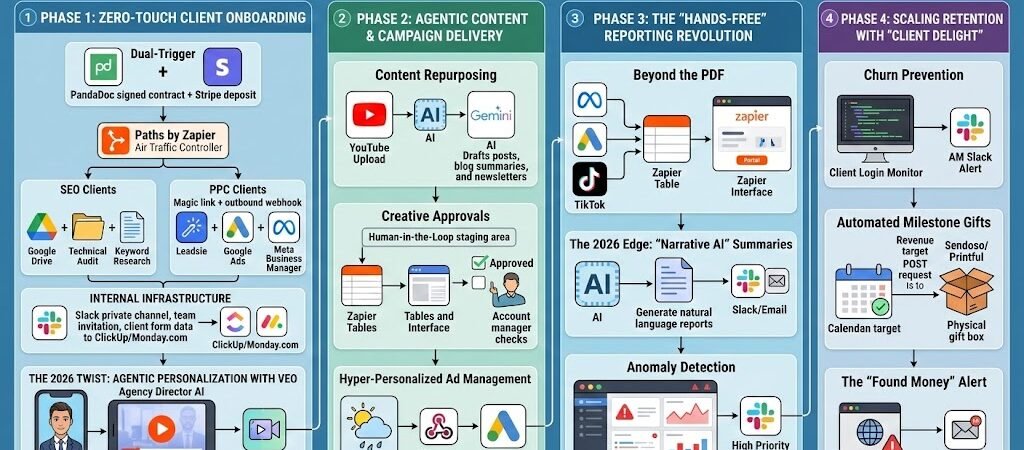
Key Takeaways : Zapier for Digital Marketing Agencies
- From “Task-Doers” to “System-Builders”: Successful agencies in 2026 spend less time in ad managers and more time building automated “Agentic” workflows that manage those platforms autonomously.
- The 5-Minute Onboarding Standard: High-growth agencies have eliminated the “onboarding lag.” Automated workflows now handle legal, financial, and project setup within minutes of a contract signature.
- Reporting as a Product: Automation has turned reporting from a monthly chore into a real-time “AI Insight” service, increasing client perceived value and retention.
- Human-in-the-Loop (HITL): The most effective agency Zaps utilize Zapier Tables and Interfaces to allow human experts to “approve” AI-generated work before it goes live, ensuring brand safety.
Introduction: The “Efficiency-First” Agency Era
The digital marketing landscape of 2026 has undergone a fundamental shift. The days of high-ticket retainers justified by manual “grunt work”—reporting, manual lead routing, and basic content scheduling—are over. In a market where AI can generate a thousand ad variants in seconds, the client’s expectation of “value” has moved from execution to orchestration.
For the modern US marketing agency, the bottleneck is no longer a lack of creative ideas; it is the sheer volume of micro-signals that must be managed. A single client might require monitoring across TikTok, Meta, Google Search, and LinkedIn, while simultaneously needing personalized email nurture tracks and real-time ROI reporting. Attempting to manage this manually doesn’t just lead to burnout—it leads to unscalable margins.
Zapier acts as the “Agency Operating System.” It is the orchestration layer that sits between your specialists and the 50+ tools they use daily. By implementing a “Zapier-first” philosophy, agencies are transforming into high-velocity engines. This allows a team of five to manage fifty high-ticket clients with the same precision and personal touch as a traditional boutique firm. This guide provides the blueprint for moving your agency from a manual service provider to an automated growth powerhouse.
Scalable Agency Workflows: For agencies managing multiple client accounts, Zapier’s dedicated agency solutions huboffers blueprints for lead routing and automated reporting.
Phase 1: Zero-Touch Client Onboarding
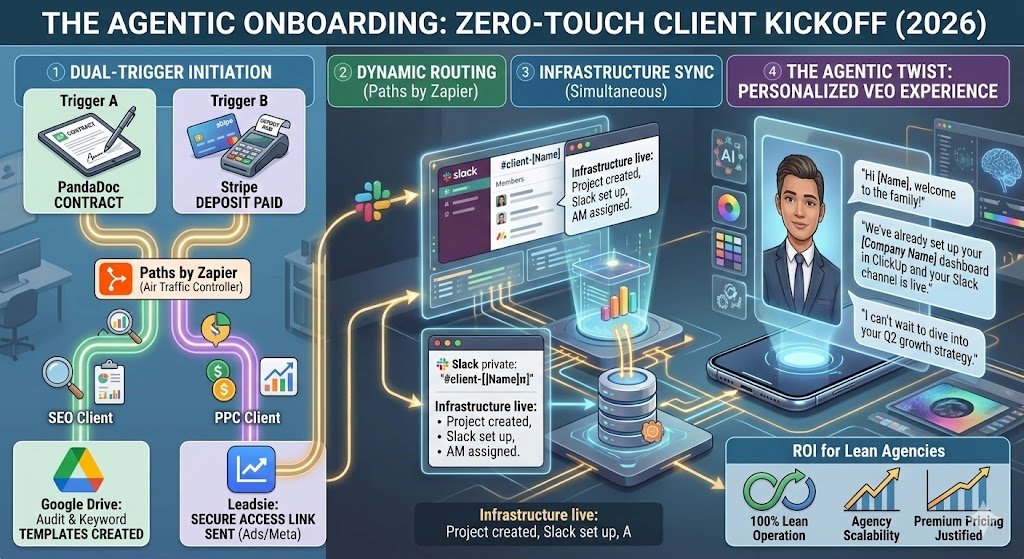
In the high-stakes world of US digital agencies, the “onboarding lag” is a silent killer of client confidence. When a client signs a $5,000/month retainer, every hour they spend waiting for a “Welcome” email is an hour they spend questioning their investment. In 2026, the gold standard is the 5-Minute Onboarding: a seamless transition from “Lead” to “Active Project” that requires zero manual clicks from your account managers.
The “Instant-Start” Workflow
The beauty of a Zapier-driven onboarding system is its ability to handle administrative heavy lifting in the background. The flow begins with a dual-trigger mechanism: a signed contract in PandaDoc or DocuSign followed by a successful deposit via Stripe.
Once the payment is confirmed, Paths by Zapier acts as the air traffic controller. It inspects the line items on the invoice to route the workflow:
- For SEO Clients: Zapier instantly creates a Google Drive folder tree populated with “Technical Audit” and “Keyword Research” templates.
- For PPC Clients: The path triggers an outbound webhook to Leadsie, sending a magic link to the client to securely grant access to their Google Ads and Meta Business Manager accounts.
Simultaneously, Zapier handles the internal infrastructure. It creates a private Slack channel (e.g., #client-global-tech), invites the assigned strategist, and pushes the client’s “Intake Form” data directly into ClickUp or Monday.com. By using pre-configured project templates, the entire 90-day roadmap is live and assigned before your team even grabs their morning coffee.
The 2026 Twist: Agentic Personalization with Veo
In 2026, automation doesn’t have to feel “robotic.” High-growth agencies are using Veo (Google’s generative video model) to create a “Wow” moment that feels deeply personal.
As the final step in the onboarding Zap, Zapier sends the client’s name, brand colors, and industry to a video generation agent. Within minutes, the client receives an email or SMS with a high-fidelity video of the Agency Director (or a realistic AI avatar) saying:
“Hi [Name], welcome to the family! We’ve already set up your [Company Name] dashboard in ClickUp and your Slack channel is live. I can’t wait to dive into your Q2 growth strategy.”
This level of “Agentic Personalization” eliminates the cold, transactional feel of traditional automation, replacing it with a high-touch experience that justifies premium agency pricing while maintaining a 100% lean operation.
Phase 2: Agentic Content & Campaign Delivery
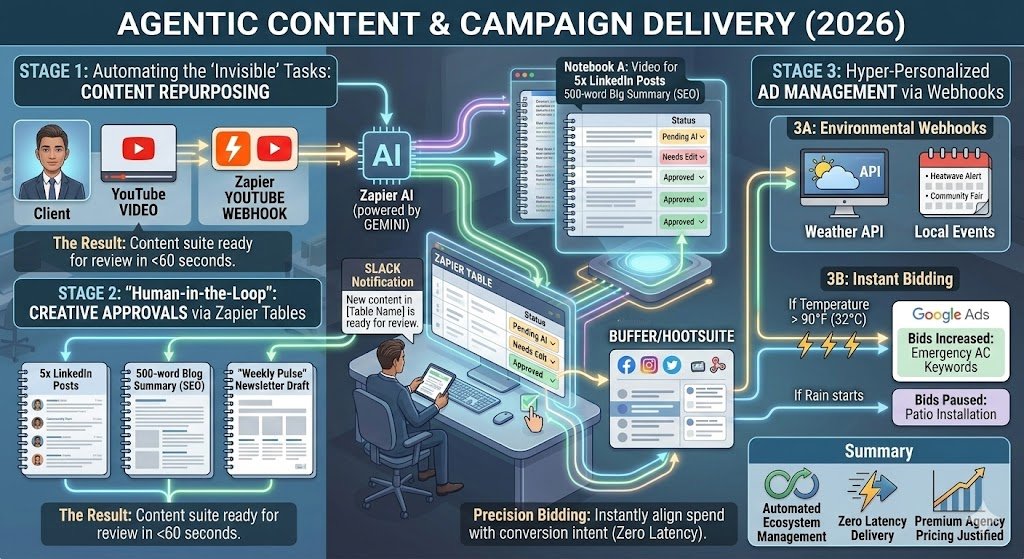
In 2026, the most profitable agencies have stopped selling “hours of content creation” and started selling “automated ecosystem management.” The goal is to move beyond manual campaign execution and toward Agentic Delivery—where your workflows don’t just move data, but proactively create and optimize assets based on real-world triggers.
Automating the “Invisible” Tasks: Content Repurposing
The “Content Treadmill” is usually the highest labor cost for a marketing agency. By using Zapier to catch a YouTube Webhook the moment a client uploads a video, you can trigger a multi-platform cascade.
- The Workflow: Zapier sends the video transcript to an AI by Zapier step (powered by Gemini). The AI is prompted to extract the core insights and draft five distinct LinkedIn posts, a 500-word SEO-optimized blog summary, and a “Weekly Pulse” newsletter.
- The Result: Instead of a social media manager spending four hours “repurposing” a single video, the entire content suite is ready for review in under 60 seconds.
Human-in-the-Loop: Creative Approvals via Zapier Tables
A common fear with 2026-level automation is “hallucinating” AI content going live without a filter. To solve this, agencies use Zapier Tables as a “Human-in-the-Loop” (HITL) staging area. Instead of sending AI drafts directly to social platforms, Zapier pushes them into a custom Zapier Interface. Your account manager receives a Slack notification, reviews the generated posts in the table, makes quick edits, and clicks a “Status” checkbox to “Approved.” Only then does Zapier trigger the final outbound webhook to Buffer or Hootsuite to schedule the posts.
Hyper-Personalized Ad Management via Webhooks
In 2026, static ad schedules are obsolete. Agencies are using external “Environmental Webhooks” to manage client budgets with surgical precision.
- Example: For a home services client (like HVAC or Roofing), Zapier can monitor a Weather API. If the temperature in a specific zip code hits 90°F (32°C), Zapier sends a webhook to Google Ads to instantly increase the bid on “Emergency AC Repair” keywords. If it rains, it pauses “Patio Installation” ads. This level of hyper-relevance ensures that client dollars are only spent when the conversion intent is at its absolute peak, a service that is nearly impossible to manage manually across 50 clients.
High-speed lead management. The agency world moves fast, much like the real estate market. Explore these Zapier automations for real estate to see how top agents use automation to close listings in record time.
Social Proof on Autopilot
Trust is the currency of 2026 marketing. Manual review management is too slow for the modern consumer. By automating Google Business Profile webhooks, Zapier can detect a new 5-star review the moment it’s posted. The workflow then:
Phase 3: The “Hands-Free” Reporting Revolution
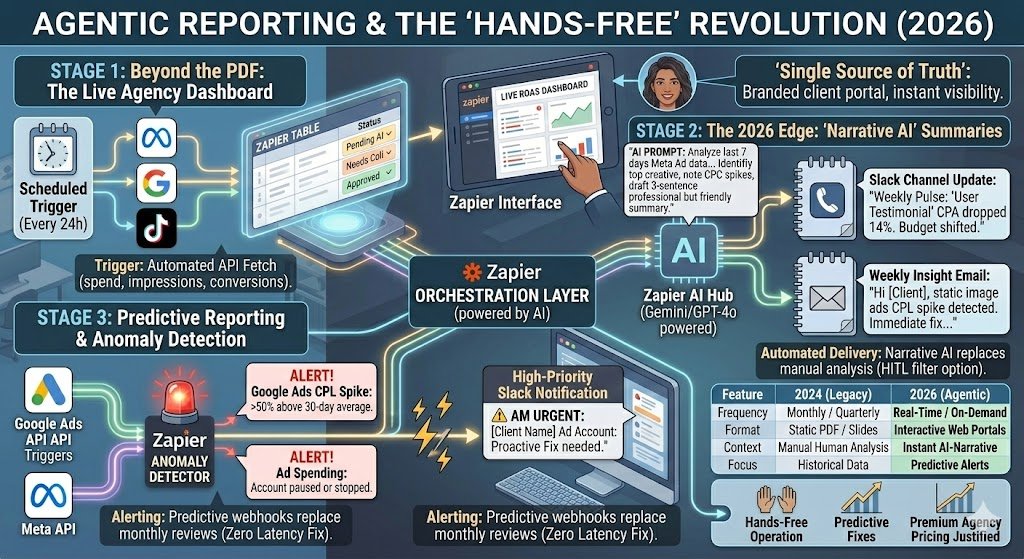
For decades, agencies have been trapped in the “End-of-Month Scramble”—a frantic 48-hour period where account managers manually export data from Meta, Google, and TikTok to build slide decks. In the Agentic Agency, reporting is a continuous, automated stream of insights that requires zero manual data entry.
Beyond the PDF: The Live Agency Dashboard
The first step in the reporting revolution is centralizing data into Zapier Tables. Unlike a standard spreadsheet, Zapier Tables are purpose-built for automation.
- The Workflow: Use a “Scheduled” trigger to ping your ad platforms every 24 hours. Zapier fetches the previous day’s spend, impressions, and conversions, and pushes them into a centralized table.
- The Benefit: This table acts as a “Single Source of Truth.” You can then connect this table to a Zapier Interface—a sleek, branded portal where your client can log in at any time to see their live ROAS without ever having to ask you for an update.
The 2026 Edge: “Narrative AI” Summaries
Data without context is just noise. The real breakthrough in 2026 is using the AI by Zapier (powered by Gemini or GPT-4o) step to write the report for you.
- The Logic: After the data is synced to the table, Zapier triggers an AI step. The prompt is simple: “Analyze these 7 days of Meta Ad data. Identify the top-performing creative, note any spike in CPC, and draft a 3-sentence summary for the client in a professional but friendly tone.”
- The Delivery: This summary is automatically posted to the client’s Slack channel or emailed as a “Weekly Pulse” update.
Example Insight: “Hey [Client], we saw a 14% drop in CPA this week specifically from the new ‘User Testimonial’ video. We’ve shifted $500 of the budget from the static image ads to capitalize on this trend.”
Predictive Reporting & Anomaly Detection
In 2026, “reporting” also means “alerting.” Agencies use webhooks to set up Anomaly Detectors. If a client’s Google Ads account stops spending or the Cost-Per-Lead (CPL) spikes 50% above the 30-day average, Zapier catches that signal instantly. Instead of finding out about a broken tracking pixel three weeks later during the monthly review, your team gets a “High Priority” Slack alert the moment it happens, allowing for a proactive fix that saves the client’s budget and reinforces your value as a high-tech partner.
The Reporting Evolution (2024 vs. 2026)
| Feature | 2024 (Legacy) | 2026 (Agentic) |
| Frequency | Monthly / Quarterly | Real-Time / On-Demand |
| Format | Static PDF / Slides | Interactive Web Portals |
| Context | Manual Human Analysis | Instant AI-Narrative Summaries |
| Focus | Historical Data | Predictive Alerts & Live ROAS |
Phase 4: Scaling Retention with Automated “Client Delight”
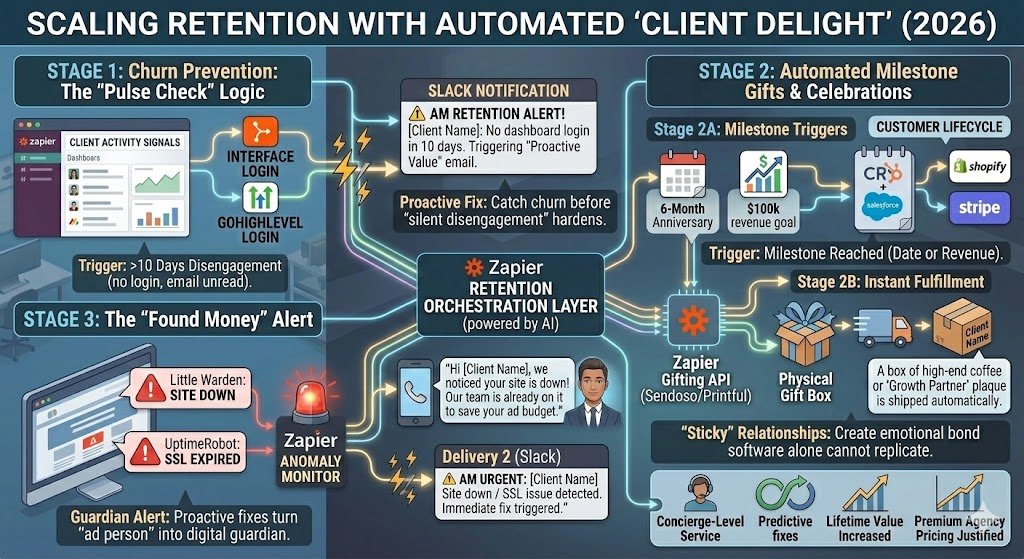
The most expensive part of running a US marketing agency is client acquisition. Therefore, protecting your current roster is the most profitable activity you can perform. Automation allows you to provide a “concierge” level of service that makes clients feel like they are your only client, even as you scale to hundreds of accounts.
1. Churn Prevention: The “Pulse Check” Logic
Clients rarely quit without warning; they leave after a period of “silent disengagement.” In 2026, agencies use webhooks to monitor client activity signals.
- The Signal: Zapier monitors your Zapier Interface or GoHighLevel login data. If a client hasn’t logged in to view their dashboard in 10 days, or if they haven’t opened a weekly report email, a webhook triggers.
- The Action: Instead of waiting for the client to go cold, Zapier alerts the Account Manager in Slack: “Warning: [Client Name] hasn’t checked their ROAS in 10 days. Triggering ‘Proactive Value’ email now.”
- The Result: You catch the churn before the client even realizes they were feeling disconnected.
2. Automated Milestone Gifts & Celebrations
Small gestures create “sticky” relationships. By using Zapier to track a client’s “Start Date” in your CRM (HubSpot or Salesforce), you can automate physical rewards that arrive at high-impact moments.
- The Trigger: A client hits their 6-month anniversary or crosses a $100k revenue milestone (detected via Shopify or Stripe webhooks).
- The Automation: Zapier sends a POST request to a gifting API like Sendoso or Printful.
- The Gift: A personalized box of high-end coffee or a custom-printed “Growth Partner” plaque is shipped to the client’s office automatically.
- The ROI: This creates an emotional bond that software alone cannot replicate, significantly increasing lifetime value (LTV).
3. The “Found Money” Alert
Nothing delights a client more than an agency finding a problem they didn’t know they had. You can build Zaps that monitor “Negative Spikes” or “Broken Links.”
- The Workflow: Use a tool like Little Warden or UptimeRobot to send a webhook to Zapier if the client’s website goes down or a SSL certificate expires.
- The Action: Zapier pings the client (and your team) immediately: “Hey, we noticed your site is down! Our team is already looking into it to ensure your ads don’t waste budget.”
- The Value: You are no longer just an “ad person”; you are a guardian of their entire digital business.
Advanced Technical Setup for Agencies
As your agency scales from 5 clients to 50, the primary risk isn’t a lack of ideas—it’s “Automation Debt.” Without a rigorous technical framework, a web of disorganized Zaps can become a liability. In 2026, professional agency operations rely on three pillars of governance to ensure security, clarity, and uptime.
Multi-Client Governance & Data Silos
For US-based agencies, data privacy is non-negotiable. Using Zapier Enterprise or Team accounts is the only way to manage multi-client workflows safely. By utilizing “Folders” and “Workspaces” with granular permissions, you ensure that a strategist working on Client A cannot accidentally access the API keys or sensitive lead data of Client B. This “Siloed Architecture” is essential for SOC2 compliance and maintaining the professional trust required for high-ticket retainers.
The “Agency Standard” Naming Convention
A Zap named “New Lead to Sheets” is a nightmare during a 2:00 AM troubleshooting session. Professional agencies adopt a strict, searchable naming convention: [Client Code] | [Core Function] | [Trigger] -> [Main Action].
Example:
[G-TECH] | Lead Gen | FB Lead Ad -> AI Enrichment -> HubSpotAdditionally, every Zap should include a brief “Description” within Zapier that links to the internal SOP (Standard Operating Procedure) in your project management tool. If an automation breaks, any team member should be able to understand its logic in under 30 seconds.
The “Global Error Catch” System
Infrastructure resilience is what separates “pro” agencies from “hobbyist” ones. Instead of relying on Zapier’s default email alerts—which often get lost in a cluttered inbox—advanced agencies build a Global Error Catch Zap. By using Zapier Manager as a trigger, you can catch any “Zap Failed” event across your entire account and route that error to a dedicated #ops-alerts Slack channel. This allows your operations lead to address a broken webhook before the client even notices a delay in their delivery.
Conclusion: The $1M Lean Agency
The digital marketing agencies thriving in 2026 are not defined by their headcount, but by the sophistication of their “glue.” By delegating the friction of onboarding, the monotony of reporting, and the complexity of campaign delivery to Zapier, you shift your firm’s value proposition from labor to logic. Technology doesn’t replace the strategist; it frees the strategist to think, allowing your team to focus on the high-level creative and psychological insights that AI cannot replicate.
Your path to a $1M lean operation starts today. Audit your current “Busy Work”—identify the repetitive tasks draining your team’s energy—and commit to building your first “Master Onboarding Zap.” Once you experience the velocity of a zero-touch kickoff, you’ll never go back to manual delivery again.

About the Author
Aapt DubeyAapt Dubey is an automation specialist and software developer dedicated to eliminating manual workflows for small businesses. With deep, hands-on experience building complex Zapier integrations, API connections, and real-world applications, Aapt writes actionable, tested tutorials to help businesses scale efficiently.