
Key Takeaways: Zapier AI Agents vs Make AI vs n8n
- Intelligence Strategy: Zapier Central is the “Apple” of agents—user-friendly and cloud-managed. Make is the “Architect’s Choice” for complex branching, while n8n is the “Developer’s Powerhouse,” offering native LangChain support for multi-agent loops.
- The “Pricing Mismatch”: Zapier’s per-task model can become prohibitively expensive for high-frequency AI “thinking.” Make’s per-operation model offers better mid-tier value, but n8n’s per-execution model (one fee regardless of steps) is the clear winner for complex, multi-step AI research.
- Data Sovereignty: In regulated US industries (Healthcare/Finance), n8n is the strongest contender due to its self-hosting capability, ensuring your proprietary data never leaves your infrastructure.
- Deployment Speed: Zapier remains the champion of “Time to Value,” allowing a non-technical founder to deploy a functioning AI agent in under 15 minutes.
Introduction: The Death of the “Linear Zap”
For over a decade, automation was a straight line: If A happens in App 1, then do B in App 2. In 2026, the “Linear Zap” is officially a legacy concept. We have entered the era of Agentic Workflows, where the automation doesn’t just move data—it pauses, “thinks,” chooses a tool, and observes the result before moving to the next step.
As US SMBs race to reclaim 15+ hours a week, three platforms have emerged as the dominant “Brains” of this revolution:
- Zapier Central: Designed for the “Managerial” class. It abstracts the complexity of AI, allowing you to “talk” your agents into existence using natural language. It is the fastest route to a digital workforce but comes with a “Task Tax” that scales steeply.
- Make AI (formerly Integromat): The favorite for “Visual Thinkers.” Its canvas-based approach allows you to see the “spaghetti logic” of your AI’s decision-making process. It is the middle ground between ease of use and developer-level control.
- n8n AI: The “Open-Source Titan.” Built for technical teams and AI engineers, n8n treats AI as a first-class citizen with native nodes for vector databases and autonomous reasoning loops (ReAct).
The “strongest” platform for your business isn’t the one with the most features—it’s the one that aligns with your team’s technical depth and your 2026 budget constraints.
In 2026, the “Intelligence” of an automation platform is no longer measured by how many apps it can connect, but by how it manages the Reasoning Loop—the ability for an AI to plan, execute, and self-correct.
The Agent Advantage: Autonomous agents are the next frontier. You can learn more about the logic behind Zapier’s Central AI Agents and how they compare to standard trigger-action Zaps.
Intelligence & Reasoning “Brains”
The three titans of 2026 have taken fundamentally different approaches to “AI Thinking.” Your choice depends on whether you want a managed assistant, a visible logic tree, or a granular cognitive architecture.
1. Zapier Central: The “Guided” Brain
Zapier Central is built for the Managerial Class. It abstracts the “Black Box” of AI into a conversational interface.
- Prompt-to-Agent Logic: You “teach” the agent through natural language instructions (image_32.png). Zapier’s Prompt Assistant auto-enhances your goals into structured system prompts.
- Agent-to-Agent Calling: In 2026, Zapier’s standout feature is the ability for one specialized agent to “call” another. For example, your Research Agent can autonomously decide to ping your Sales Agent to draft a pitch.
- The “Black Box” Trade-off: While intuitive, you have less visibility into the intermediate “thought steps.” If an agent fails, you refine the prompt rather than the underlying logic path.
2. Make AI: The “Orchestrated” Brain
Make (formerly Integromat) is the choice for Visual Architects. In 2026, it moved AI agents directly onto its famous “Scenario Canvas.”
- Transparent Reasoning: Make introduced the Reasoning Panel. As the agent runs, you see a real-time visual trace of every decision, tool call, and “thought” (image_40.png).
- Hybrid Logic: Make excels at combining Deterministic Steps (If/Then) with Agentic Reasoning. You can use a standard filter for simple data and only trigger the “expensive” AI brain for nuanced judgment calls.
- Visual Debugging: Because the agent lives on the canvas, you can literally see where the logic “breaks,” making it the most reliable for complex, multi-branch operations.
3. n8n AI: The “LangChain” Native
n8n is the Developer’s Powerhouse. It is the only platform built natively on LangChain and LangGraph principles.
- The ReAct Loop: n8n’s AI Agent node uses a native Reasoning-Action (ReAct) loop. It doesn’t just follow a path; it cycles through “Thought → Action → Observation” until the goal is met.
- Stateful Multi-Agent Systems: Using LangGraph nodes, n8n can maintain complex “States.” If an agent fails a task, it can “remember” its past attempt and try a different strategy in the next loop—something Zapier and Make still struggle to do natively.
- Custom “Cognitive” Nodes: n8n allows you to swap LLMs mid-flow (e.g., use GPT-4o for high-level planning and Claude 3.5 Haiku for cheap summarization) within the same execution.
Intelligence Comparison Matrix
| Feature | Zapier Central | Make AI | n8n AI |
| Logic Type | Natural Language / Pods | Visual Canvas / Scenarios | LangChain Nodes / Graphs |
| Visibility | Activity Dashboard | Real-time Reasoning Panel | Node-by-Node Debugger |
| State Memory | Basic Conversation | Scenario-based | Advanced (LangGraph) |
| Learning Curve | Low (Hours) | Medium (Days) | High (Weeks) |
Choose your LLM. Regardless of the platform, the quality of your AI depends on the model. See these Claude and ChatGPT automation examples to see which one performs best for your business.
The 2026 Forensic Rule: Use Zapier if you want to delegate; use Make if you want to orchestrate; use n8n if you want to engineer.

In 2026, the gap between “setting up a tool” and “seeing a return” has widened. As AI agents become more complex, the time you spend in the “Builder” determines whether you’re saving hours or creating a new part-time job for yourself.
Speed to ROI vs. Complexity
This category measures the “15-Minute Rule”: how quickly can a non-technical founder go from an idea to a live, value-generating agent?
1. Zapier Central: The “Plug-and-Play” Champion
Zapier remains the undisputed king of Speed to Value.
- Implementation Time: 15–30 Minutes. * The Experience: You describe your agent in plain English, and Zapier’s “AI Copilot” builds the trigger-action skeleton for you. Because it maps to 8,000+ apps natively, you don’t spend time reading API documentation.
- 2026 ROI: For a US SMB needing a quick win (e.g., an “Auto-Responder” for Facebook Leads), Zapier provides the fastest path to reclaimed time. You “hire” the agent almost as fast as a human assistant.
2. Make AI: The “Architect’s” Sweet Spot
Make (formerly Integromat) is designed for those who find Zapier too simple but n8n too daunting.
- Implementation Time: 2–4 Hours.
- The Experience: You don’t just “talk” to Make; you draw. Its visual canvas requires you to map out exactly how data flows. In 2026, its “AI Scenario Builder” helps with the initial draft, but you still need to manually configure “Routers” and “Filters.”
- 2026 ROI: The payoff comes in Reliability. Because you’ve visually architected the logic, debugging a failing agent takes minutes, whereas Zapier’s linear list can become a “black box” of errors.
3. n8n AI: The “High-Effort, High-Ceiling” Powerhouse
n8n is not a “quick fix”; it is an Infrastructure Investment.
- Implementation Time: Days to Weeks.
- The Experience: For self-hosted versions, you (or a developer) must first set up a Docker container or server. Building the agent involves technical concepts like “JSON Mapping,” “HTTP Requests,” and “Vector Store Nodes.”
- 2026 ROI: The ROI is Scalability and Ownership. Once built, an n8n agent can handle 100,000 “thoughts” for the same cost as 100 “thoughts” on Zapier. It is the only choice for a business building a core, proprietary AI workforce.
The Setup Comparison Matrix
| Feature | Zapier Central | Make AI | n8n AI |
| First Agent Setup | 15 Minutes | 2 Hours | 4+ Hours (if self-hosted) |
| Technical Skill Req. | None (Natural Language) | Moderate (Logic-based) | High (Developer-level) |
| Templates | 50,000+ Pre-built | 1,500+ Deep Scenarios | Community-led / Custom |
| Debugging Style | Error Logs (Text) | Visual (Real-time Trace) | Console / Code Execution |
The 2026 Forensic Rule: If your team is non-technical and needs a result this week, start with Zapier. If you have a “Power User” who loves flowcharts, move to Make. If you have a developer and a 12-month vision, build on n8n.

In 2026, the cost of automation is no longer just a line item; it is a Forensic Variable. As AI agents move from simple triggers to complex “Reasoning Loops,” the way your platform bills you—per task, per operation, or per execution—will determine if your automation is a profit center or a budget drain.
The 2026 Pricing Audit (The “Tax” Comparison)
Understanding the “Unit of Billing” is critical. A single 2026 AI Research Agent might perform 20 different “thoughts” or “steps” to complete one job. Here is how that impacts your wallet across the three titans.
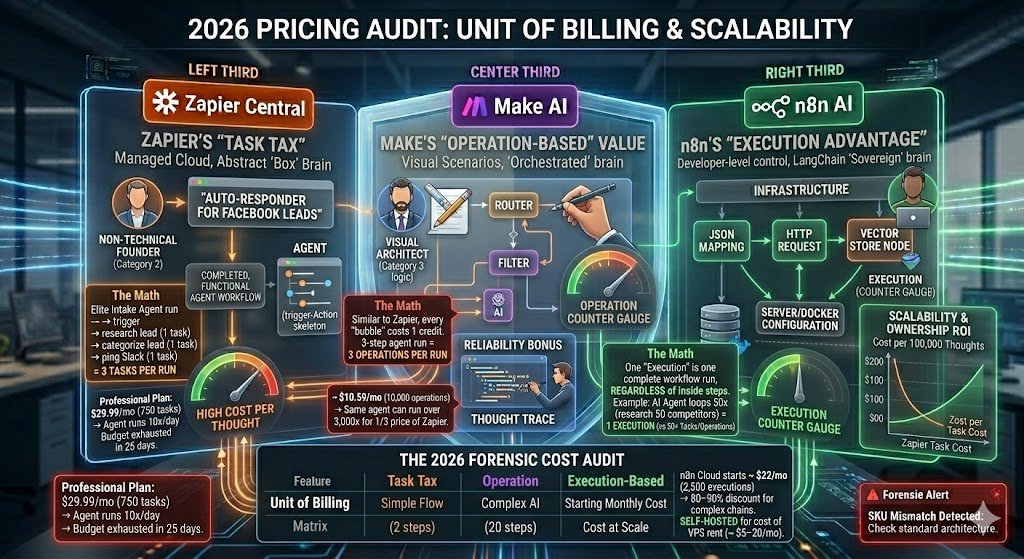
1. Zapier’s “Task Tax” (The Meter is Always Running)
Zapier bills per Task (each individual action).
- The Math: If your “Elite Intake Agent” triggers, researches a lead (1 task), categorizes them (1 task), and pings Slack (1 task), that’s 3 tasks per run.
- The 2026 Cost: On a Professional plan ($29.99/mo for 750 tasks), running this agent 10 times a day will exhaust your entire budget in 25 days.
- Forensic Verdict: Zapier is the most expensive for “chattier” AI agents that need to perform many small steps to reach a conclusion. You are paying for the convenience of their 8,000+ connectors.
2. Make’s “Operation-Based” Value (The Middle Ground)
Make (formerly Integromat) bills per Operation (each module execution).
- The Math: Similar to Zapier, every “bubble” on your canvas that runs costs 1 credit. However, Make is significantly more generous with its volume.
- The 2026 Cost: For ~$10.59/mo, you get 10,000 operations. That same 3-step agent can run over 3,000 times for a third of the price of Zapier.
- Forensic Verdict: Make offers the best “Price-to-Logic” ratio for mid-sized US SMBs who need complex branching but aren’t ready to manage their own servers.
3. n8n’s “Execution Advantage” (The Scalability King)
n8n uses a fundamentally different model: Execution-Based Billing.
- The Math: One “Execution” is one complete run of a workflow, regardless of how many steps are inside.
- Example: An AI agent that loops 50 times to research 50 competitors costs 1 Execution on n8n, but 50+ Tasks on Zapier.
- The 2026 Cost: n8n Cloud starts at ~$22/mo for 2,500 executions. For complex AI chains, this is effectively an 80–90% discount compared to Zapier.
- The Self-Hosted “Nuclear” Option: If you host n8n on your own VPS (costing ~$5–$20/mo), the software is free. You can run a million “thoughts” for the price of your server rent.
The 2026 Forensic Cost Matrix
| Billing Unit | Zapier (Task) | Make (Operation) | n8n (Execution) |
| Simple Flow (2 steps) | 2 Tasks | 2 Operations | 1 Execution |
| Complex AI (20 steps) | 20 Tasks | 20 Operations | 1 Execution |
| Starting Monthly Cost | ~$30 (750 units) | ~$11 (10,000 units) | ~$22 (2,500 units) |
| Cost at Scale | Very High | Moderate | Lowest |
The 2026 Forensic Rule: If your AI agent needs to “think” in loops or perform multi-step research, n8n is the only fiscally responsible choice. If you only have 5–10 simple leads a day, Zapier’s convenience is worth the premium.
In 2026, for a US-based SMB, automation is no longer just about productivity; it is a Compliance Anchor. If you operate in healthcare (HIPAA), finance (FINRA), or government contracting (FedRAMP), where your data “lives” and who can see it is the difference between a successful audit and a catastrophic legal liability.
Security, Compliance & The “Forensic” Audit
This category evaluates which platform offers the most robust “Shield” for your proprietary and sensitive data.
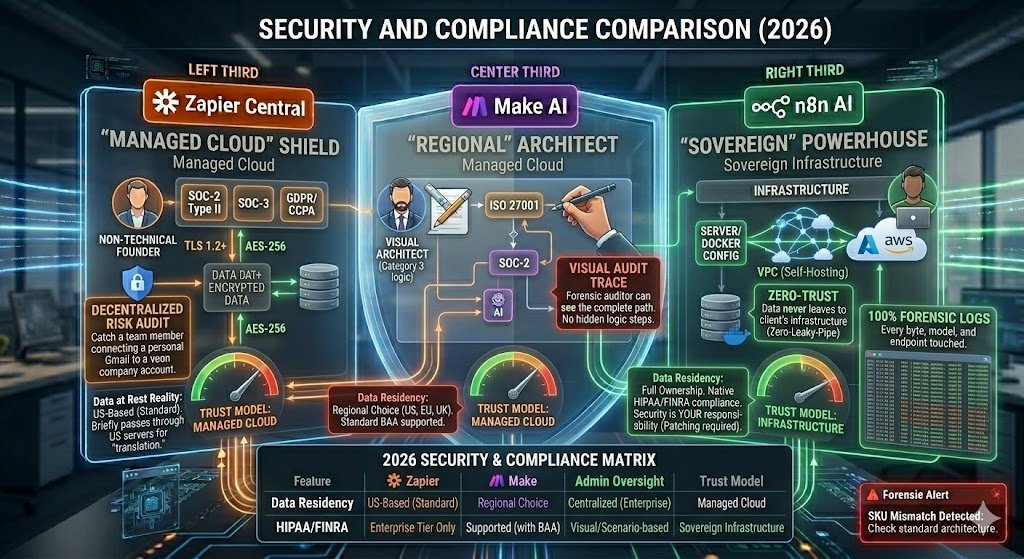
1. Zapier: The “Managed Cloud” Shield
Zapier has spent 2026 shedding its “Shadow IT” reputation. It is now a highly secure environment for 90% of standard US businesses.
- Certifications: SOC-2 Type II, SOC-3, and fully GDPR/CCPA compliant.
- The “Data at Rest” Reality: Zapier encrypts data in transit (TLS 1.2+) and at rest (AES-256). However, because Zapier acts as a “Universal Translator,” your data must briefly pass through their US-based servers to be “translated” between apps.
- The Risk: In the Professional/Team tiers, decentralized access is common. A team member might connect a personal Gmail to a company Zap, creating a “Data Leakage” risk that is harder to audit without the Zapier Enterprise Admin Center.
2. Make AI: The “Regional” Architect
Make (formerly Integromat) offers a more granular approach to where your data physically resides.
- Data Residency: Unlike Zapier’s standard US-centric model, Make allows you to choose specific Data Regions(e.g., US, EU, or UK). This is critical for businesses with international clients or specific state-level data mandates.
- Compliance: ISO 27001 certified and SOC-2 compliant.
- The “Visual” Audit: Because Make is canvas-based, a forensic auditor can literally see the path of the data. There are no “hidden” logic steps, making it easier to prove compliance during a security review.
3. n8n AI: The “Sovereign” Powerhouse
For high-security US firms, n8n is often the only choice because of its Self-Hosting capability.
- Zero-Trust Ownership: By hosting n8n on your own VPC (Azure, AWS, or private local server), your data never leaves your infrastructure. This is the gold standard for HIPAA and FedRAMP compliance.
- The “Forensic” Audit Trail: Since you own the database, you have 100% of the logs. You can see every single byte of data that passed through an AI agent, which model it touched, and where it ended up.
- The Trade-off: Security is your responsibility. If you don’t patch your server, the “Sovereign” advantage disappears.
2026 Security & Compliance Matrix
| Feature | Zapier | Make AI | n8n AI |
| Data Residency | US-Based (Standard) | Regional Choice | Full Ownership (Self-Host) |
| HIPAA/FINRA | Enterprise Tier Only | Supported (with BAA) | Native (via Self-Hosting) |
| Admin Oversight | Centralized (Enterprise) | Visual/Scenario-based | Full Server Logs |
| Trust Model | Managed Cloud | Managed Cloud | Sovereign Infrastructure |
The 2026 Forensic Rule: If your data is “Standard” (Marketing/Sales), Zapier is perfect. If you have “Regulated” data (Medical/Financial), n8n is the only way to ensure 100% data sovereignty.
Final Verdict: Which is Strongest in 2026?
- The “Manager’s Choice”: Zapier. Strongest for speed, ease of use, and the sheer breadth of 8,000+ US app connections.
- The “Architect’s Choice”: Make. Strongest for complex, visual logic and mid-tier cost efficiency.
- The “Engineer’s Choice”: n8n. Strongest for data privacy, technical scaling, and heavy-duty AI research agents.

About the Author
Aapt DubeyAapt Dubey is an automation specialist and software developer dedicated to eliminating manual workflows for small businesses. With deep, hands-on experience building complex Zapier integrations, API connections, and real-world applications, Aapt writes actionable, tested tutorials to help businesses scale efficiently.