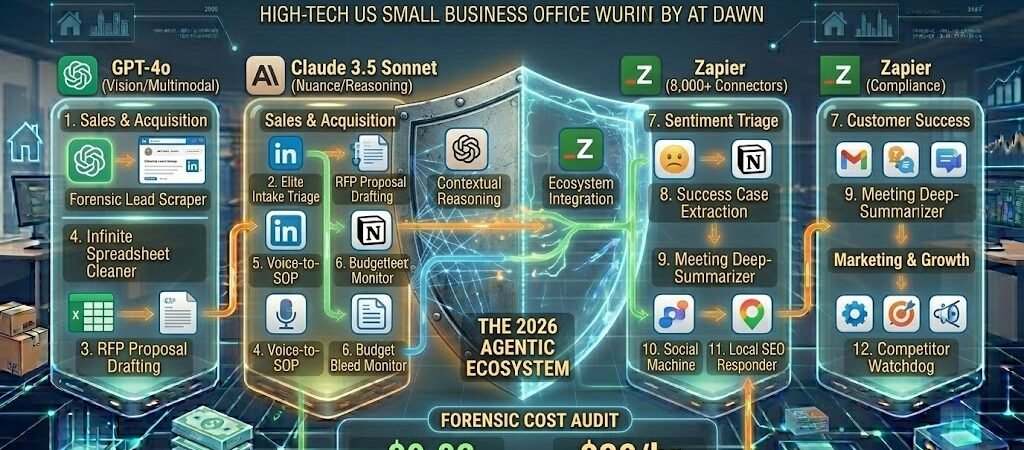
Key Takeaways: Zapier Claude and Chatgpt Automations
- The Model Split: Use GPT-4o for high-speed, multimodal tasks (like analyzing screenshots or images) and Claude 3.5 Sonnet for long-form reasoning, complex coding, and nuanced brand-voice alignment.
- From Linear to Agentic: These 12 examples move away from simple “Trigger-Action” flows and into Agentic Workflows where the AI decides how to process the data based on its content.
- ROI of Time: The primary goal is Forensic Efficiency—reclaiming at least 15 hours per week by automating the “low-value/high-context” tasks that previously required a human Virtual Assistant.
- Cost Control: By using AI to filter and process data before it hits your CRM or heavy tools, you significantly reduce “Budget Bleed” in your 2026 task consumption.
LLM Connectivity: To see the specific differences in how AI models respond, check the official OpenAI + Zapier integration page to see current prompt and token capabilities.
Sales & Client Acquisition
In the high-velocity sales environment of 2026, “personalized” outreach is the baseline, not the exception. These three automations ensure your sales team—or you, the solo founder—can act with the precision of a 50-person agency.
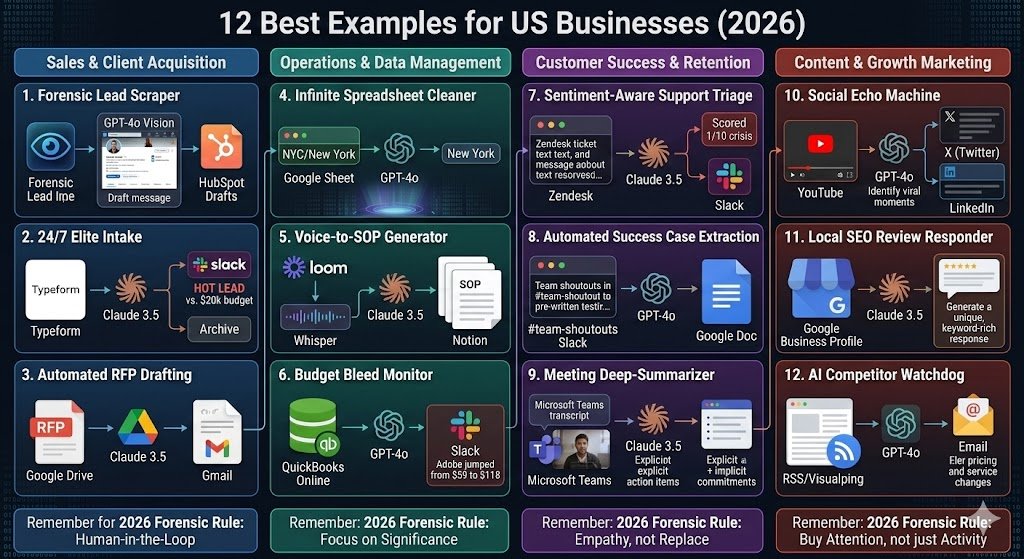
1. The “Forensic Lead Scraper” (Zapier + GPT-4o Vision + HubSpot)
In 2026, standard scraping is often blocked or yields generic data. This flow uses GPT-4o Vision to “see” lead profiles like a human would.
- The Logic: You capture a screenshot of a prospect’s LinkedIn profile or recent post → Zapier sends the image to GPT-4o Vision → The AI analyzes the tone and current pain points mentioned in their recent activity.
- The Result: It drafts a bespoke outreach message in your HubSpot “Drafts” folder that references a specific detail from their post, ensuring your 2026-compliant pitch feels 100% human-made.
2. The 24/7 “Elite Intake” Triage (Typeform + Claude 3.5 + Slack)
Generic lead forms are where potential revenue goes to die. This automation acts as a digital gatekeeper.
- The Logic: A lead submits a detailed Typeform → Claude 3.5 analyzes the text for “Budget Intent,” “Technical Maturity,” and “Urgency.”
- The Result: Instead of a generic notification, your Slack alert says: “🔥 HOT LEAD: High-intent enterprise prospect with $20k budget. Urgent triage recommended.” It separates the “tire-kickers” from the “revenue-generators” instantly.
3. Automated RFP Drafting (Google Drive + Claude 3.5 + Gmail)
Responding to Requests for Proposals (RFPs) used to take days. In 2026, it takes minutes.
- The Logic: You drop a new RFP PDF into a Google Drive folder → Zapier triggers Claude 3.5 to summarize the 50+ pages → It maps the requirements against your “2026 Capabilities” document.
- The Result: Claude drafts a preliminary response, matching your past successful proposal language to the current requirements. You simply review, edit, and hit send.
The 2026 Forensic Rule: Never send an AI-generated sales message without a Human-in-the-Loop review. Use these tools to build the 90% draft so you can focus the final 10% on genuine human connection.
Operations & Data Management
In 2026, the back-office of a successful US SMB isn’t just a place where data is stored; it’s where data is refined. These three automations eliminate the “grunt work” of data entry and monitoring, allowing you to move from reactive management to proactive strategy.
4. The “Infinite Spreadsheet” Cleaner (Google Sheets + GPT-4o)
Every business has that one spreadsheet—the one with 5,000 rows of messy, inconsistent data. Manual cleaning is a Category 1 “Time Tax” that drains your energy.
- The Logic: A new row is added to a messy sheet (e.g., mismatched product categories or inconsistent address formats) → Zapier sends the row to GPT-4o with a “Standardization Prompt.”
- The Result: The AI reasons through the mess (e.g., “NYC,” “New York,” and “N.Y.” all become “New York”) and updates the row instantly. It turns a “garbage-in” scenario into a “clean-data-out” asset without a single formula.
5. Voice-to-SOP Generator (Fireflies.ai/Whisper + Zapier + Notion)
In 2026, the fastest way to document a process is to speak it. This flow captures your “tribal knowledge” and turns it into a company asset.
- The Logic: You record a quick Loom or voice memo explaining a new internal process → The transcription (via Fireflies or Whisper) is sent to Claude 3.5.
- The Result: Claude extracts the “Step-by-Step” instructions, adds a “Why This Matters” summary, and creates a formatted page in your Notion SOP database. You’ve just built a training manual while walking to your car.
6. The “Budget Bleed” Monitor (QuickBooks + GPT-4o + Slack)
Forensic financial oversight is often the first thing to slip in a busy month. This automation acts as an autonomous CFO.
- The Logic: A new expense or bill is logged in QuickBooks Online → Zapier sends the transaction details and a summary of the last 3 months of spend to GPT-4o.
- The Result: The AI looks for anomalies. If a software subscription suddenly doubles in price or a new vendor appears without a contract, it pings your private Slack: “⚠️ BUDGET ALERT: Adobe subscription jumped from $59 to $118 this month. Investigating?”
The 2026 Forensic Rule: Use AI to handle the Structure of your data so you can focus on the Significance of your data. If you are spending more than 30 minutes a week cleaning a spreadsheet, you are losing the 2026 efficiency war.
Customer Success & Retention
In 2026, client retention is built on Anticipatory Service. It is no longer enough to respond to a ticket; you must respond to the emotion behind it. These three automations use AI to act as a “Sentiment Radar,” ensuring no client feels like just a number in your database.
7. “Sentiment-Aware” Support Triage (Zendesk + Claude 3.5 + Slack)
Not all support tickets are created equal. A “How do I change my password?” query is fundamentally different from a “Your software crashed during my board meeting!” crisis.
- The Logic: A new ticket arrives in Zendesk (or Freshdesk/Intercom) → Zapier sends the full text to Claude 3.5 for emotional analysis.
- The Result: If Claude detects high frustration, sarcasm, or “Churn Language” (e.g., “considering other options”), it bypasses the standard queue and pings a high-priority Slack channel: “🚨 URGENT: High-frustration alert from Tier 1 Client. Sentiment Score: 1/10.”
8. Automated “Success Case” Extraction (Slack + GPT-4o + Google Docs)
Small businesses often forget to document their wins because they are too busy chasing the next one. This flow builds your 2026 social proof “silently.”
- The Logic: A team member posts a “win” or a client compliment in a specific #team-shoutouts Slack channel →GPT-4o summarizes the achievement and identifies the core benefit delivered.
- The Result: The AI appends this to a “Weekly Testimonial & Case Study” Google Doc. By Friday, you have a pre-written list of success stories ready for your marketing newsletter or LinkedIn feed.
9. The Meeting “Deep-Summarizer” (Teams + Claude 3.5 + Email)
Standard AI summaries often miss the “implied” stuff. This flow focuses on the Forensic Promises made during a call.
- The Logic: A Microsoft Teams or Zoom transcript is generated → Claude 3.5 is tasked with extracting two specific things: “Explicit Action Items” and “Implicit Commitments” (e.g., when you said, “I’ll see if I can get that done by Friday”).
- The Result: A clean, bulleted email is sent to you and the client 10 minutes after the call ends, ensuring that “casual” promises don’t become “broken” promises three weeks later.
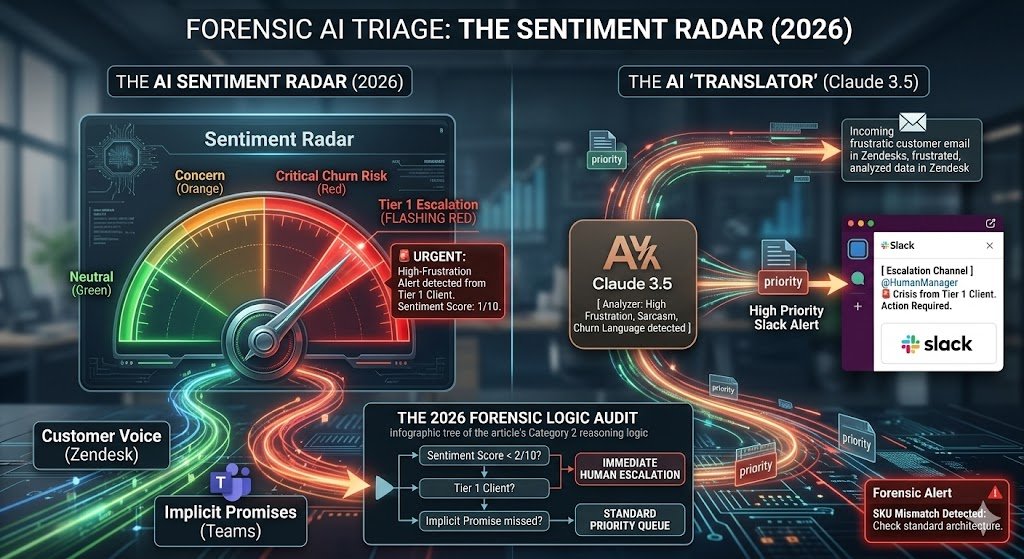
The 2026 Forensic Rule: Use AI to heighten your Empathy, not replace it. The goal of sentiment triage isn’t to have the AI solve the problem, but to get a human in front of a frustrated client faster than the competition.
Content & Growth Marketing
In 2026, the digital noise is deafening. To grow, a US SMB cannot just create content; they must create an Omnipresent Echo. These three automations allow you to take one high-value thought and distribute it across the entire 2026 social landscape without spending all day on your phone.
10. The “Social Echo” Machine (YouTube/Podcast + GPT-4o + X/LinkedIn)
Content repurposing is usually the first thing to be neglected when a business gets busy. This flow ensures your video or audio content lives forever.
- The Logic: A new video is uploaded to YouTube or a podcast to Spotify → Zapier sends the transcript to GPT-4o.
- The Result: The AI identifies the 5 most “viral” moments or “Hot Takes.” It then drafts 5 unique X (formerly Twitter) posts and 2 long-form LinkedIn articles that match your specific 2026 brand voice. You simply approve the drafts in your buffer.
11. Local SEO “Review Responder” (Google Business + Claude 3.5)
For local US businesses (lawyers, doctors, contractors), Google reviews are your lifeblood. Leaving them unanswered—or using a generic “Thanks!”—hurts your SEO.
- The Logic: A new 4 or 5-star review is posted on your Google Business Profile → Claude 3.5 analyzes the specific keywords used (e.g., “fast response,” “affordable plumbing”) and drafts a unique, keyword-rich response.
- The Result: The AI responds in a way that signals to Google’s 2026 algorithm that you are active and relevant, while making the customer feel heard.
- Safety Note: For medical or legal fields, this flow is set to “Require Approval” to ensure HIPAA/compliance safety.
12. The AI “Competitor Watchdog” (RSS/Webflow + GPT-4o + Email)
In 2026, keeping up with the competition is a full-time job. This automation does the “spying” for you.
- The Logic: An RSS feed or site-change monitor (like Visualping) detects a change on a competitor’s pricing or service page → GPT-4o compares the new version to the old version.
- The Result: Instead of just getting a “site changed” alert, you get a strategic email: “🚨 COMPETITOR ALERT: [Competitor] just dropped their ‘Pro’ tier price by 15% and added a new ‘AI Consulting’ service. This matches our Q3 roadmap.”
The 2026 Forensic Rule: Marketing automation should buy you Attention, not just Activity. Use AI to find the “signal” in your content and competitor data so your human team can focus on the “strategy.”
Ready to save time? We’ve identified the high-impact tasks you should offload first. Check out the best AI automations for freelancers to reclaim 10+ hours of your week.
The “Forensic” Cost Audit
Automating 15+ hours a week isn’t “free.” In 2026, you must weigh the “Task Tax” against the “Labor Cost.” * The Consumption Reality: Most of these agentic workflows use GPT-4o or Claude 3.5, which often count as “Premium” steps in Zapier. A typical “Deep-Summarizer” (Example #9) might use 5-10 tasks per run if it involves multiple logic branches.
- The ROI Math: If your Zapier “Pro” plan costs $49/mo and handles 2,000 tasks, you are effectively paying roughly $0.02 per “thought.” Compare this to a Virtual Assistant costing $20–$35/hour. Even at high volumes, the automation is 95% cheaper than human labor for these specific repetitive logic tasks.
Conclusion: Starting Your 2026 Roadmap
You don’t need to build all 12 of these today. The most successful 2026 automations are built incrementally.
- Pick One: Choose the automation that solves your biggest “Energy Drain” (usually Example #2 or #4).
- Build the Logic: Follow the “Brain-Knowledge-Tools” framework.
- Audit the ROI: Use it for two weeks. If it saves you 2 hours, move to the next one.
The 2026 Forensic Rule: Automation is an asset, not an expense. The goal isn’t to have the most Zaps; it’s to have the most Uninterrupted Focus.

About the Author
Aapt DubeyAapt Dubey is an automation specialist and software developer dedicated to eliminating manual workflows for small businesses. With deep, hands-on experience building complex Zapier integrations, API connections, and real-world applications, Aapt writes actionable, tested tutorials to help businesses scale efficiently.