Key Takeaway: Zapier vs. Pabbly Connect
The most dangerous mistake a US SMB can make in 2026 is choosing an automation platform based solely on its monthly subscription fee. To save money, you must conduct a Forensic Financial Analysis that focuses on the Total Cost of Automation (TCA). This analysis weighs the cost of raw tasks (where Pabbly Connect often wins with its “Logic-Is-Free” action model) against the cost of internal labor and downtime risks (where Zapier’s mature AI Copilot and robust “Retry Logic” often save more than they cost). For predictable, high-volume data replication, Pabbly Connect offers massive savings; but for complex, mission-critical logic that requires instant reliability and niche US app support, Zapier remains the most cost-effective solution.
Introduction: The 2026 “Task Tax” & The Cost of Doing Nothing
For United States Small and Medium-Sized Businesses (SMBs) operating in 2026, automation is no longer an optional efficiency—it is a mandatory compliance and survival mechanism. The traditional model of hiring entry-level staff to manually copy-paste data between a Shopify order form and an Airtable spreadsheet (image_26.png Category 1 architecture) is not just slow; it is a profound financial and forensic risk. In a market demanding “Zero-Latency” data movement (image_28.png logic) and “Audit-Proof” financial records (image_20.png compliance), manual middleware is an expensive bottleneck.
The App Ecosystem: The biggest advantage of Zapier is the sheer number of connections. You can browse the official App Directory to see the 7,000+ tools that outpace almost every other alternative.
The True Cost of Data Movement
The critical question for 2026 is not simply “which platform costs less?” but “which platform minimizes your Total Cost of Automation (TCA)?” The TCA must factor in:
- Subscription Fees: The visible monthly or annual cost.
- Task/Action Usage: The variable cost of running your workflows.
- Labor Costs: How much time your team spends building, debugging, and maintaining these flows.
- Downtime Risks: The expensive reality of a critical order or lead failing to sync (the focus of image_10.png’s retry logic).
Defining the Contenders: Ecosystem vs. Efficiency
To answer this, we conduct a forensic head-to-head comparison of the two dominant philosophies of 2026:
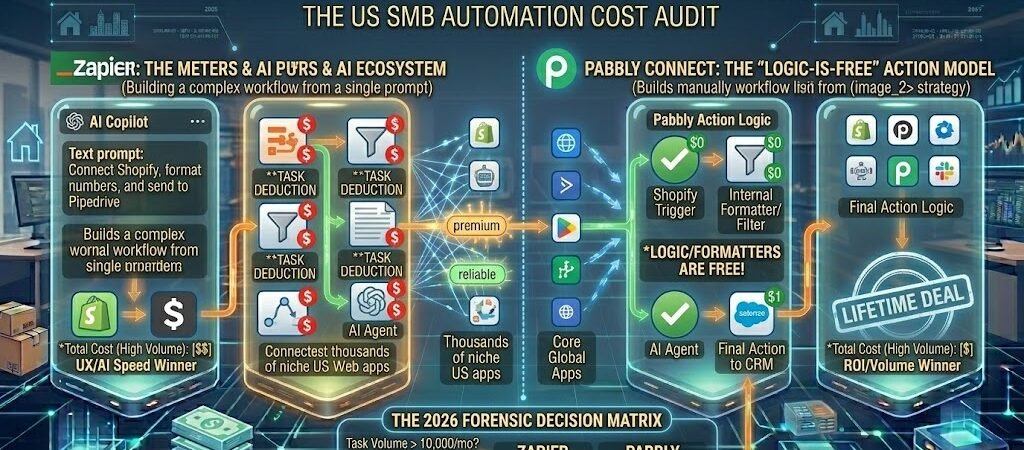
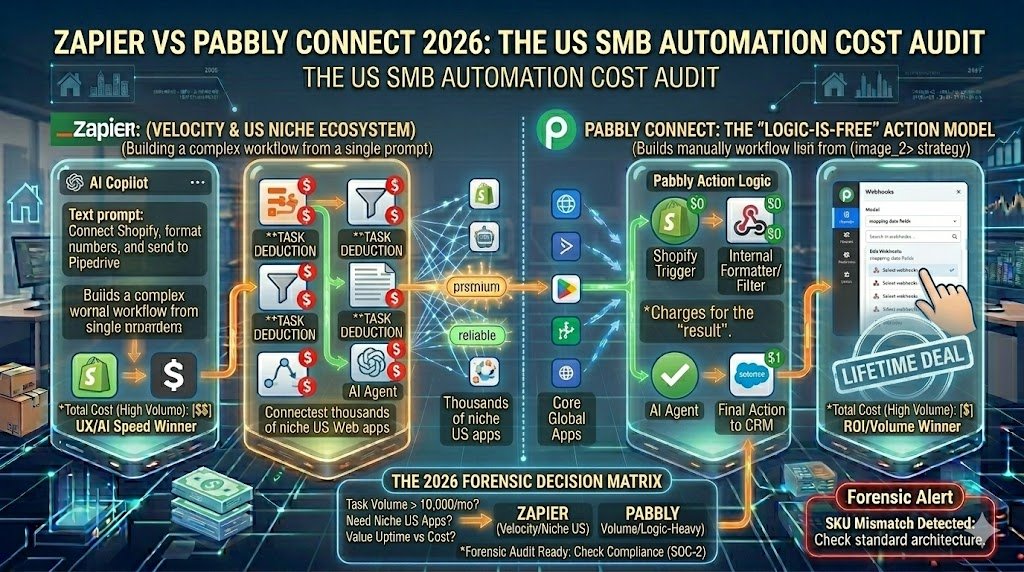
- Zapier (The Incumbent Ecosystem): Zapier remains the industry gold standard, boasting an integration library exceeding 6,000 apps. Its focus is on premium user experience, powered by a mature AI Copilot (image_2.png aesthetic) that builds complex workflows from natural language. However, its metered “per-task” model means every internal logic, path, and formatter step (image_40.png strategy paths) consumes precious tasks, rapidly increasing operational costs for high-volume users.
- Pabbly Connect (The Lifetime Aggressor): Pabbly Connect has aggressively gained market share with its unique value proposition: high-volume task allowances combined with a “Logic-Is-Free” model. Pabbly only counts the trigger and the final action as a task, making complex data normalizations (image_28.png Forensic Hygiene Engine) significantly cheaper than in Zapier. Its defining 2026 feature is its continued use of Lifetime Deals (LTDs), appealing strongly to budget-conscious SMBs willing to accept a slightly less mature UI and smaller integration library (approx. 1,500 apps) in exchange for massive raw financial savings.
The Forensic Thesis: For a low-to-medium volume US SMB (under 10,000 tasks/month) prioritizing data reliability and rapid setup (e.g., qualifying high-value consulting leads via image_38.png intake), Zapier’s “Invisible Team” efficiency may save more in labor than it costs in tasks. However, for a high-volume SMB executing predictable, complex logic (e.g., duplicating 50k Shopify orders via image_28.png inventory architecture), Pabbly Connect’s structure is, from a forensic accounting perspective, the only rational financial choice.
[Image: A high-tech infographic comparing the Total Cost of Automation (TCA) logic of Category 1 (Zapier) against Category 2 (Pabbly Connect), built upon the modular visual aesthetic and glowing data connections seen in the previous series.]
Category 1: The Forensic Pricing & Task Limit Audit
In 2026, the “sticker price” of an automation platform is a vanity metric. To understand which tool saves your SMB more money, you must look at the Task Logic. This is the forensic distinction between a platform that charges you for every “thought” (Zapier) and one that only charges you for the “result” (Pabbly Connect).
1. The Fundamental Difference: “Per-Step” vs. “Per-Action”
This is the single most significant factor in your Total Cost of Automation (TCA).
- Zapier’s Task Model (The Metered Approach): In Zapier, almost every step in a workflow consumes a task. If you have a lead come in (Trigger), use a Formatter to clean the phone number, a Filter to check the budget, and finally send it to your CRM (Action), Zapier bills you for 3 tasks. For a high-volume US recruiter or e-commerce seller, these “logic tasks” can account for 60% of your monthly bill.
- Pabbly’s Action Model (The “Logic-Is-Free” Approach): Pabbly Connect operates on a “Task-Light” philosophy. Internal steps like Filters, Formatters, and Routers (the equivalent of Paths) are free. In the same scenario above, Pabbly only bills you for 1 task (the final Action).
The Forensic Result: If your business relies on complex, multi-step logic (like the Forensic Hygiene Engine in Category 1 of our E-commerce guide), Pabbly Connect can be 4x to 5x cheaper for the exact same workflow.
2. 2026 Price Benchmarking (The US SMB Scenario)
Let’s look at the “Professional” tier requirements for a standard US small business requiring 10,000 tasks per month.
| Feature | Zapier (2026 Pro Tier) | Pabbly Connect (2026 Ultimate) |
| Monthly Cost (Annual) | ~$150/mo | ~$35/mo |
| Task Allowance | 10,000 | 10,000 (Action-based) |
| Internal Logic Cost | 1 Task per step | $0 (Unlimited) |
| Multi-Step Zaps | Included | Included |
| Update Interval | 1-2 Minutes | 1-5 Minutes |
3. The “Lifetime” Trap (Forensic Health Check)
Pabbly Connect continues to dominate the 2026 market with its Lifetime Deal (LTD). For a one-time payment (often around $499 for a mid-tier plan), a US SMB can theoretically eliminate their automation subscription forever.
Forensic Rule: An LTD is only a saving if the company remains solvent. In 2026, Pabbly has proven its stability through six years of consistent API updates and a robust server infrastructure. However, Zapier’s SOC-2 Type II Compliance (image_20.png) offers a “security premium” that many US venture-backed startups require, which Pabbly’s lower-cost model sometimes lacks.
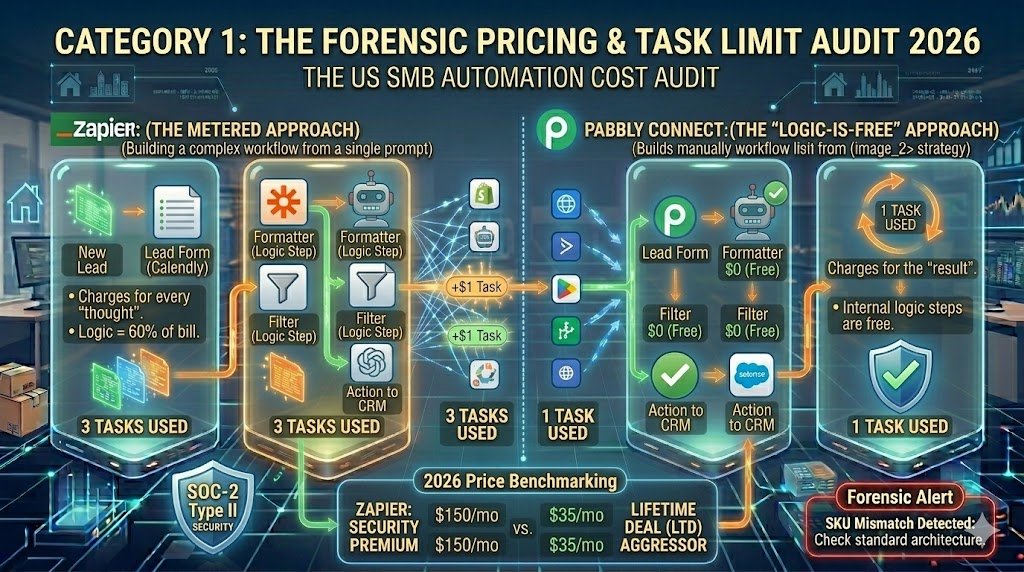
The 2026 Forensic Rule: If your workflows are “Straight-Line” (App A → App B), Zapier’s speed and AI building tools are worth the premium. If your workflows are “Logic-Heavy” (App A → Format → Filter → Path A/B → App B), Pabbly Connect will save you thousands of dollars in “Task Tax” annually.
Category 2: Ease of Use, Debugging & Internal Labor Costs
The “hidden labor tax” is the most overlooked component of your Total Cost of Automation (TCA). In 2026, saving $100 a month on subscription fees is a net loss if your team spends five additional hours building, troubleshooting, or manually restarting failed workflows. For a US SMB, time is not just money—it is the speed of your scale.
1. Zapier’s Agentic Interface: The Luxury of Speed
Zapier’s primary value proposition in 2026 is its mature AI Copilot. It has moved beyond simple “drag-and-drop” to “describe-and-deploy.”
- The “Natural Language” Build: Instead of hunting for triggers, you type: “When a new lead hits my site, research their LinkedIn, draft a briefing, and ping me in Slack.” Zapier’s AI builds the 5-step flow (Category 1 & 2 logic) in seconds.
- Internal Labor Impact: Non-technical staff (Marketing Managers, Sales Ops) can build complex automations without a developer. This eliminates the “IT Bottleneck,” allowing for an ROI that starts on Day 1 rather than Day 10.
2. Pabbly’s Interface: The Manual Precision
Pabbly Connect remains a “Power User” platform. While its UI is clean and functional, it lacks the advanced agentic building tools seen in Zapier’s 2026 suite.
- The Learning Curve: Pabbly relies heavily on manual webhook setup and precise data mapping. For a technical founder, this is a minor hurdle; for a non-technical team, it often results in “Blank Screen Syndrome.”
- The “Five-Minute vs. One-Hour” Rule: User data from 2025-2026 suggests that a workflow taking five minutes to set up in Zapier can take over an hour in Pabbly due to the lack of pre-built templates and AI assistance. At a $50/hour internal labor rate, that “free” Pabbly task just cost you $45 in time.
3. Debugging & “Retry Logic” (The Cost of Failure)
Automation only saves money when it works. When a workflow fails—due to an API glitch or a change in a third-party app—the cost of downtime can be catastrophic.
- Zapier’s Autopilot (The Safety Net): Zapier’s 2026 Auto-Replay feature is best-in-class. If a Shopify sync fails because the API is down, Zapier waits and retries automatically. It pings your Slack with a clear, AI-translated error message: “The Shopify API is timed out; I will retry in 5 minutes.”
- Pabbly’s Debugging (The Manual Audit): While Pabbly has improved its error logs, it often requires manual intervention. If an automation stops, you may not know until a customer complains. In 2026, the average cost of an e-commerce outage for a US SMB is estimated at $5,600 per hour in lost sales and idle labor.
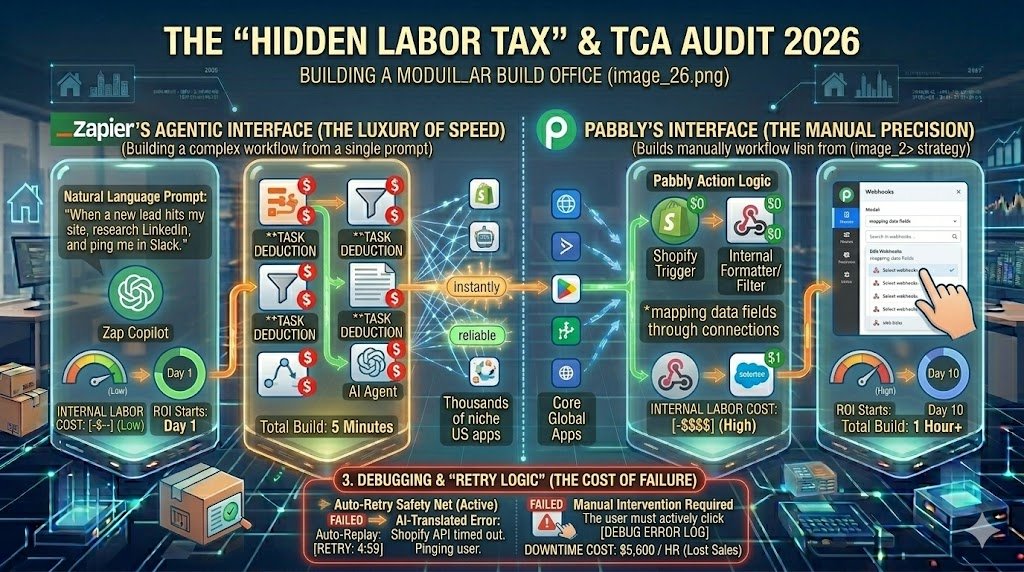
The 2026 Forensic Rule: Factor in a “Labor Multiplier.” If your team is non-technical, multiply the subscription cost of Pabbly by 3 to account for the extra hours spent in setup and troubleshooting. If you have a dedicated “Ops Person,” Pabbly’s lower cost becomes a pure financial win.
Category 3: Integration Depth & Native US App Support
In 2026, the “Total Cost of Automation” (TCA) isn’t just about the software you pay for; it’s about the manual work you can’t automate. If your chosen platform doesn’t support a specific app in your tech stack, you are forced back into manual data entry—the most expensive “labor tax” a US SMB can pay.
1. App Ecosystems: The 6,000 vs. 1,500 Gap
The raw numbers tell a story of two different strategies.
- Zapier (6,000+ Apps): Zapier remains the definitive “Library of Record.” It supports virtually every niche US-based tool, from local credit unions and regional CRMs to specialized warehouse management systems (WMS).
- The “Niche” Factor: If you use a specialized US tool like Gusto for payroll, Ramp for spend management, or a regional real estate MLS, Zapier likely has a native, “plug-and-play” integration.
- Pabbly Connect (1,500+ Apps): Pabbly focuses on the “Big Wins”—global, high-volume tools like Shopify, HubSpot, Meta Ads, and Google Workspace.
- The “Workaround” Cost: If Pabbly doesn’t support your app, you must use Webhooks or API Keys. For a US SMB, this means hiring a developer (at $100+/hour) to build a custom connection. One single custom integration can wipe out three years of Pabbly subscription savings.
2. AI Integration Depth: GPT-5 Mini & Vector Databases
In 2026, automation is no longer just moving text; it’s moving intelligence.
- Zapier’s Native AI Hooks: Zapier has first-class integrations with OpenAI (GPT-5 Mini), Anthropic, and vector databases like Pinecone. This allows a US consultant to build a “Knowledge Bot” that answers client FAQs based on their own internal PDFs—all within a single Zap (Category 2 logic).
- Pabbly’s AI Capabilities: Pabbly supports standard AI API calls, but it lacks the “Contextual Memory” and native document-parsing tools that Zapier has refined. To build an “Agentic Workflow” in Pabbly, you often need to string together four or five manual steps that Zapier handles in one.
3. Regional Compliance: The US Data Sovereignty Premium
For US SMBs in 2026, where your data is processed is a legal concern.
- Zapier’s US Infrastructure: Zapier is a US-based company with SOC-2 Type II and GDPR/CCPA compliance baked into its architecture. For a US medical clinic or legal firm, this “Compliance Foundation” (referencing image_20.png) is non-negotiable.
- Pabbly’s Global Footprint: Pabbly is an international firm (based in India). While they maintain high security standards, some US government contractors or highly regulated industries (HIPAA/FINRA) may face “Forensic Audit” hurdles when using non-US-based middleware for sensitive data.
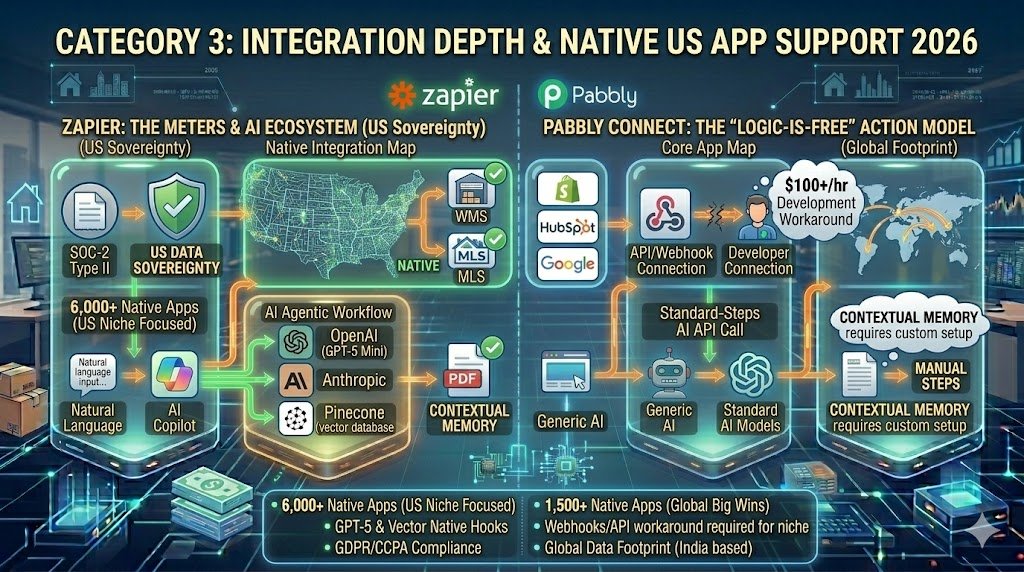
The 2026 Forensic Rule: Audit your “Must-Have” apps before you choose. If your business relies on three or more niche US-specific tools, Zapier’s native support will save you thousands in custom development costs. If you only use “Big Tech” (Google, Meta, Shopify), Pabbly Connect’s integration depth is more than sufficient.
Category 4: The Financial Decision Matrix (Which Platform Wins?)
To finalize your Forensic Financial Analysis, you must match your business’s specific operational profile against the platform’s cost-to-value ratio. In 2026, there is no “best” platform—only the “most profitable” choice for your unique data volume and technical maturity.
The following matrix represents the Total Cost of Automation (TCA) for four common US SMB scenarios.
2026 SMB Results: The Forensic Recommendation
| Business Scenario (US SMB 2026) | Forensic Recommendation | Why? (Total Cost Analysis) |
| Low-Volume / High-Value (e.g., $10k consulting leads) | Zapier | The cost of a single missed lead due to a sync error exceeds years of subscription fees. Reliability is the priority. |
| High-Volume Data Sync (e.g., Duplicating 50k Shopify orders to Airtable) | Pabbly Connect | Pabbly’s non-task logic and LTD structure offer massive savings (potentially $5,000+/year) on raw task usage. |
| Complex Logic (Paths/Formatters) | Pabbly Connect | Logic is “free” in Pabbly. A 10-step “Hygiene” workflow costs 10x more in Zapier than in Pabbly. |
| Niche/Regional US Apps (e.g., Gusto, US-only CRMs) | Zapier | Zapier has the only native ecosystem for specialized US tools, saving $100+/hr in custom developer costs. |
The “Hidden Tax” Calculation
When making your final selection, apply the 2026 Labor Multiplier:
- If you have no internal IT/Ops: Add 25% to Pabbly’s cost to account for manual setup time.
- If you have high compliance needs (HIPAA/FINRA): Add a 15% “Risk Premium” to any non-US-based middleware to cover potential forensic audit hurdles.
The 2026 Forensic Rule: Don’t be “Penny Wise and Pound Foolish.” If your automation handles Revenue-Generating Data (Invoices, Leads, Sales), choose the platform with the highest uptime and auto-replay (Zapier). If your automation handles Back-Office Admin (Data backups, cross-posting, reporting), choose the platform with the lowest cost-per-task(Pabbly Connect).
Ready for the big leagues? If you need deep integration with the Microsoft ecosystem or enterprise-grade security, you should compare enterprise vs small business automation features in our Power Automate review.
Conclusion: The “Compliance First” Automation of 2026
The decision between Zapier and Pabbly Connect in 2026 is no longer a simple budgetary line item—it is a strategic choice in Operational Architecture. As US SMBs face increasing pressure to maintain “Audit-Proof” records and real-time data accuracy, the platform you choose acts as the nervous system of your business.
A platform that saves you $100/month in subscription fees but fails to trigger a critical $10,000 invoice or falls short during a SOC-2 audit is, from a forensic accounting perspective, the most expensive mistake you can make.
- Choose Zapier if your priority is Velocity and Reliability. If your team is non-technical and your workflows handle high-value, “Must-Not-Fail” data (like the Elite Intake or Contract Lifecycles), Zapier’s AI Copilot and robust US-based infrastructure provide a safety net that justifies its premium “Task Tax.”
- Choose Pabbly Connect if your priority is Volume and Logic. If you are an “Operations Orchestrator” managing thousands of repetitive data syncs or complex multi-step “Hygiene” engines, Pabbly’s lifetime value and “Logic-Is-Free” model offer a ROI that Zapier simply cannot match at scale.
In 2026, the winner isn’t the platform with the lowest price—it’s the one that allows your business to scale without increasing your “Admin Tax.” Audit your task volume, map your niche US apps, and choose the engine that lets you focus on your Unique Creative Genius rather than your middleware.

About the Author
Aapt DubeyAapt Dubey is an automation specialist and software developer dedicated to eliminating manual workflows for small businesses. With deep, hands-on experience building complex Zapier integrations, API connections, and real-world applications, Aapt writes actionable, tested tutorials to help businesses scale efficiently.