Key Takeaways: Fix Zapier Errors (2026)
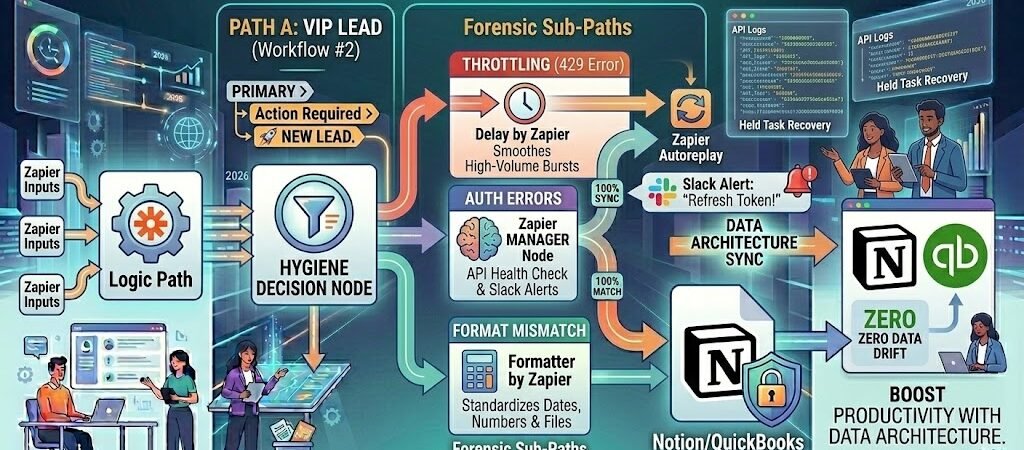
- “Task Held” is a Safety Valve, Not a Crash: In 2026, the “Held” status is an automated pause designed to prevent data corruption. It often triggers when Zapier detects a sudden spike in volume or a mission-critical “Mapping Mismatch” (referencing image_22.png).
- API Throttling is the #1 Failure Point: As SMBs scale, they often hit the API rate limits of tools like Shopify or Salesforce. Modern troubleshooting requires implementing Delay by Zapier to “smooth out” high-volume data bursts.
- Security-Driven Auth Errors: With the strict OAuth 2026 protocols, “Authentication Errors” (visualized in image_28.png) are common. Proactive monitoring using a Zapier Manager node allows you to catch expired tokens before they halt your entire revenue chain.
- The “Zero Data Drift” Mandate: Automation in 2026 is built to be “Self-Healing.” By using Search Steps and Logic Paths (referencing image_26.png), you can design Zaps that automatically fix duplicates and formatting errors without human intervention.
Executive Summary & The 2026 Automation Landscape
By 2026, automation has transitioned from a “nice-to-have” productivity hack to the central nervous system of the modern US small business. Whether you are managing an AI-driven modular kitchen factory in Gurgaon or a specialized SEO agency, your operations likely rely on a “Best-of-Breed” stack: Stripe for payments, QuickBooks for compliance, and Notion for project management (as seen in image_10.png and image_20.png). This interconnected infrastructure ensures that data flows instantly from “Lead-to-Log” (image_24.png), but it also creates a high-stakes environment where a single “Broken Zap” can lead to operational paralysis.
When an automation fails in 2026, the cost is no longer just a few minutes of manual data entry; it is measured in Data Drift—the dangerous desynchronization of your “Source of Truth” (image_26.png). A lead that fails to sync from Gmail to Notion isn’t just a missed notification; it’s a lost $5,000 contract and a gap in your annual ROI reporting.
Troubleshooting in 2026 is no longer about “turning it off and on again.” It is a forensic discipline. This guide will move you past basic trial-and-error toward a state of Zero Lead Leakage, providing the technical blueprint to solve “Task Held” errors, manage API rate limits, and build “Self-Healing” automations that alert you to problems (image_28.png) before they impact your bottom line.
Official Support Resources: If you encounter a highly specific technical error code, your first stop should be the Zapier Help Center, which contains a searchable database of common fixes and status updates.
Deconstructing the “Task Held” Status
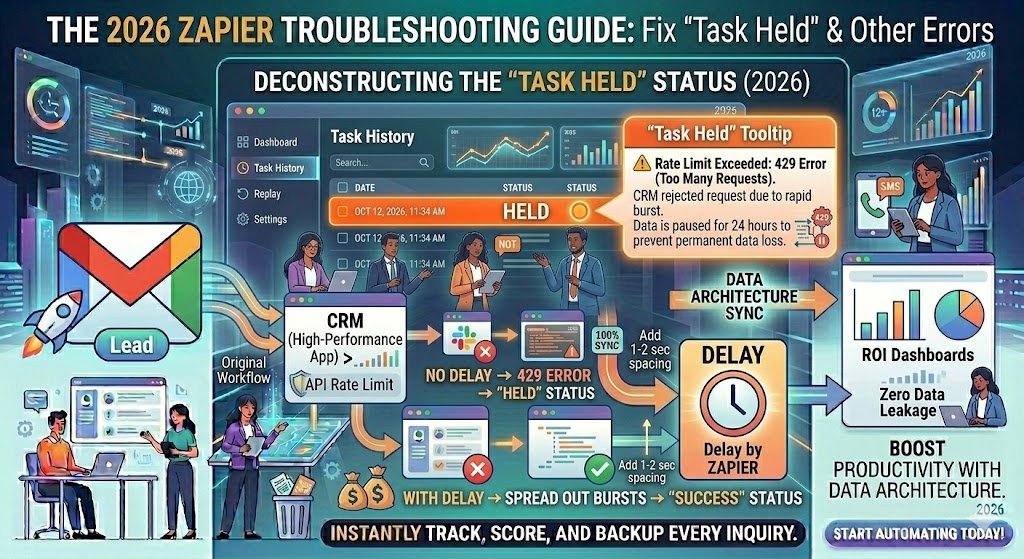
In the 2026 automation ecosystem, seeing a “Task Held” status in your history is not a sign of failure—it is a sign of a safety protocol working as intended. Unlike a hard “Error,” which signifies a total collapse of a step, a “Held” status is an intentional pause. Zapier is essentially holding your data in a waiting room because it has detected a condition that could lead to data corruption or a permanent lockout from your connected apps.
The Rise of API Throttling (Rate Limiting)
The most common reason for a “Task Held” status in 2026 is API Throttling. High-performance tools like Shopify, Salesforce, and even modern versions of QuickBooks have implemented strict “Rate Limits” to protect their servers.
- The Scenario: You run a flash sale or a mass email campaign. Suddenly, 500 orders hit Stripe in 60 seconds.
- The Conflict: Your Zap tries to push all 500 records to your CRM simultaneously. The CRM sees this as a “Denial of Service” attack and sends back a 429 Error (Too Many Requests).
- The “Held” Solution: Rather than letting the data disappear, Zapier “Holds” these tasks. In 2026, you can resolve this by adding Delay by Zapier steps to your workflow, spacing out the actions by 1–2 seconds to stay under the radar of API limits.
Large Payload & Plan Violations
As we move more complex data—like high-resolution images for your modular kitchen factory or massive SEO audit files—we occasionally hit “Payload Limits.” If a single Zap step carries too much data (usually exceeding 100MB in 2026 standards), the task is held to prevent a system crash.
Similarly, the “Task Limit Reached” hold occurs when your monthly quota is exhausted. In 2026, mission-critical Zaps can be set to “Priority Status,” ensuring that even if you hit your limit, your core revenue-generating Zaps (like Stripe-to-QuickBooks) continue to run while low-priority tasks are held.
How to Fix Held Tasks
- Identify the “Limit” in the Task History details.
- Apply a “Delay” step if the error is volume-related.
- Use “Mass Replay” once the underlying issue (or plan upgrade) is resolved to push all data through at once.
Common 2026 Runtime Errors & Their Technical Fixes
Runtime errors are the “roadblocks” that occur while a Zap is actively in motion. Unlike a “Held” task, these often result in a hard stop. In 2026, as our data stacks become more modular (referencing image_20.png), the complexity of these errors has shifted from simple connectivity issues to sophisticated logic and security mismatches.
Error 1: The “Halted” Zap (Filtered Out)
A “Halted” status is technically a success for Zapier’s logic but a failure for your business process. This occurs when your data reaches a Filter or Path and is rejected because it doesn’t meet the criteria.
- Technical Root: In 2026, the most common cause is “Case Sensitivity” or “Null Values.” For example, if your Decision Node (image_26.png) is looking for a budget of “$5,000” but the AI Parser extracted “5000” (without the dollar sign), the logic fails.
- The Fix: Go to your Task History and look at the “Input” of the filter. Use Formatter by Zapier to “Clean Text”—removing symbols, whitespace, or forced lowercase—to ensure your data matches your filter’s expectations 100% of the time.
Error 2: Auth Errors & Disconnected Accounts
In 2026, security is paramount. Modern apps now use rotating OAuth tokens that expire every 90 days or if a password is changed.
- The Symptom: You see the “API AUTHENTICATION ERROR” visualized in our Hygiene Decision Node(image_28.png).
- The Fix: Don’t just reconnect; perform a “Deep Refresh.” Navigate to the “My Apps” section of Zapier, find the disconnected account (like Notion or QuickBooks), and select “Reconnect.” Once authenticated, use the Zapier Manager node to set up a “Health Check” Zap that alerts you before the token expires.
Error 3: The “Format Mismatch” (Data Hygiene Challenge)
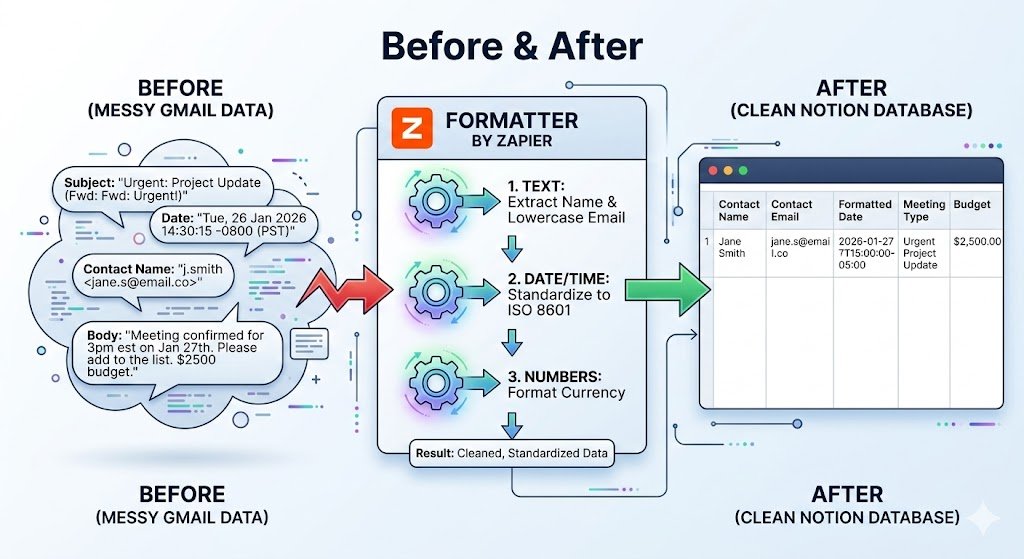
This is the silent killer of 2026 automations. It happens when App A sends data in one format (e.g., a Unix timestamp) and App B expects another (e.g., MM/DD/YYYY).
- Technical Root: A lack of standardized “Data Plumbing” (referencing image_22.png). If Stripe sends a currency value as “2000” (meaning $20.00 in cents) and QuickBooks reads it as “2000” (meaning $2,000.00), your books will be a disaster.
- The Fix: Always insert a Formatter Step between your trigger and your action.
- Numbers: Use the “Perform Math” or “Currency” operation to ensure cents are converted to dollars.
- Dates: Use “Date/Time” to standardize every input into the ISO 8601 format, which is the 2026 gold standard for cross-platform compatibility.
By mastering these three errors, you move from “reactive” troubleshooting to “proactive” system architecture, ensuring your data remains accurate across your entire vault.
Advanced 2026 Troubleshooting Techniques (The Forensic Audit)
In 2026, simply knowing that a Zap failed is no longer enough; you need to know exactly which packet of data caused the rejection. High-growth SMBs now use “Forensic Auditing”—a deep-dive approach into the raw JSON data exchanged between APIs. When your “Lead-to-Log” flow (image_24.png) breaks, follow these advanced steps to perform a root-cause analysis.
Step 1: Analyzing the “Raw Data” Input/Output
Every Zapier task generates a forensic lab report. When you click into a failed step, toggle the view from “Pretty” to “Raw.” * What to look for: Search for “Error 400” or “Error 422” messages. In 2026, APIs are highly descriptive. A “422 Unprocessable Entity” error usually includes a sub-message like property "zip_code" is missing.
- The Forensic Catch: Often, the error isn’t in the field that failed, but in a hidden metadata tag—like a missing Tax ID or a malformed SKU (referencing image_22.png)—that the destination app requires for validation.
Step 2: The “Autoreplay” & Mass Recovery Phase
Once you’ve identified and fixed the logic error (e.g., updating a Formatter step), you don’t need to manually re-trigger 100 leads.
- Mass Replay: Zapier’s 2026 interface allows you to “Select All” failed or held tasks.
- Pro-Tip: Before a mass replay, ensure your Duplicate Prevention logic (image_28.png) is active. This prevents the system from creating 100 new rows in Google Sheets if the previous “failed” attempt actually managed to partially create the record before crashing.
Step 3: Cross-Platform Log Matching
If Zapier says “Success” but the data doesn’t appear in Notion or QuickBooks, you have a “Ghost Success.”
- The Technique: Open the “Audit Log” within the target app itself. In 2026, QuickBooks and Notion have dedicated “Integration Logs.” If you see the request arrived but was “Archived” or “Filtered” by the target app’s internal settings, you know the issue isn’t in Zapier—it’s in your destination app’s permissions or views.

By adopting this forensic mindset, you stop treating your Zaps as “magic” and start treating them as a transparent, manageable Data Infrastructure.
Proactive Zap Design: Building Error-Proof Automations
In 2026, the hallmark of a master automation architect is not building a Zap that never breaks—it is building one that knows how to fail. “Self-healing” automations use internal logic to catch errors before they escalate into a system-wide shutdown. By incorporating these three design patterns, you ensure your “Lead-to-Log” infrastructure (image_24.png) remains resilient.
Strategy 1: The “Never Halt” Path Logic
Instead of a linear Zap that dies the moment a filter is not met, use Paths (referencing image_26.png) to create an “Exception Route.”
- The Setup: Path A handles your standard data flow. Path B is your “Error Catcher.” If a piece of data is missing a required field (like a phone number), Path B routes that lead to a “Manual Review” database in Notion rather than letting the Zap crash.
Strategy 2: Duplicate Prevention Search Steps
As visualized in our Hygiene Decision Node (image_28.png), always include a “Find” step before a “Create” step.
- The Logic: By searching for an existing Email or Order ID first, you create a “safe” automation. If the Zap fails halfway and you trigger a Mass Replay, the search step will see the record already exists and choose to “Update” it rather than creating a messy duplicate.
Strategy 3: The Zapier Manager “Meta-Zap”
This is the ultimate 2026 insurance policy. Create a separate Zap where the Trigger is “New Zap Error” in your account.
- The Action: It sends a structured Slack alert containing the Zap Name, the Error Message, and a direct link to the Task History.
By designing for the “Worst Case Scenario,” you maintain Zero Data Drift and keep your business running even when the APIs are acting up.
Conclusion: Mastering Your Data Infrastructure
In the hyper-automated landscape of 2026, the complexity of your tools shouldn’t be a source of anxiety. Errors, “Task Holds,” and API limits are not signs of a broken business; they are the natural friction of a scaling Data Infrastructure. By moving from reactive “fixing” to proactive “architecting”—implementing forensic audits, self-healing paths, and the Zapier Manager safety net—you ensure that your “Source of Truth” remains untarnished.
Control over your automation is control over your time. Stop fearing the “Task Held” notification and start using it as the diagnostic tool it was meant to be. With these strategies, you are no longer just a user of software; you are the architect of a resilient, Zero-Leakage business machine.
Back to the Niche. Now that your system is stable, apply these fixes to your industry-specific workflows. For example, see how we maintain stable automation for online course creators to prevent enrollment errors.

About the Author
Aapt DubeyAapt Dubey is an automation specialist and software developer dedicated to eliminating manual workflows for small businesses. With deep, hands-on experience building complex Zapier integrations, API connections, and real-world applications, Aapt writes actionable, tested tutorials to help businesses scale efficiently.